
Key Takeaways
- A new catalyst made from coconut shells effectively turns carbon dioxide into a useful chemical building block.
- This specialized material possesses an ultrahigh surface area that provides more space for chemical reactions to occur.
- The technology achieves nearly perfect selectivity, meaning it produces the desired product without creating unwanted waste.
- It remains stable and efficient for over fifty hours of continuous use, which is vital for real-world industrial applications.
In the twenty-first century, the escalating threat of climate change and ocean acidification due to excessive greenhouse gas emissions has made the efficient utilization of carbon dioxide a critical global priority. Researchers are increasingly looking for ways to transform these emissions into value-added chemicals, turning a major environmental challenge into an economic opportunity. One of the most promising methods for large-scale transformation is the reverse water gas shift reaction, which converts carbon dioxide and hydrogen into carbon monoxide and water. Carbon monoxide serves as a vital intermediate for producing various high-value chemicals like methanol, fuels, and polymers. A new study published in the journal BiocharBiochar is a carbon-rich material created from biomass decomposition in low-oxygen conditions. It has important applications in environmental remediation, soil improvement, agriculture, carbon sequestration, energy storage, and sustainable materials, promoting efficiency and reducing waste in various contexts while addressing climate change challenges. More by Xueyuan Pan, Hao Sun, and their research team introduces a breakthrough in this field using a novel material derived from coconut shells.
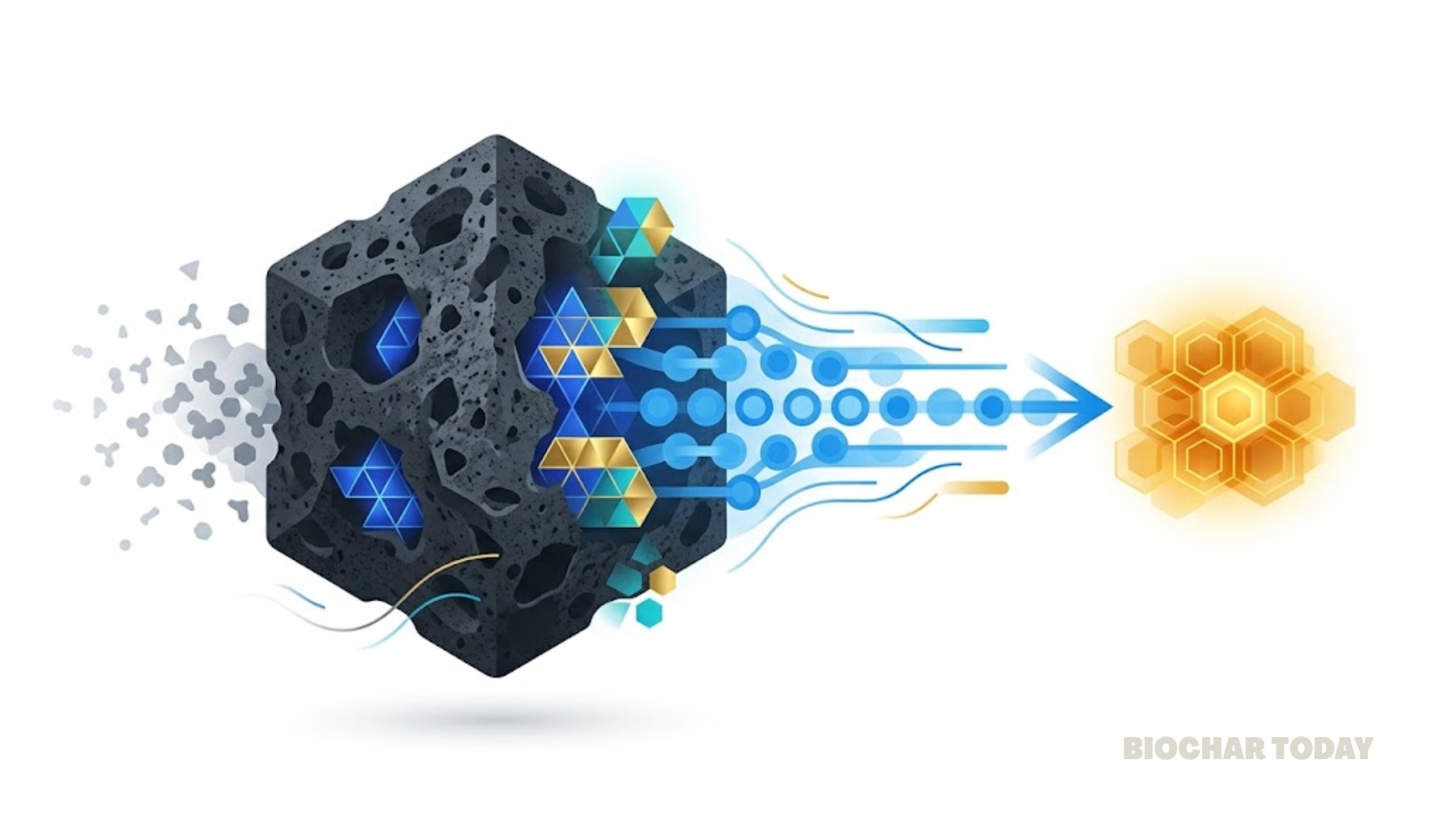
The researchers developed a unique mesoporous biochar with an ultrahigh specific surface area to support a specialized copper and molybdenum carbide nano-interface. By using coconut shells as a starting material, the team created a granule catalyst that is not only environmentally friendly but also possesses high mechanical strength. This biochar serves a dual purpose as both a support structure and a carbon source for the reaction. The resulting material featured an exceptionally high surface area of 2693 square meters per gram. This vast surface area is crucial because it allows for a high dispersion of the active metal sites, ensuring that the reactant molecules can easily access the catalyst to complete the transformation.
One of the standout findings of the research was the superior performance of this biochar-supported catalyst compared to traditional carbon materials. Under standard reaction conditions, the conversion rate of carbon dioxide was more than twice that of catalysts supported by traditional carbon. The specific architecture of the mesoporous biochar facilitates better adsorption of carbon dioxide and smoother mass transfer within the reaction system. The study revealed a strong interaction between the molybdenum carbide and the copper, which leads to a specialized electron transfer that anchors the copper sites firmly in place. This interaction is key to the high activity and stability observed throughout the experimental trials.
The efficiency of this new system is particularly notable in its selectivity. The catalyst achieved 99.08 percent selectivity for carbon monoxide, meaning almost all of the converted carbon dioxide became the desired product rather than being lost to side reactions that produce methane or other byproducts. Achieving such high selectivity at low operating pressures is a significant advantage for potential industrial scaling. Furthermore, the catalyst demonstrated remarkable durability. In long-term testing, the material maintained its high level of activity and selectivity for over fifty hours without any noticeable decrease in performance. This longevity is essential for any catalyst intended for use in continuous industrial fixed-bed reactors.
The structural analysis of the material after use confirmed that the biochar support and the metal interfaces remained stable throughout the process. This stability prevents the common industrial problems of active site leachingLeaching is the process where nutrients are dissolved and carried away from the soil by water. This can lead to nutrient depletion and environmental pollution. Biochar can help reduce leaching by improving nutrient retention in the soil. More or the clumping together of metal nanoparticles, which usually degrades catalyst performance over time. By combining the natural benefits of biomass-derived biochar with advanced nanotechnology, the research team has provided a new development strategy for carbon recycling. This study offers a promising candidate for large-scale industrial applications that could significantly reduce carbon emissions while simultaneously producing the building blocks for necessary chemical products.
Source: Pan, X., Sun, H., Ma, M., Liao, H., Zhan, G., Wang, K., Fan, M., Xu, J., Ding, L., Sun, K., & Jiang, J. (2024). Preparation of nano Cu-Mo2C interface supported on ordered mesoporous biochar of ultrahigh surface area for reverse water gas shift reaction. Biochar, 6(1), 93.





Leave a Reply