
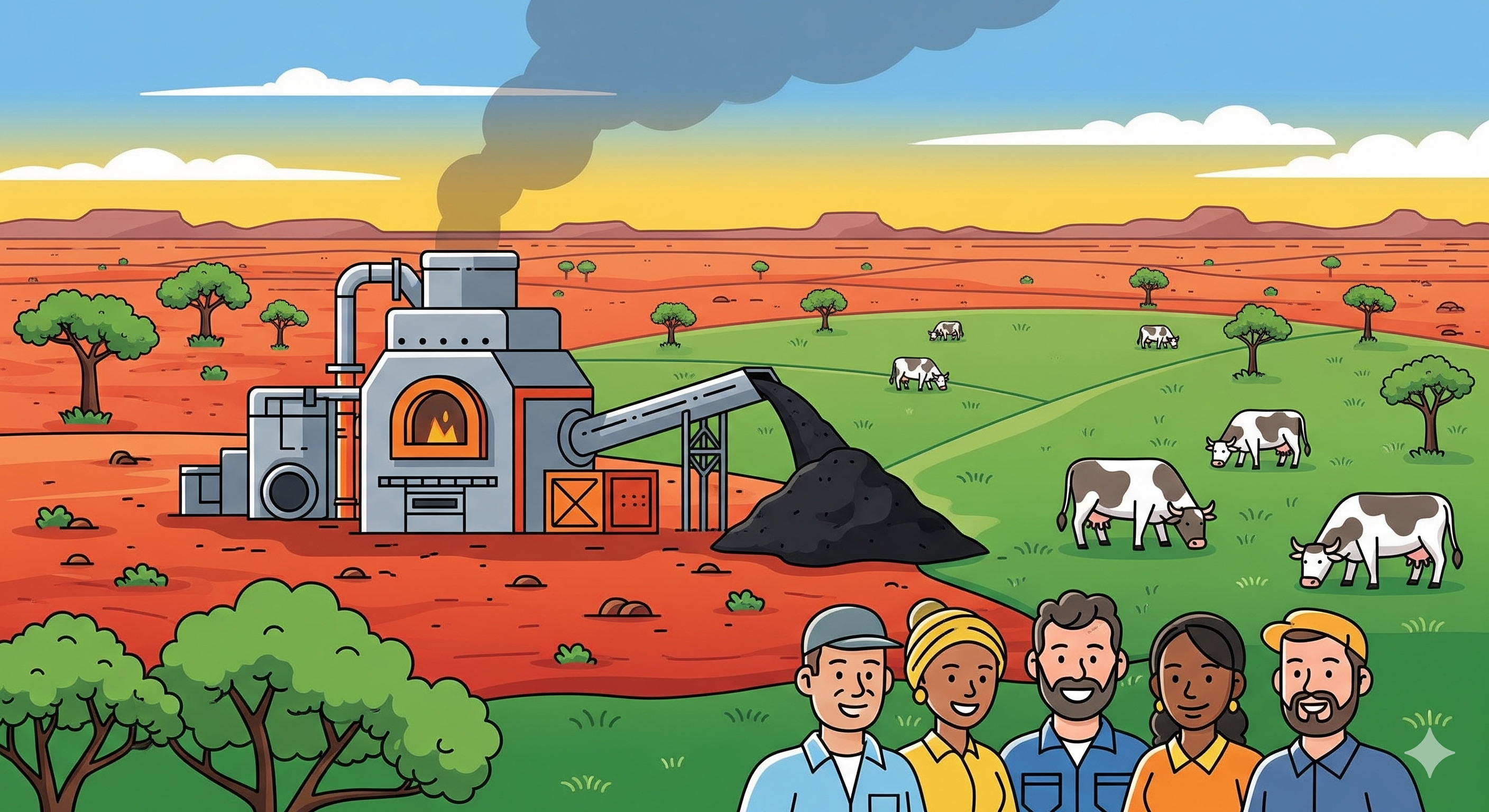
A significant new project in South Africa’s Northern Cape is poised to make a substantial impact on land restoration and rural livelihoods through the strategic use of biocharBiochar is a carbon-rich material created from biomass decomposition in low-oxygen conditions. It has important applications in environmental remediation, soil improvement, agriculture, carbon sequestration, energy storage, and sustainable materials, promoting efficiency and reducing waste in various contexts while addressing climate change challenges. More. The initiative, spearheaded by Terraligna, a subsidiary of Kickstart Capital, targets the arid Hantam region, an area severely affected by woody plant encroachment, which impacts a staggering 7.3 million hectares of land across the country. The central focus is the aggressive and invasive Prosopis tree, or mesquite, which consumes up to five times more water than indigenous species, directly contributing to the depletion of scarce water resources and reducing the land’s capacity for grazing.
The first phase of the project is scheduled to launch in late 2025 with the ambitious goal of clearing 3,000 hectares of these trees. This initial effort is part of a broader plan to treat a total of 23,000 hectares over the coming years. A key component of the strategy involves transforming the harvested Prosopis biomassBiomass is a complex biological organic or non-organic solid product derived from living or recently living organism and available naturally. Various types of wastes such as animal manure, waste paper, sludge and many industrial wastes are also treated as biomass because like natural biomass these More into biochar, which is anticipated to yield 10,000 tonnes in the first phase alone. This biochar will then be distributed to local farming projects, helping to enhance soil health and fertility in a region where such improvements are critical for agricultural resilience.
This approach not only provides a solution for the invasive species problem but also aligns with national and global sustainability objectives. The project directly contributes to South Africa’s commitment to clearing over one million hectares of invasive species and 633,000 hectares of encroached land by 2030, in line with Land Degradation Neutrality targets. Beyond its environmental benefits, the project is designed to have a significant socio-economic impact. It is expected to create at least 100 jobs and provide valuable income and training opportunities for local farmers, creating a sustainable economic loop where environmental restoration fuels community development. This model of using biochar to combat invasive species and improve soil health while supporting local economies is gaining traction, with similar projects exploring the conversion of other problematic biomass sources, such as agricultural waste and forestry by-products, into this beneficial soil amendmentA soil amendment is any material added to the soil to enhance its physical or chemical properties, improving its suitability for plant growth. Biochar is considered a soil amendment as it can improve soil structure, water retention, nutrient availability, and microbial activity. More.
SOURCE: Project aims to restore grazing land in Northern Cape



Leave a Reply