
In a technical article published in the journal JOM, a team of researchers including Dongyang Dou, Baozhong Ma, Zhihe Cao, Yongqiang Chen, and Chengyan Wang introduced an innovative and green method for recovering valuable metals from laterite residue. The study addresses the dual challenges of laterite residue accumulation and the scarcity of iron ore resources by developing a biomass-carbon-based smelting reduction ironmaking technology. This new process efficiently recovers strategic metals like iron (Fe) and chromium (Cr) from laterite residue, which is a byproduct of hydrometallurgical nickel extraction.
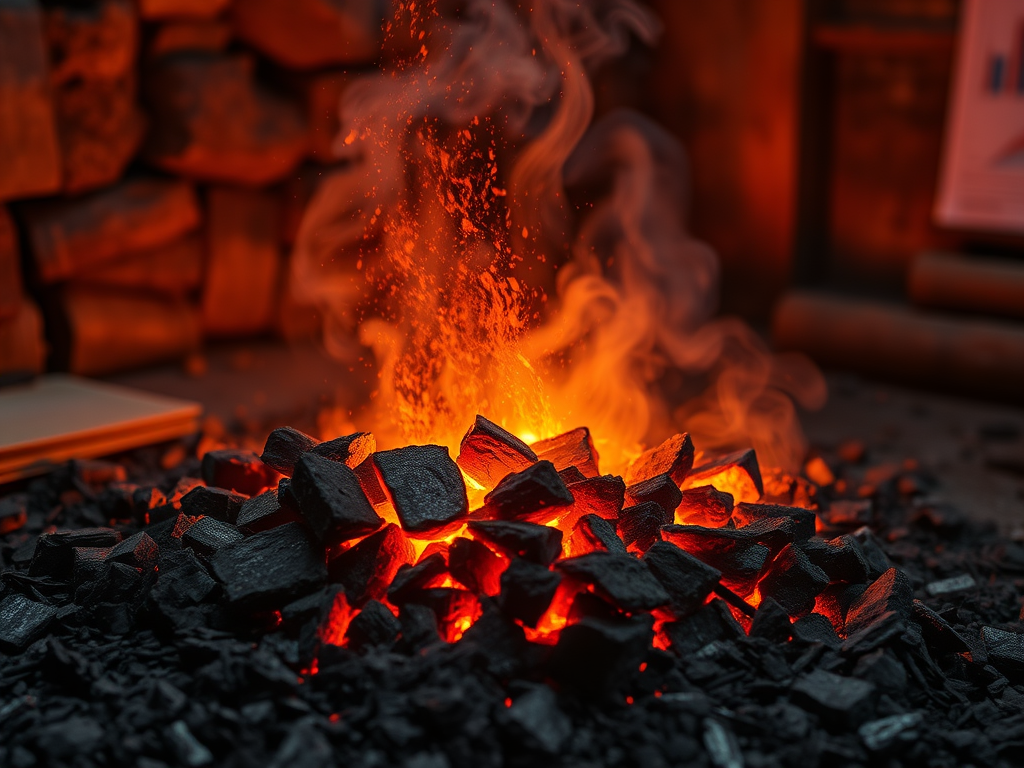
The laterite residue used in the experiment contained a high concentration of iron (59.62%) and chromium (1.63%). The researchers used charcoalCharcoal is a black, brittle, and porous material produced by heating wood or other organic substances in a low-oxygen environment. It is primarily used as a fuel source for cooking and heating. More, a carbon-rich solid produced from woody biomassBiomass is a complex biological organic or non-organic solid product derived from living or recently living organism and available naturally. Various types of wastes such as animal manure, waste paper, sludge and many industrial wastes are also treated as biomass because like natural biomass these More, as a reducing agent. Charcoal is an ideal alternative to traditional reducing agents because it has a high fixed carbon content, low ashAsh is the non-combustible inorganic residue that remains after organic matter, like wood or biomass, is completely burned. It consists mainly of minerals and is different from biochar, which is produced through incomplete combustion. Ash Ash is the residue that remains after the complete More content, and offers significant carbon emission reduction benefits. The research focused on the reduction behavior of the iron-bearing and chromium-bearing minerals, specifically analyzing phase transformations and the effects of different processing conditions on recovery efficiency.
The experiments aimed to find the optimal conditions for the smelting reduction process. The team systematically varied three key parameters: the mass ratio of charcoal to laterite residue, the reaction temperature, and the reduction time. The mass ratio of charcoal to laterite residue had a significant impact on chromium content and recovery. The highest recovery for both iron and chromium was achieved at a mass ratio of 0.21. At this ratio, the iron and chromium recovery rates were 97.12% and 92.20%, respectively. A mass ratio higher than 0.21 led to a decline in iron recovery, as the increased residual carbon raised the slag’s viscosity, hindering effective slag-metal separation.
Temperature also played a crucial role. As the temperature increased from 1450∘C to 1475∘C, the iron content in the product increased from 89.20% to 94.86% and the chromium content rose from 2.25% to 2.51%. This temperature increase also raised the recovery rates for iron and chromium from 87.12% to 93.84% and from 80.38% to 90.81%, respectively. The researchers concluded that a temperature of1475∘C was optimal, as further increases in temperature did not yield significant changes in content or recovery. Higher temperatures reduce slag viscosity, promoting better separation of the metal from the slag and minimizing losses of iron and chromium.
Finally, the study investigated the effect of reduction time. The results showed that an optimal reduction time of 120 minutes was sufficient to achieve peak iron content and high recovery rates for both metals. At this time, the iron content reached 95.76%, while the chromium content was 2.64%. This resulted in iron recovery of 95.09% and chromium recovery of 95.88%. Under these optimized conditions, the final product was found to be highly pure, consisting predominantly of metallic iron and chromium, with minimal impurities like silicon and oxygen.
This research successfully demonstrates that using charcoal as a reducing agent in a molten reduction process is an effective, green, and economically viable method for recovering iron and chromium from laterite residue. This approach not only provides a high-value utilization method for a significant industrial byproduct but also helps address iron ore supply shortages and supports carbon neutrality goals.
Source: Dou, D., Ma, B., Cao, Z., Chen, Y., & Wang, C. (2025). Efficient and Green Recovery of Iron and Chromium from Laterite Residue Using BiocharBiochar is a carbon-rich material created from biomass decomposition in low-oxygen conditions. It has important applications in environmental remediation, soil improvement, agriculture, carbon sequestration, energy storage, and sustainable materials, promoting efficiency and reducing waste in various contexts while addressing climate change challenges. More. JOM, 77(9), 2538465.




Leave a Reply