
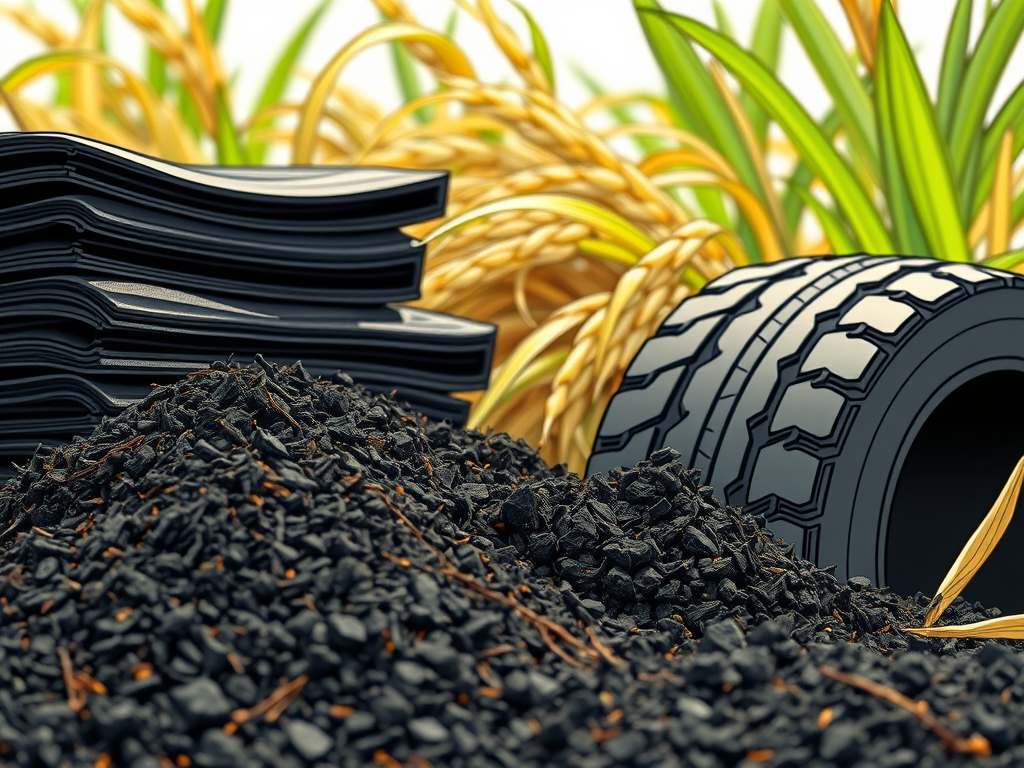
In a study published in BiocharBiochar is a carbon-rich material created from biomass decomposition in low-oxygen conditions. It has important applications in environmental remediation, soil improvement, agriculture, carbon sequestration, energy storage, and sustainable materials, promoting efficiency and reducing waste in various contexts while addressing climate change challenges. More, authors Karunanayake et al. explore the potential of biochar (BC) as a sustainable alternative to carbon black (CB) in rubber composites. Traditionally, CB has been the primary reinforcing filler in rubber composites due to its superior mechanical properties. However, its production is energy-intensive and environmentally detrimental, releasing significant amounts of CO2. This has led to a growing interest in eco-friendly alternatives like biochar.
Biochar from biomassBiomass is a complex biological organic or non-organic solid product derived from living or recently living organism and available naturally. Various types of wastes such as animal manure, waste paper, sludge and many industrial wastes are also treated as biomass because like natural biomass these More, has garnered attention for its high surface area, stability, and carbon content. It can be produced from various biomass materials, including rice husks, corncobs, and nutshells. The study emphasizes that the effectiveness of biochar as a reinforcing filler is influenced by its production conditions and feedstockFeedstock refers to the raw organic material used to produce biochar. This can include a wide range of materials, such as wood chips, agricultural residues, and animal manure. More type.
The research reviewed indicates that biochar has not yet matched the rheological and mechanical properties of carbon black. However, partial replacement of carbon black with biochar in rubber composites has shown promising results. Further studies are needed to optimize biochar’s properties for effective incorporation into rubber matrices.
The review highlights several factors that influence the viability of biochar as a reinforcing filler, including the type of biochar, the rubber matrix used, the preparation method of the biochar-rubber composite, and the cross-linking system employed. The authors also provide a bibliometric analysis of biochar in natural rubber, revealing that China, the United States, and India are the top three countries involved in biochar-incorporated rubber composites research.
Karunanayake et al.’s review concludes that while biochar holds promise as a sustainable alternative to carbon black, more research is needed to optimize its use in rubber composites.
SOURCE: Karunanayake, L., Etampawala, T., de Silva, D. J., Bandara, J., Rajapaksha, A. U., & Vithanage, M. (2025). Role and potential of biochar as a sustainable alternative reinforcing filler to carbon black in rubber composites. Biochar, 7(1), 1-26. Sources and related content


![Eucalyptus Wood Waste-Derived Biochar Achieves a Ninety-Eight Percent Removal Efficiency for Benzo[ghi]perylene in Vehicle-Wash Wastewater](https://biochartoday.com/wp-content/uploads/2026/10/SCIENCE-BLOGS-2026-2026-10-19T160523.703.jpg)


Leave a Reply