
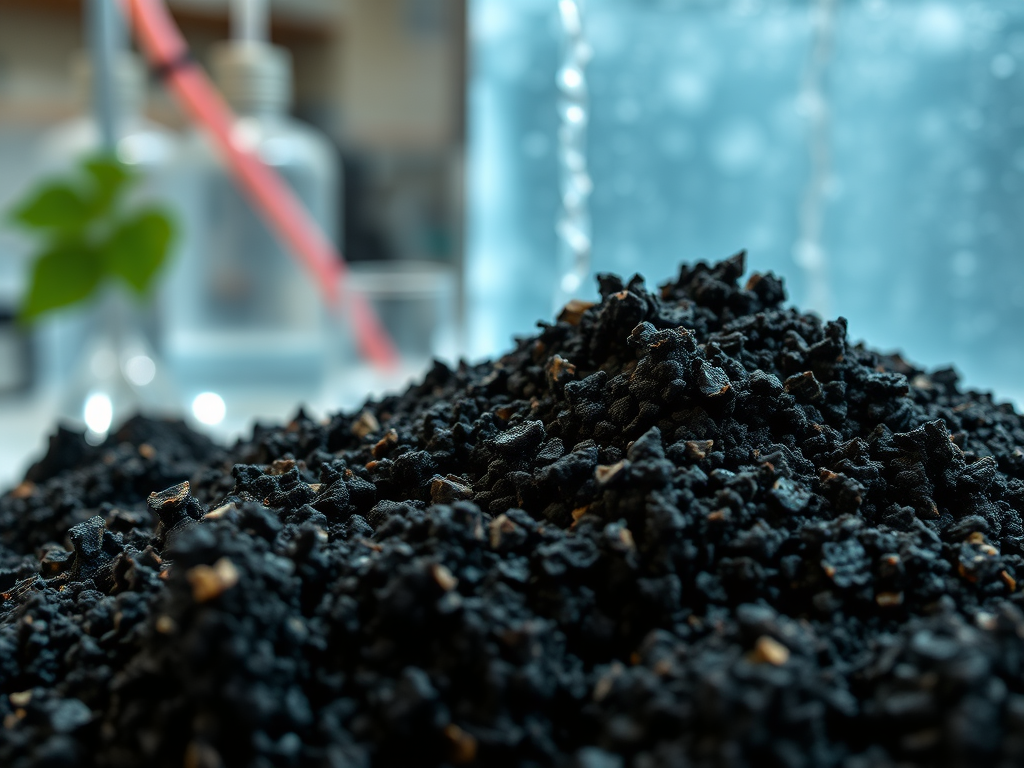
Hospital wastewater is a significant source of antibiotic-resistant bacteria and other hazardous substances, including unmetabolized pharmaceuticals like meropenem (MRP). MRP is a powerful, last-resort antibiotic used to combat drug-resistant infections, but it is highly resistant to conventional wastewater treatment and is increasingly found in aquatic environments. To address this, a study published in the Journal of Environmental Management by José L. S. Duarte and colleagues explored the use of biocharBiochar is a carbon-rich material created from biomass decomposition in low-oxygen conditions. It has important applications in environmental remediation, soil improvement, agriculture, carbon sequestration, energy storage, and sustainable materials, promoting efficiency and reducing waste in various contexts while addressing climate change challenges. More derived from grape stalks to effectively remove MRP from hospital wastewater.
This research is particularly important within the framework of a circular economy, which seeks to turn waste materials into valuable resources. Grape stalks, a common agricultural waste product, are rich in lignocellulosic materials like cellulose, hemicellulose, and lignin. When pyrolyzed, these materials can be converted into biochar, a porous carbon material that can be modified to serve as an effective adsorbent for pollutants. The researchers chemically activated the biochar with sodium hydroxide (NaOH) under mild conditions to enhance its surface functionality and porosityPorosity of biochar is a key factor in its effectiveness as a soil amendment and its ability to retain water and nutrients. Biochar’s porosity is influenced by feedstock type and pyrolysis temperature, and it plays a crucial role in microbial activity and overall soil health. Biochar More, which is crucial for efficient adsorption.
The team conducted a series of batch experiments to evaluate the performance of the activated biochar (BCA). Preliminary tests showed that the activated biochar consistently achieved a much higher removal of MRP (79-92%) compared to the raw biochar (48-60%). The researchers also tested the biochar’s performance in a simulated hospital wastewater (HWW) environment, which contains a complex mix of ions and salts. The results were remarkable: the activated biochar achieved complete (100%) removal of MRP from HWW at both low (5 mg dm−3) and high (100 mg dm−3) concentrations. In contrast, the removal in ultrapure water was slightly lower, at 86% and 82% respectively, highlighting the beneficial effect of the complex HWW matrix. The presence of other ions in HWW actually helped facilitate the adsorption of MRP, a phenomenon known as the “salting-out effect,” where the high ionic strength drives the MRP molecules out of the solution and onto the biochar surface.
The study also investigated the ideal operating conditions for the biochar. The maximum adsorption capacity of 80 mg g−1 was achieved at an initial MRP concentration of 100 mg dm−3. The optimal pHpH is a measure of how acidic or alkaline a substance is. A pH of 7 is neutral, while lower pH values indicate acidity and higher values indicate alkalinity. Biochars are normally alkaline and can influence soil pH, often increasing it, which can be beneficial More for MRP removal was found to be 3, where the biochar surface and MRP molecules had complementary charges, facilitating strong electrostatic attraction and leading to 77% removal efficiency. When the pH was near the isoelectric point of MRP (~5.15), the removal efficiency dropped sharply to about 5% due to electrostatic repulsion. The research also confirmed that the adsorption kinetics were best described by a pseudo-second-order model, suggesting that chemical interactions, rather than simple physical diffusion, were the primary mechanism for MRP binding to the biochar.
Reusability is a key factor for the practical application of any adsorbent. The grape stalk-derived biochar proved to be highly reusable, retaining over 90% of its MRP removal capacity in HWW even after five consecutive adsorption-desorption cycles. A control experiment showed that without regeneration with NaOH, the biochar’s removal efficiency dropped significantly, underscoring the importance of the regeneration step. The biochar also demonstrated the ability to concurrently reduce the salinity of the hospital wastewater by adsorbing other ions like sulfate, phosphate, and chloride, which further enhances the quality of the treated effluent and opens up opportunities for water reuse.
In conclusion, this study demonstrates the significant potential of NaOH-activated biochar from grape stalks as a sustainable, effective, and reusable material for treating hospital wastewater. The research provides a robust understanding of the adsorption mechanisms and highlights how an agricultural waste product can be valorized into a high-performance adsorbent to tackle a critical environmental and public health issue.
Source: Duarte, J. L. S., Santos, A., Hayat, A., de la Fuente, M., Domínguez, C. M., & Cotillas, S. (2025). Removal of meropenem from hospital wastewater using biochar derived from grape stalks. Journal of Environmental Management, 393, 127004.




Leave a Reply