
Key Takeaways
- BiocharBiochar is a carbon-rich material created from biomass decomposition in low-oxygen conditions. It has important applications in environmental remediation, soil improvement, agriculture, carbon sequestration, energy storage, and sustainable materials, promoting efficiency and reducing waste in various contexts while addressing climate change challenges. More adds unique chemical components to soil that can create highly reactive oxygen molecules.
- These oxygen molecules reduce the activity of specialized soil enzymes responsible for breaking down carbon.
- In acidic black and red soils, this process slows down the transformation of organic carbon into carbon dioxide.
- The protective effect is completely reversed in certain soils, where the same particles can increase carbon gas release.
- Tailoring biochar production and application methods based on specific soil properties is necessary to maximize long-term carbon storage.
A recent study published in the journal Biochar by authors Ping Wu, Yingdong Fu, Hailong Wang, and Shuping Qin explores the intricate biochemical pathways that govern how biochar interacts with soil organic carbon pools. The application of biochar to agricultural lands has long been recognized as a viable strategy to improve soil fertility and advance climate change mitigation through long-term carbon sequestration. Despite these benefits, the specific chemical and biological mechanisms through which biochar influences the stabilization or loss of native organic matter remain complex and highly variable. The researchers focused their investigation on the role of persistent free radicals embedded within the biochar matrix, which are known to act as active centers that react with surrounding oxygen to produce reactive oxygen species, most notably hydroxyl radicals.
The primary operational challenge addressed by this research is the unpredictable nature of soil respiration and carbon mineralization following biochar amendment. While biochar is inherently stable, its addition frequently induces a priming effect that temporarily accelerates the microbial decomposition of native soil organic carbon, leading to an unwanted increase in carbon dioxide emissions. This phenomenon introduces a significant paradox because the concurrent production of hydroxyl radicals is theoretically capable of damaging the extracellular enzymes that microorganisms secrete to break down complex organic matter. Resolving these contradictory interactions is crucial for predicting whether biochar will function as an efficient carbon sink or inadvertently trigger localized carbon losses across different agricultural environments.
To determine the exact influence of these radical-driven pathways, the study evaluated the performance of raw wheat straw biochar containing active free radicals against a modified version where these radicals were chemically quenched using triethanolamine solutions. These distinct biochar variants were mixed into three geographically and chemically diverse soil types collected from China, including an acidic Black soil, an acidic Red soil, and a neutral Fluvo-aquic soil. The experimental design subjected the soil-biochar mixtures to controlled anaerobic-aerobic cycles to simulate natural field redox fluctuations, which are known to stimulate the generation of reactive oxygen species. By tracking cumulative gas emissions, monitoring the concentrations of hydroxyl radicals, and performing precise assays on key carbon-degrading enzymes such as cellulase, chitinase, and beta-glucosidase, the researchers mapped the cascading biochemical responses of the soil systems.
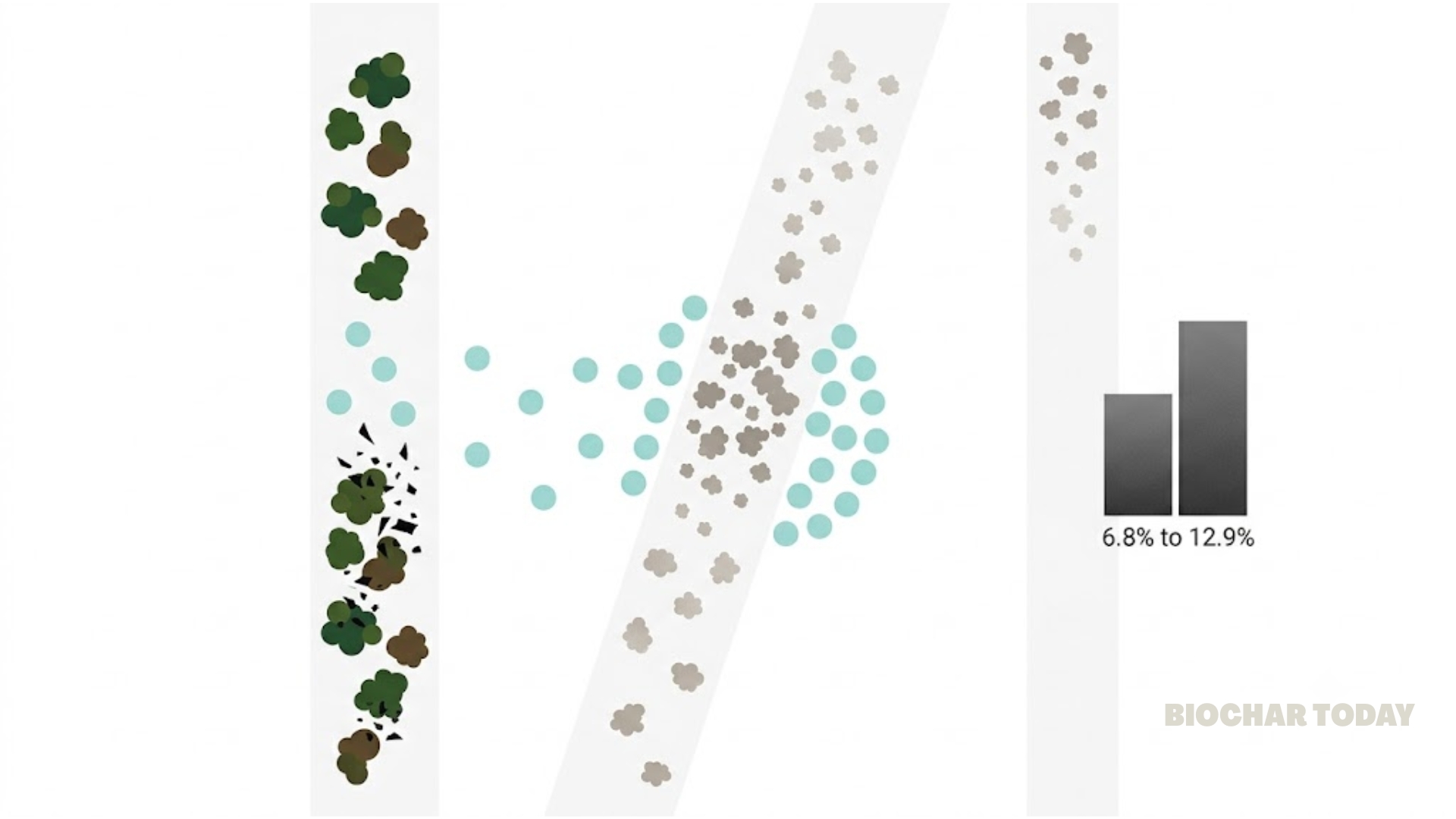
The experimental results revealed that the net impact of biochar on carbon cycling is highly soil-specific and dictated by the balance between direct chemical oxidation and enzyme suppression. In both the acidic Black and Red soils, the presence of untreated biochar suppressed cumulative carbon dioxide emissions by 6.8 percent and 12.9 percent, respectively, compared to unamended control soils. This reduction occurred because the high concentration of iron and aluminum oxides typical of these acidic environments promotes the adsorption of extracellular enzymes onto mineral surfaces, rendering them highly vulnerable to structural damage and inactivation by the nearby biochar-derived hydroxyl radicals. When the free radicals were chemically quenched in the modified biochar treatments, this enzyme inactivation was severely diminished, causing a complete reversal that stimulated carbon dioxide emissions above control levels.
Conversely, the neutral Fluvo-aquic soil exhibited an entirely different response, where the addition of untreated biochar increased cumulative carbon dioxide emissions by 19.4 percent, a stimulatory effect that escalated even further to a 45.6 percent increase when the radical-quenched biochar was applied. In this neutral, low-oxide soil environment, extracellular enzymes do not readily adsorb to mineral surfaces and remain largely protected from radical-induced damage, allowing the positive priming effect driven by the microbial consumption of labile biochar components to override any minor inhibitory processes. Furthermore, parallel experiments utilizing a selective chemical scavenger to isolate and remove background soil hydroxyl radicals resulted in a universal surge in dissolved organic carbon and a sharp drop in total soil organic carbon across all three soil types. This final verification establishes that while hydroxyl radicals can participate in the direct abiotic oxidation of dissolved organic compounds, their dominant ecological role in oxide-rich acidic soils is the suppression of hydrolase activities, which effectively shields the solid-phase organic carbon pool from microbial respiration.
Source: Wu, P., Fu, Y., Wang, H., & Qin, S. (2026). Soil-specific protection of organic carbon by biochar-derived hydroxyl radicals associated with enzyme suppression. Biochar, 8(1), 126.




Leave a Reply