
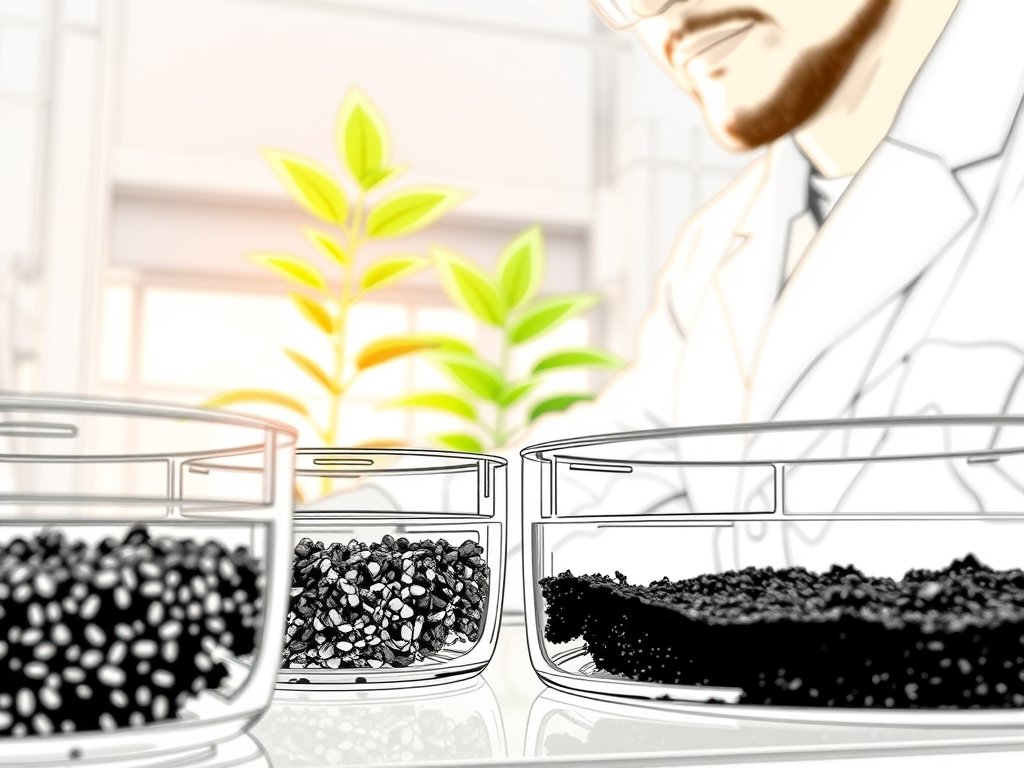
A recent study published in Scientific Reports by Guo et al. explores the use of biocharBiochar is a carbon-rich material created from biomass decomposition in low-oxygen conditions. It has important applications in environmental remediation, soil improvement, agriculture, carbon sequestration, energy storage, and sustainable materials, promoting efficiency and reducing waste in various contexts while addressing climate change challenges. More to remediate soil contaminated by domestic waste. The research highlights the dual role of biochar in both environmental and engineering remediation of contaminated soil, offering a sustainable approach to managing this challenging environmental issue.
The accumulation of domestic waste leads to soil contamination, posing environmental risks due to the release of pollutants and greenhouse gases, and engineering challenges due to the weakening of soil structure. Biochar, a stable and carbon-rich material derived from biomassBiomass is a complex biological organic or non-organic solid product derived from living or recently living organism and available naturally. Various types of wastes such as animal manure, waste paper, sludge and many industrial wastes are also treated as biomass because like natural biomass these More, has shown promise in addressing these issues.
Study investigated the effects of biochar dosage and particle size on the remediation of domestic-sources-contaminated soil. The study revealed that biochar can effectively remediate contaminated soil by adsorbing and aggregating organic matter, regulating the soil’s physicochemical properties, and altering its structure.
The optimal remediation effects were observed with a biochar dosage of 6% and a particle size of 1-3 mm. Lower biochar dosages and smaller particle sizes primarily influenced soil remediation through adsorption, aggregation, and regulation of physicochemical properties. In contrast, higher dosages and larger particle sizes mainly affected soil structure.
This study provides valuable insights into using biochar for the effective and sustainable remediation of domestic-sources-contaminated soil, addressing both environmental and engineering concerns.
Source: Guo, Y., Cao, L., Zhang, R., Chen, W., & Chen, H. (2025). Study on the coupling environmental and engineering remediation effects of biochar on domestic source contaminated soils. Scientific Reports, 15(1), 17204.


Leave a Reply