
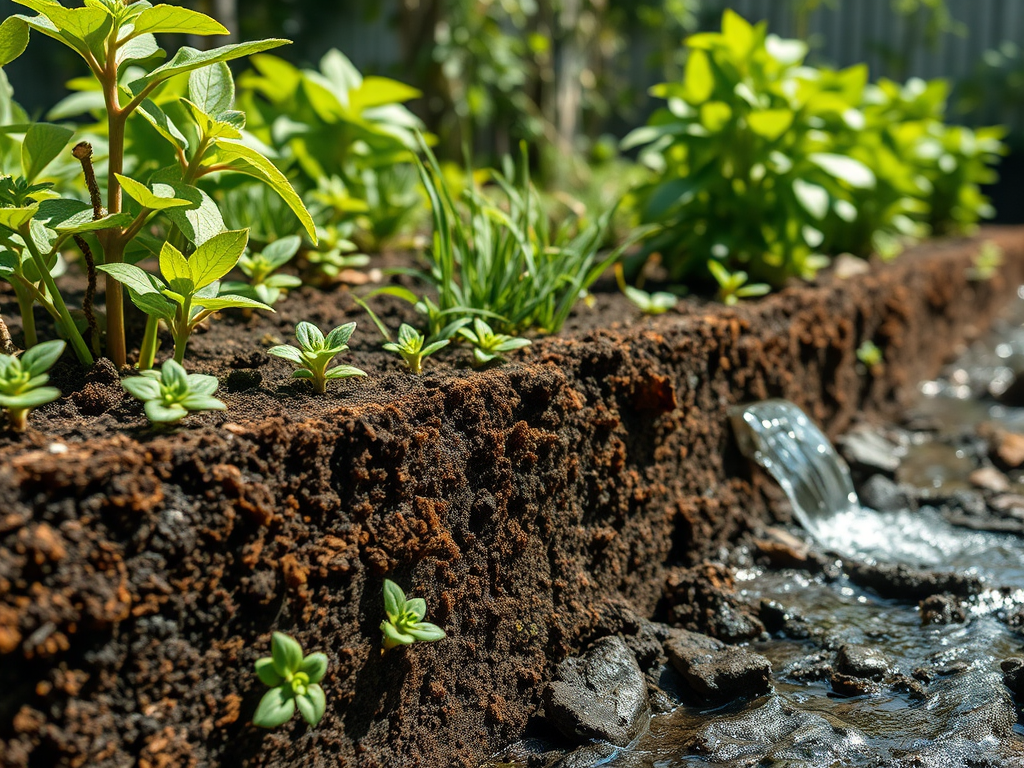
In a recent dissertation by Mohammad Khalid from The University of North Carolina at Charlotte, new insights into biochar’s role as a multi-beneficial and cost-effective amendment for fine-grained soils were unveiled. This research addresses the critical issue of stormwater runoff pollution from impervious urban surfaces, particularly highways, which often carry suspended solids, organic, and inorganic pollutants, exacerbated by compacted, fine-grained roadside soils that hinder infiltration. Khalid’s work explores how biocharBiochar is a carbon-rich material created from biomass decomposition in low-oxygen conditions. It has important applications in environmental remediation, soil improvement, agriculture, carbon sequestration, energy storage, and sustainable materials, promoting efficiency and reducing waste in various contexts while addressing climate change challenges. More, a porous, carbon-rich byproduct of biomassBiomass is a complex biological organic or non-organic solid product derived from living or recently living organism and available naturally. Various types of wastes such as animal manure, waste paper, sludge and many industrial wastes are also treated as biomass because like natural biomass these More pyrolysisPyrolysis is a thermochemical process that converts waste biomass into bio-char, bio-oil, and pyro-gas. It offers significant advantages in waste valorization, turning low-value materials into economically valuable resources. Its versatility allows for tailored products based on operational conditions, presenting itself as a cost-effective and efficient More, can improve soil hydraulic properties and remove these contaminants.
The dissertation’s first objective focused on biochar’s impact on soil hydraulic conductivity. Construction activities and vehicular traffic negatively affect soil structure, leading to reduced infiltration, decreased porosityPorosity of biochar is a key factor in its effectiveness as a soil amendment and its ability to retain water and nutrients. Biochar’s porosity is influenced by feedstock type and pyrolysis temperature, and it plays a crucial role in microbial activity and overall soil health. Biochar More, and increased stormwater runoff. Biochar offers a promising solution for improving soil structure and stormwater management. The study involved mixing two types of fine-grained soils with nine commercially available biochars at 3% and 6% by weight. Laboratory tests revealed that biochar application, especially at 6% content, led to a reduction in dry bulk density and an increase in total porosity, with average improvements in porosity up to 8.4%. This enhancement in porosity directly improved both saturated (Ksat) and unsaturated (Kunsat) hydraulic conductivity. Specifically, Biochar Now Medium, Biochar Now Small, and Char Bliss were the most effective among the tested biochar types in increasing Ksat for both soils. These findings underscore biochar’s importance in addressing stormwater runoff and infiltration challenges in fine-grained soils, with the effectiveness being governed by soil type, biochar type, and application rates.
The second objective delved into the long-term performance of biochar for stormwater runoff treatment. Conventional green infrastructure often falls short in effectively treating pollutants. Lab studies assessed the contaminant removal efficiencies of ten commercially available biochars, using methylene blue (MB) adsorption as an indicator. Batch testing showed an additional benefit of up to 60% removal for target contaminants, reaching up to 95% removal at low MB concentrations (25-50 mg/L). Scanning electron microscopy (SEM) confirmed the porous structures and high surface areas of biochar, correlating with enhanced adsorption capacity. Six top-performing biochars were selected for a year-long column study using real-world stormwater samples. Initially, Blue Sky, Char Bliss, and Naked Char biochars consistently achieved up to 90% removal of nutrients, heavy metals, and indicator bacteria. However, this performance gradually declined over time, with observed added benefits stabilizing at 10-30% over one year due to the saturation of active sites on the biochar. Despite the decline, the study concludes that biochar can be effectively integrated with fine-grained soil for stormwater management, providing valuable insights for optimizing biochar-based green infrastructure.
Finally, the third chapter explored the effectiveness of chemically modified biochar, particularly through acid and alkali treatments, for enhanced contaminant removal. Biochar modification offers several advantages, including enhanced surface functional groups, higher surface area and porosity, and improved adsorption properties. Laboratory batch and column experiments demonstrated that biochar with a higher pHpH is a measure of how acidic or alkaline a substance is. A pH of 7 is neutral, while lower pH values indicate acidity and higher values indicate alkalinity. Biochars are normally alkaline and can influence soil pH, often increasing it, which can be beneficial More exhibited enhanced adsorption capacities, especially for heavy metals, total organic carbon, and indicator bacteria. Specifically, alkali-modified Naked Char biochar showed significant improvements in contaminant removal rates compared to Char Bliss biochar. These results highlight the significant potential of modified biochar as an eco-friendly and cost-effective solution for mitigating various contaminants in stormwater management systems.
This comprehensive research by Mohammad Khalid provides crucial data supporting biochar’s role in addressing critical environmental challenges related to stormwater runoff. Its ability to both improve soil hydraulics and remove a broad spectrum of pollutants positions biochar as a key component in future sustainable urban development strategies.
Source: Khalid, M. (2025). Biochar – A Multi-Beneficial and Cost-Effective Amendment to Fine-Grained Soils to Improve Hydraulic Properties and Treat Pollutants from Stormwater Runoff. (Doctoral dissertation, The University of North Carolina at Charlotte).





Leave a Reply