
In a recent study published in AgroEnvironmental Sustainability (June 2025 issue) , Collins Otieno Majengo, Jonathan Mutonyi, Caroline Agamala Kundu, and Francis Namasake Muyekho investigated the potential of biocharBiochar is a carbon-rich material created from biomass decomposition in low-oxygen conditions. It has important applications in environmental remediation, soil improvement, agriculture, carbon sequestration, energy storage, and sustainable materials, promoting efficiency and reducing waste in various contexts while addressing climate change challenges. More produced from readily available agricultural waste to enhance soil quality in Western Kenya. Their research offers a promising circular pathway to address intertwined crises of climate change, pollution, and biodiversity loss by transforming biomassBiomass is a complex biological organic or non-organic solid product derived from living or recently living organism and available naturally. Various types of wastes such as animal manure, waste paper, sludge and many industrial wastes are also treated as biomass because like natural biomass these More into a valuable soil conditioner.
Biochar is well-documented for its ability to improve soil fertility, water retention, and crop yields, while simultaneously sequestering carbon and reducing greenhouse gas emissions. When combined with compost and inorganic fertilizers, biochar can dramatically boost plant growth and nutrient retention, particularly in infertile soils. Its high surface area, cation exchange capacity (CEC), low bulk density, alkaline pHpH is a measure of how acidic or alkaline a substance is. A pH of 7 is neutral, while lower pH values indicate acidity and higher values indicate alkalinity. Biochars are normally alkaline and can influence soil pH, often increasing it, which can be beneficial More, and stable carbon content make it an ideal soil conditioner for tropical clay and sandy soils common in Sub-Saharan Africa (SSA).
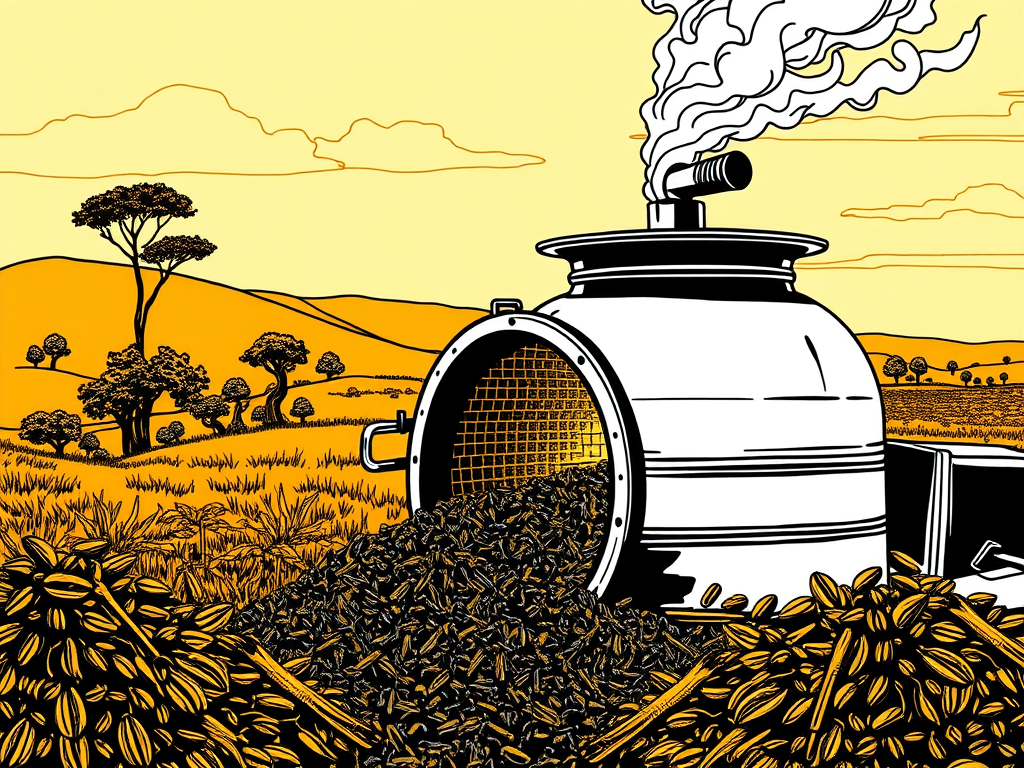
The researchers focused on three prevalent agricultural residues in Western Kenya: coffee husk (CH), sugarcane bagasse (SB), and wood sawdust (WS). These feedstocks were air-dried for 72 hours, then subjected to slow pyrolysisPyrolysis is a thermochemical process that converts waste biomass into bio-char, bio-oil, and pyro-gas. It offers significant advantages in waste valorization, turning low-value materials into economically valuable resources. Its versatility allows for tailored products based on operational conditions, presenting itself as a cost-effective and efficient More in a sealed metal kiln at 350∘C for 60 minutes, and subsequently cooled under an inert atmosphere. This specific pyrolysis process yielded an average of 37% biochar from coffee husk, 32% from sugarcane bagasse, and 28% from wood sawdust.
The produced biochars exhibited several favorable characteristics for soil enhancement. They showed high pH values, ranging from 8.4 to 9.2. This alkalinity is crucial for neutralizing acidic soils, which are prevalent in the study area and often have pH values below 4.3. The study also revealed high surface areas for the biochars, ranging from 145 to 275 m2g−1. A large surface area is vital for nutrient retention and adsorption of contaminants. Furthermore, the biochars demonstrated impressive cation-exchange capacities, reaching up to 92 cmol c kg−1. This high CEC indicates a strong potential for retaining essential nutrients in the soil, which is particularly important for sandy soils prone to nutrient leachingLeaching is the process where nutrients are dissolved and carried away from the soil by water. This can lead to nutrient depletion and environmental pollution. Biochar can help reduce leaching by improving nutrient retention in the soil. More.
Elemental analysis of the biochars showed increasing aromaticity (H/C < 0.35) and carbon stability with decreasing O/C ratios. This high aromaticity implies that the carbon in biochar is highly recalcitrant, meaning it remains stable in soils for extended periods—ranging from hundreds to thousands of years. This long residence timeResidence time refers to the duration that the biomass is heated during the pyrolysis process. The residence time can influence the properties of the biochar produced. More makes biochar a significant terrestrial carbon sink and a means of mitigating carbon dioxide (CO2) emissions.
Structural differences in the biomasses were reflected in the physical properties of the biochars. Bulk density followed the order WS > SB > CH, while porosityPorosity of biochar is a key factor in its effectiveness as a soil amendment and its ability to retain water and nutrients. Biochar’s porosity is influenced by feedstock type and pyrolysis temperature, and it plays a crucial role in microbial activity and overall soil health. Biochar More exhibited the opposite pattern. Low bulk density, particularly below 0.30 g/cm3, combined with highly stable organic carbon, can reduce soil bulk density and penetration resistance, thereby increasing total soil porosity. This function is especially beneficial for soils with high dry bulk density and penetration resistance due to natural causes or poor management.
The correlation between ashAsh is the non-combustible inorganic residue that remains after organic matter, like wood or biomass, is completely burned. It consists mainly of minerals and is different from biochar, which is produced through incomplete combustion. Ash Ash is the residue that remains after the complete More alkalinity and the content of calcium and magnesium suggested that the mineral composition of the original feedstockFeedstock refers to the raw organic material used to produce biochar. This can include a wide range of materials, such as wood chips, agricultural residues, and animal manure. More largely dictates the biochar’s buffering capacity. Based on these metrics, coffee husk (CH) biochar emerged as the most suitable amendment for acidic Ferralsols, likely due to its higher ash content and superior liming potential. Conversely, wood sawdust (WS) biochar may be more effective in sandy Arenosols that require structural improvement.
This research provides compelling evidence that agricultural waste in Western Kenya can be effectively valorized into biochar with significant agricultural value. The findings underscore the potential for site-specific biochar recommendations, guiding county-level policies that aim to couple waste reduction with soil fertility restoration within smallholder farming systems. This study contributes valuable data to the still-limited research on biochar as a remedy for soil degradation, especially in SSA countries.
Source: Majengo, C. O., Mutonyi, J., Kundu, C. A., & Muyekho, F. N. (2025). Characterization of Biochar Produced from Locally Available Agricultural Waste Resources for Soil Enhancement in Western Kenya. AgroEnvironmental Sustainability, 3(2), 164–169.



Leave a Reply