
Key Takeaways
- Biochar-based porous materials offer an environmentally friendly, low-cost solution for separating and recovering uranium from various water sources.
- Scientists utilize four primary techniques for uranium extraction: simple sorption, chemical precipitation, photocatalytic reduction, and electrocatalytic extraction.
- Modifying biocharBiochar is a carbon-rich material created from biomass decomposition in low-oxygen conditions. It has important applications in environmental remediation, soil improvement, agriculture, carbon sequestration, energy storage, and sustainable materials, promoting efficiency and reducing waste in various contexts while addressing climate change challenges. More with special functional groups like amidoxime and phosphate significantly improves its selectivity and binding strength toward uranium ions.
- Data-driven machine learning models help evaluate material properties and identify key factors like solution pHpH is a measure of how acidic or alkaline a substance is. A pH of 7 is neutral, while lower pH values indicate acidity and higher values indicate alkalinity. Biochars are normally alkaline and can influence soil pH, often increasing it, which can be beneficial More and surface area that govern uranium sorption efficiency.
The rapid growth of nuclear energy requires efficient methods to preconcentrate and separate uranium to support sustainable power generation and environmental safety. Natural waters, salt lakes, and industrial wastewaters often contain low concentrations of uranium alongside high levels of competing ions, making selective extraction a major operational challenge. Traditional raw biochar exhibits poor selectivity because its native surface functional groups lack strong coordination affinity toward target uranium species compared to coexisting metal ions. Addressing this limitation requires advanced material tailoring to ensure high removal efficiency without being hindered by background matrix interference.
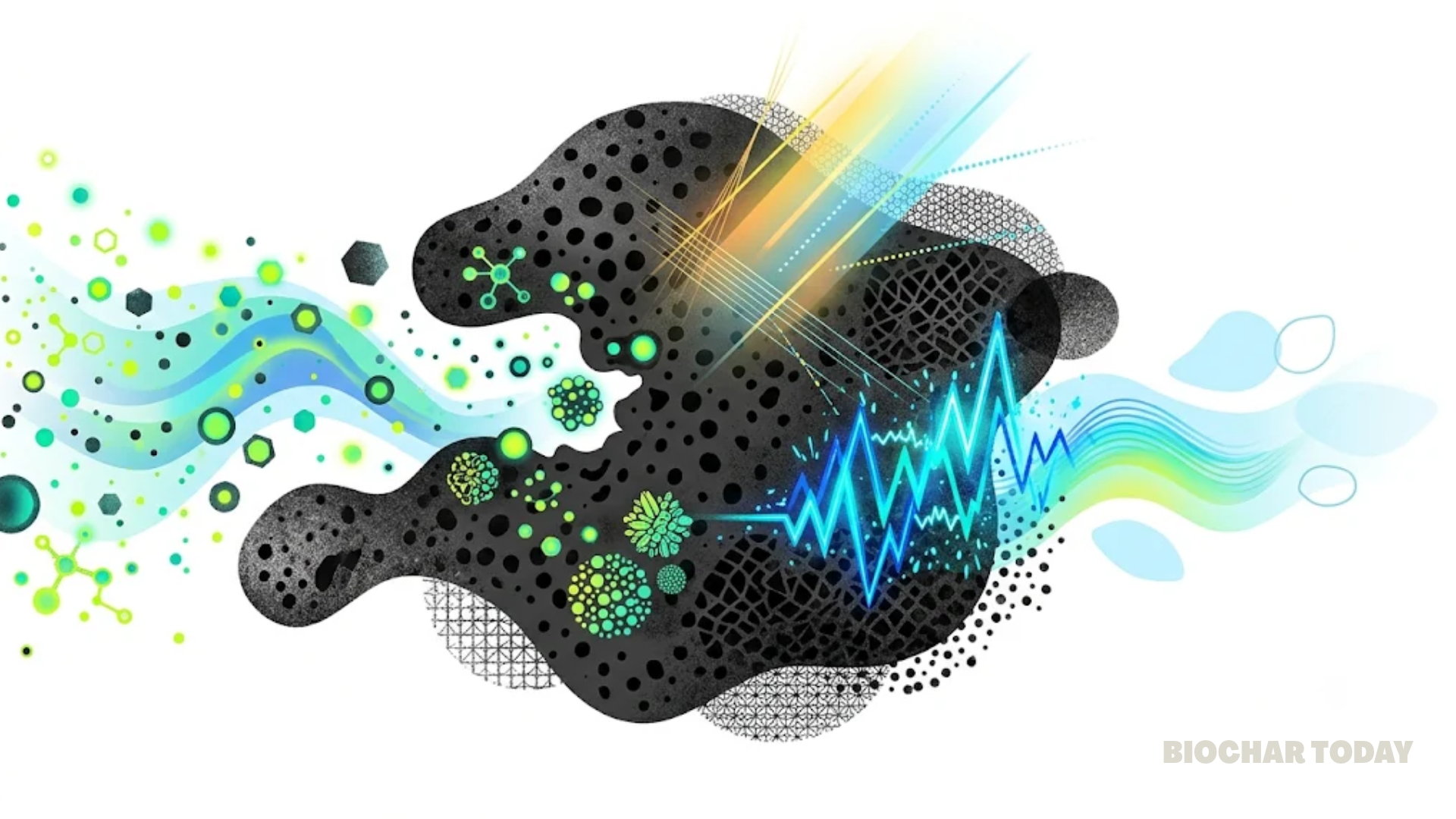
To overcome these hurdles, researchers employ diverse modification techniques—such as physical activation, chemical doping, and functional group grafting—to transform raw biochar into high-performance porous composites. Sorption processes rely on tailored surface chemistry and porous structures to bind uranium via electrostatic attraction and ligand-specific coordination, while precipitation strategies immobilize uranium by forming insoluble solid phases like metal-uranium phosphates. Furthermore, integrating catalytic components enables advanced photocatalytic and electrocatalytic systems to drive reduction-oxidation transformations, converting soluble uranium species into stable solid precipitates under light irradiation or applied electrical voltages.
The collective findings show that these engineered biochar composites achieve exceptional extraction capabilities, with maximum sorption capacities frequently surpassing hundreds of milligrams per gram. Advanced spectroscopic analyses confirm that chemical complexation, ion exchange, and redox reactions are the primary molecular-level drivers behind this performance. Additionally, incorporating machine learning frameworks allows researchers to model complex datasets, accurately predict adsorption performance, and guide the rational design of future carbon-based materials for targeted nuclear waste remediation.
Source: Sun, Z., Chen, Z., Chen, Y., Tai, X., Wang, S., Lei, J., Wang, Q., Fan, F., Ma, B., & Wang, X. (2026). Highly selective separation of uranium by biochar-based porous materials through sorption, precipitation, photocatalysis, and electrocatalysis strategies. Biochar, 8, 119.



Leave a Reply