
Key Takeaways
- Making biocharBiochar is a carbon-rich material created from biomass decomposition in low-oxygen conditions. It has important applications in environmental remediation, soil improvement, agriculture, carbon sequestration, energy storage, and sustainable materials, promoting efficiency and reducing waste in various contexts while addressing climate change challenges. More at a tiny nanoscale can improve how well it captures pollutants and supports crops, but smaller particles are not always better.
- Surface chemistry and open pathways matter just as much as total surface area when trapping contaminants.
- Tiny biochar particles can move more easily through soil and water, which can help reach targets or carry pollutants deeper underground.
- Adding metals or special chemical groups can boost performance, yet those extras can wash out or raise costs and environmental risks.
- Laboratory wins need real-world testing over time to prove safety, lasting value, and practical use outside controlled experiments.
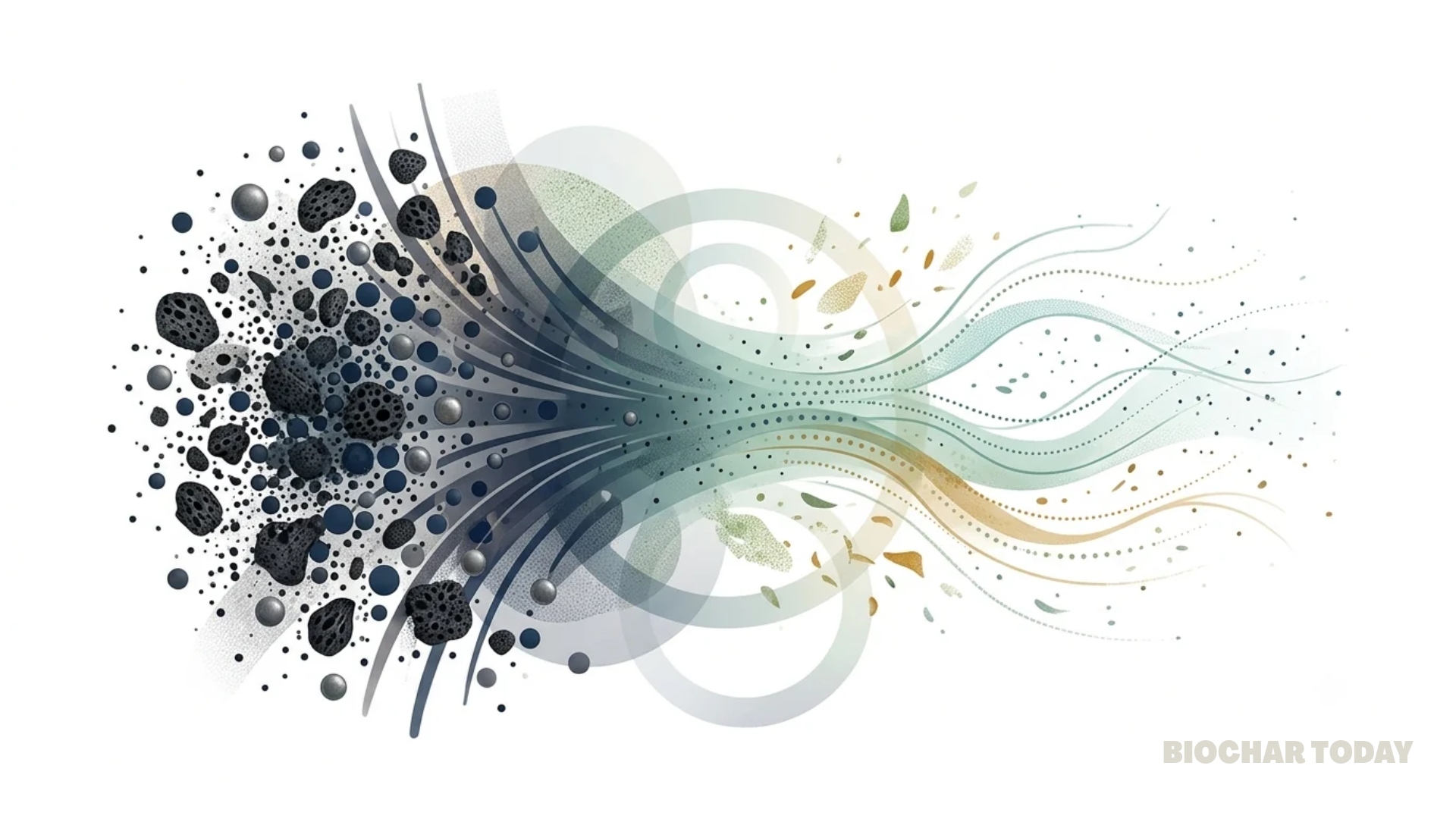
In Discover Environment, Kirti, Vikas Yadav, Jitendra Gurjar, Prakash Yadav, and Aina Yadav examine how converting waste biomassBiomass is a complex biological organic or non-organic solid product derived from living or recently living organism and available naturally. Various types of wastes such as animal manure, waste paper, sludge and many industrial wastes are also treated as biomass because like natural biomass these More into nanoscale biochar shapes performance, environmental safety, and practical readiness across pollution control, agriculture, energy storage, and biomedicine. Their findings show that nanoscale biochar is not simply a smaller version of conventional biochar. Nanosizing and surface modification alter surface charge, pore accessibility, mineral phases, and movement through water and soil, creating strong functional gains alongside clear trade-offs.
Across water treatment studies reviewed by the authors, nano-biochar removes heavy metals, organic pollutants, dyes, and nutrients through overlapping processes rather than a single mechanism. Agricultural-waste nano-biochar reaches lead adsorption capacities approaching 200 milligrams per gram, while specific treatment conditions achieve roughly 96 percent lead removal and 91 percent cadmium removal. Across broader biochar modification findings cited in the review, modification increases average heavy-metal adsorption capacity by about 208 percent and removal rates by 110 percent compared with pristine biochar, while a biochar zinc sulfide composite reaches roughly tenfold higher sorption capacity than its unmodified parent material. Studies also show nano-biochar capturing dyes such as methylene blue and nutrients such as phosphorus and nitrogen, though real wastewater contains competing ions, shifting acidity, and dissolved organic matter that can reduce apparent uptake compared with single-contaminant tests.
Air and catalytic results point to similar promise paired with practical limits. Corn-stover nano-biochar reaches roughly 120 milligrams per gram for toluene uptake compared with about 20 to 60 milligrams per gram for conventional biochar under different test conditions, while agricultural-waste nano-biochar reaches about 150 milligrams per gram for formaldehyde under mildly acidic conditions. In catalytic and light-driven systems, iron-oxide-doped nano-biochar achieves roughly 90 percent benzene degradation under ultraviolet light, iron-oxide-modified nano-biochar exceeds 85 percent degradation of phenolic compounds, and nano-biochar paired with titanium dioxide reaches roughly 90 percent methylene blue degradation within 60 minutes under ultraviolet light. The authors note that high removal percentages alone do not separate true chemical breakdown from surface adsorption or confirm stability across repeated uses.
In energy storage, nanoscale biochar and its composites show wide performance gains depending on formulation and operating conditions. While corn-stover nano-biochar reaches about 250 farads per gram in specific capacitance, optimized biochar nanocomposites incorporating nanoscale metal oxides or heteroatoms reach specific capacitances exceeding 400 to 700 farads per gram, energy densities approaching 90 watt-hours per kilogram, and cycling stability beyond 10,000 cycles. Even so, real-world value depends on energy and chemical demands, electrode consistency, and end-of-life management.
Agricultural and biomedical findings highlight both benefits and environmental risks. In soil and crop systems, nano-biochar supports nutrient retention, water holding, microbial activity, and stress tolerance, including roughly 1.9-fold higher ammonium adsorption for rice-straw nano-biochar than bulk biochar and higher tomato yields under salt stress from foliar application. However, greater mobility in soil allows tiny particles to travel farther, potentially carrying bound pollutants into deeper soil layers or nearby water, while metal-modified materials risk releasing added elements as they age in water, soil, or sunlight. In biomedical research, early results on drug loading, antimicrobial activity, and biosensing remain largely at the laboratory stage, where cell toxicity, breakdown, and safety remain major hurdles.
Overall, the review shows that higher surface area or smaller particle size does not automatically guarantee better performance. Pore fit, surface chemistry, mineral content, aging, and surrounding environmental conditions govern results, and adding chemical or metal treatments can increase costs, energy use, and leachingLeaching is the process where nutrients are dissolved and carried away from the soil by water. This can lead to nutrient depletion and environmental pollution. Biochar can help reduce leaching by improving nutrient retention in the soil. More risks. Moving nanoscale biochar from laboratory demonstrations to real-world use requires consistent reporting, multi-contaminant and field testing, aging and recovery checks, and full life-cycle and cost evaluations.
Source: Kirti, Yadav, V., Gurjar, J., Yadav, P., & Yadav, A. (2026). Synthesis characterization and applications of nano biochar derived from waste biomass. Discover Environment, 4, 682.

Leave a Reply