
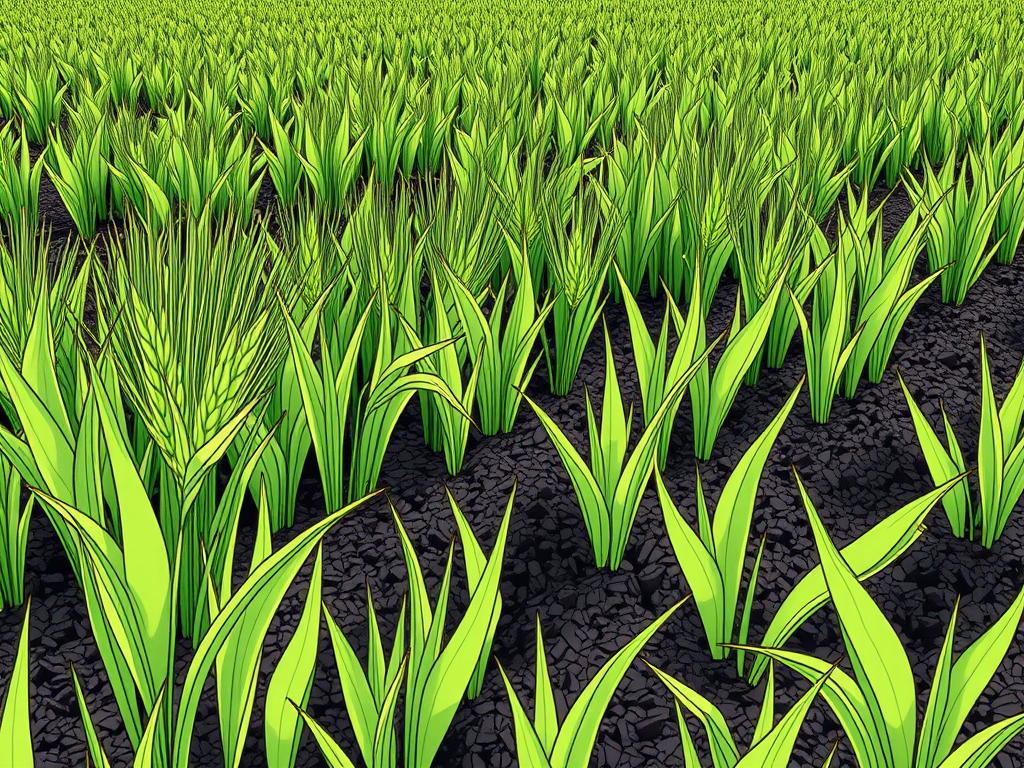
Nitrogen fertilizers are a cornerstone of modern agriculture, vital for supporting high crop yields and global food security. However, nearly half of the applied nitrogen is lost to the environment, contributing to pollution and greenhouse gas emissions like nitrous oxide (N₂O). A recent study published in Agronomy by Zeng, Chen, Li, Xiong, Liu, Azeem, Jie, Chen, Zhang, and Sun investigates the potential of biochar-based fertilizers (BBFs) to address this “nitrogen dilemma” in China. Their research, utilizing machine learning models, projects that BBFs can significantly boost crop production and reduce N₂O emissions in the country’s staple crops.
BBFs combine biocharBiochar is a carbon-rich material created from biomass decomposition in low-oxygen conditions. It has important applications in environmental remediation, soil improvement, agriculture, carbon sequestration, energy storage, and sustainable materials, promoting efficiency and reducing waste in various contexts while addressing climate change challenges. More with chemical fertilizers, aiming to improve nutrient efficiency and mitigate environmental impacts. Biochar, a stable carbon-rich material from biomassBiomass is a complex biological organic or non-organic solid product derived from living or recently living organism and available naturally. Various types of wastes such as animal manure, waste paper, sludge and many industrial wastes are also treated as biomass because like natural biomass these More pyrolysisPyrolysis is a thermochemical process that converts waste biomass into bio-char, bio-oil, and pyro-gas. It offers significant advantages in waste valorization, turning low-value materials into economically valuable resources. Its versatility allows for tailored products based on operational conditions, presenting itself as a cost-effective and efficient More, can retain approximately 70% of its initial carbon over a century, making it a viable strategy for carbon dioxide removal. While traditional biochar application can improve crop yields by 10-16% globally by enhancing soil fertility and microbial activity, its high production costs and application rates limit its economic viability. BBFs offer an innovative solution by reducing reliance on mineral fertilizers and addressing these economic constraints.
The study compiled a global dataset of BBF field experiments (50 datasets from 10 sites across 9 Chinese agricultural regions and 1 Indonesian site) to build predictive models using three machine learning algorithms: artificial neural network (ANN), random forest (RF), and support vector machine (SVM).
Variable importance analysis revealed that traditional factors like mineral nitrogen amount, crop type, and growing season temperature were the most influential variables for crop yield prediction, contributing 21.69%, 15.84%, and 14.98% respectively. BBF characteristics, specifically BBF C/N and BBF N/Mineral N, explained 4.25% and 3.95% of yield variation, respectively. For N₂O emissions, total nitrogen fertilizer application was the most influential factor (12.2% contribution), with BBF C/N and BBF N/Mineral N playing a smaller role (3.19% and 0.55% respectively).
Based on simulations, substituting conventional mineral fertilizers with BBFs could increase China’s major crop yields (wheat, rice, maize) by an average of 4.3–5.0%. Simultaneously, this substitution is projected to reduce N₂O emissions by 3.7–6.3%. This spatially varied effect means wheat yields could increase by 4.3–11.5%, rice by 3.9–5.5%, and maize by 3.8–4.8% across different agricultural regions. Notably, the South (S) and Southwest (SW) agricultural regions showed the highest yield increases (4.8–11.5%) for these staple crops. Most agricultural regions experienced N₂O reductions, with the Northeast (NE) region showing the most significant decrease (3.5–7.0%), though a slight increase of 1.4% was observed for wheat N₂O emissions in the S agricultural region.
The beneficial effects of BBFs on crop yield stem from improved nitrogen use efficiency, driven by biochar’s ability to prevent excessive nutrient diffusion and leachingLeaching is the process where nutrients are dissolved and carried away from the soil by water. This can lead to nutrient depletion and environmental pollution. Biochar can help reduce leaching by improving nutrient retention in the soil. More, retaining more nutrients in the root zone. The high surface area and porous structure of biochar enhance its capacity to adsorb essential nutrients, increasing their availability to crops. For N₂O mitigation, BBFs reduce the conversion of applied nitrogen into N₂O, primarily through their slow-release properties. However, the ANN model revealed a complex, non-linear relationship where N₂O emissions initially decline but then rise beyond a BBF C/N ratio of 2, possibly due to increased soil porosityPorosity of biochar is a key factor in its effectiveness as a soil amendment and its ability to retain water and nutrients. Biochar’s porosity is influenced by feedstock type and pyrolysis temperature, and it plays a crucial role in microbial activity and overall soil health. Biochar More and anaerobic microsites promoting denitrification.
Despite these environmental advantages, economic and technical challenges persist, including higher production costs compared to conventional fertilizers and an underdeveloped supply chain. The nitrogen content of BBFs is also lower than conventional fertilizers, potentially limiting their use as a primary nitrogen source in high-demand systems. Realizing the full potential of BBFs requires addressing these challenges through optimized production, standardized protocols, expanded trials in diverse regions, and coordinated policy support for large-scale adoption.
Source: Zeng, Y., Chen, S., Li, Y., Xiong, L., Liu, C., Azeem, M., Jie, X., Chen, M., Zhang, L., & Sun, J. (2025). Using Machine Learning to Assess the Effects of Biochar-Based Fertilizers on Crop Production and N₂O Emissions in China. Agronomy, 15(5), 1238.





Leave a Reply