
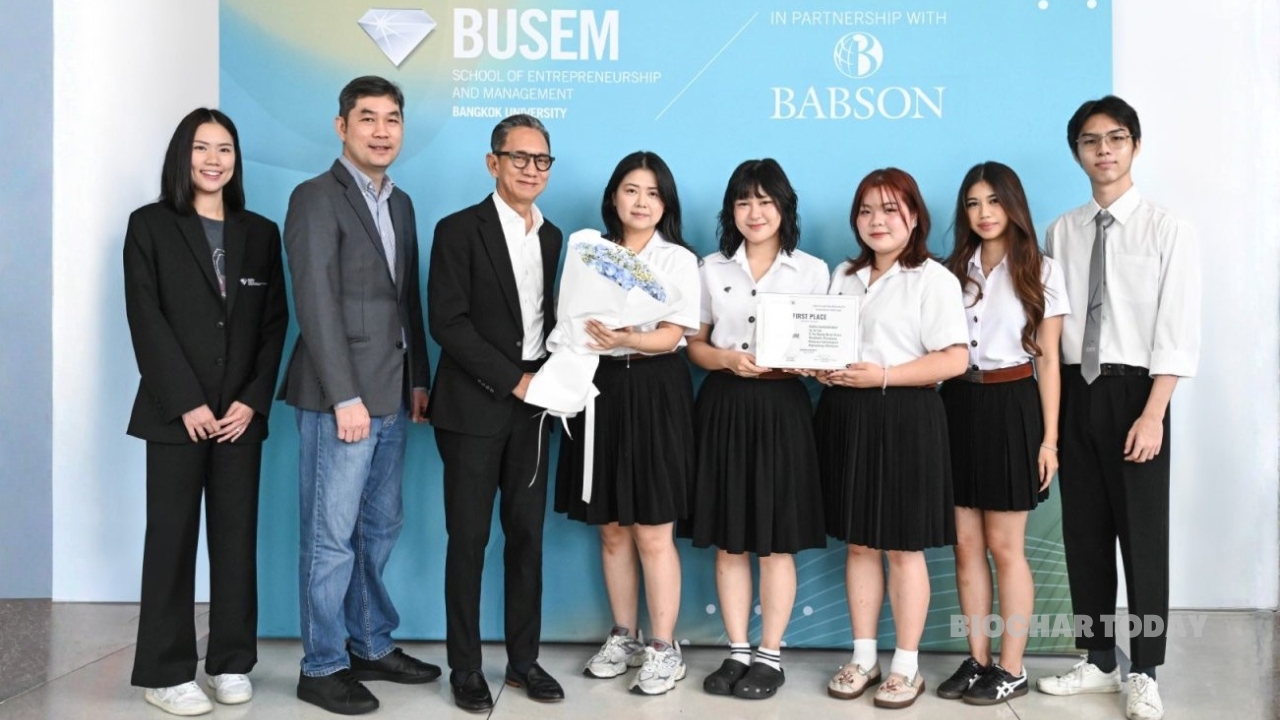
A student team named Cassapure from Bangkok University’s School of Entrepreneurship and Management recently secured first place at the 2026 Babson Collaborative Global Student Challenge. The international competition, organized by the Babson Collaborative for Entrepreneurship Education network, required global participants to construct entrepreneurial models aligned with the United Nations Sustainable Development Goals. The annual challenge attracted more than 1,280 competing student teams representing 33 distinct universities across 24 nations. The winning innovation from Thailand utilizes a localized circular economy framework to process abundant agricultural waste into an adsorbent material suitable for industrial operations.
The primary challenges addressed by the Cassapure team center on widespread wastewater pollution and the disposal burdens of agricultural by-products in Thailand. Small and medium-sized enterprises frequently face prohibitive financial costs when trying to implement conventional wastewater treatment systems or purchase commercial chemical absorbents. Concurrently, agricultural processing facilities struggle to manage large volumes of discarded biomassBiomass is a complex biological organic or non-organic solid product derived from living or recently living organism and available naturally. Various types of wastes such as animal manure, waste paper, sludge and many industrial wastes are also treated as biomass because like natural biomass these More. The initial concept for the venture originated from industrial waste observations at a family-owned processing factory operated by one of the student team members, where vast quantities of raw cassava peel were routinely discarded despite severe surrounding water management concerns.
To address these overlapping issues, the Cassapure team designed a commercially viable business model focused on converting discarded cassava peel into porous biocharBiochar is a carbon-rich material created from biomass decomposition in low-oxygen conditions. It has important applications in environmental remediation, soil improvement, agriculture, carbon sequestration, energy storage, and sustainable materials, promoting efficiency and reducing waste in various contexts while addressing climate change challenges. More. The raw material represents one of the most abundant agricultural residues in the region. By applying thermal conversion processes, the students transformed this low-value biomass into a highly effective adsorbent capable of stripping contaminants from industrial effluents. The resulting product provides a lower-cost, chemical-free alternative to traditional filtration media, allowing small and medium-sized enterprises to access affordable, decentralized wastewater treatment infrastructure while eliminating the logistics costs associated with burning or dumping raw peels.
The operational outcomes of this business model span environmental remediation, corporate savings, and agricultural supply chain improvements. By implementing the project, local small and medium-sized enterprises cut wastewater treatment expenses and reduce waste management friction while complying with regional environmental regulations. Furthermore, the commercialization of the material introduces new economic value to agricultural residues, establishing secondary income opportunities for cassava farmers and processing plants that sell their previously valueless waste. The project advances several United Nations Sustainable Development Goals, specifically focusing on clean water, climate action, responsible consumption, and sustainable industrial innovation.



Leave a Reply