
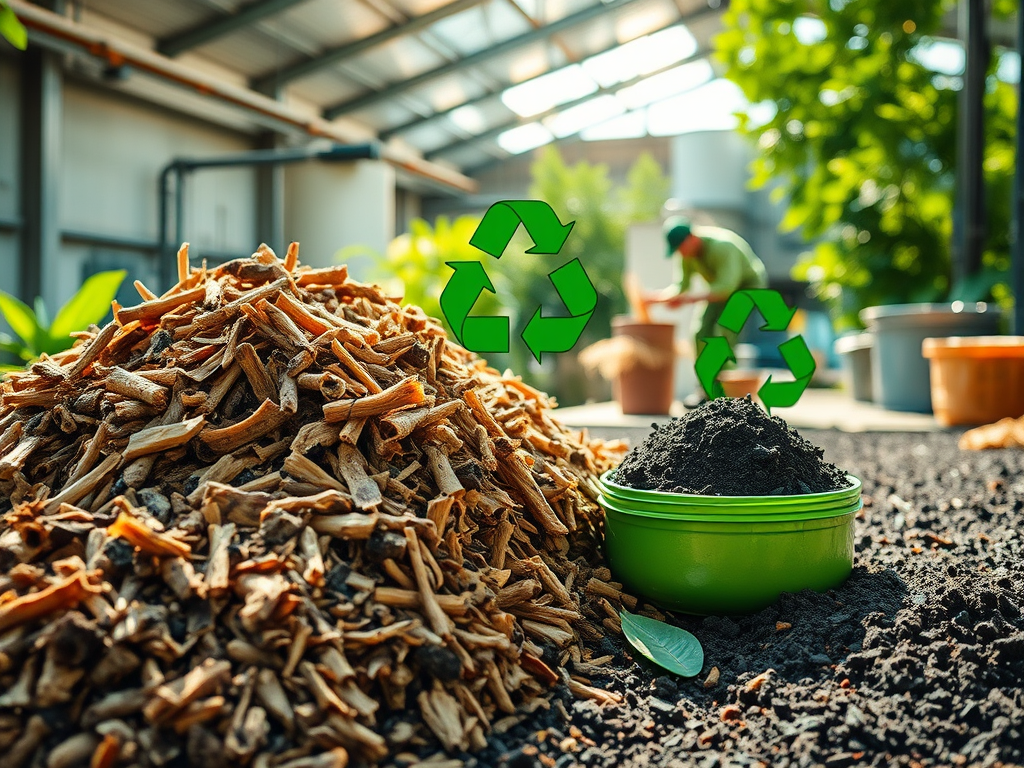
In a new systematic literature review published in the International Economics and Business Conference (IECON), researchers Sweet Nabila Imsaki Aulia, Ririn Indah Romadloni, Muhammad Fikri Maududi, and Fenty Fauziah explored the use of Green Supply Chain Management (GSCM) and the 3R principles (Reduce, Reuse, Recycle) to address the growing problem of wood waste. Wood waste, including wood chips, sawdust, and ashAsh is the non-combustible inorganic residue that remains after organic matter, like wood or biomass, is completely burned. It consists mainly of minerals and is different from biochar, which is produced through incomplete combustion. Ash Ash is the residue that remains after the complete More, presents a significant economic and environmental challenge because it has low recycling potential due to a lack of sustainable applications. The study’s analysis of 30 scholarly articles revealed that implementing GSCM and the 3Rs can help increase the income of wood artisans, lower production costs, and contribute to environmental preservation.
The researchers found that GSCM, which integrates environmental concerns into every phase of the supply chain, can create a “win-win” situation by providing both economic and environmental benefits. For example, GSCM can be combined with Geographic Information Systems (GIS) to help with geospatial decision-making and the transportation of wood waste in the furniture industry. According to the review, a key priority of GSCM is innovation, which not only improves the environment but also enhances a manufacturer’s competitive advantage.
The core of a successful wood waste management strategy lies in the 3R principles. The most effective measure is Reduction, which focuses on preventing waste from being created in the first place. This can be achieved by using resources efficiently during manufacturing and reducing resource use in the pre-manufacturing phase. For example, a reduction strategy could involve using a selective cutting system to harvest only the right trees in the right amounts and then replanting them. Reuse involves using waste that does not require special processing, such as turning sawdust into particleboards. Lastly, Recycling converts waste into new raw materials, such as reprocessing used products to make them as good as new. By using these methods, a substantial amount of CO2 can be saved, and natural resources can be conserved.
The review identified a wide range of valuable products that can be made from recycled wood waste. The conversion of wood waste into biocharBiochar is a carbon-rich material created from biomass decomposition in low-oxygen conditions. It has important applications in environmental remediation, soil improvement, agriculture, carbon sequestration, energy storage, and sustainable materials, promoting efficiency and reducing waste in various contexts while addressing climate change challenges. More was a key finding. The study noted that wood waste can be processed into biochar, which is then used to reduce iron oxide. In one specific study cited in the review, biochar derived from eucalyptus wood waste (EWB) was shown to be highly effective in adsorbing dissolved dyes like methylene blue and crystal violet from wastewater. The EWB, which was carbonized at 450∘C and activated with ZnCl2, had a maximum adsorption capacity of 14.42 mg/g for methylene blue and 12.95 mg/g for crystal violet.
In addition to biochar, the review highlighted other valuable products. Wood waste ash, for instance, can be used as an ingredient in concrete mixtures or for making shiny ceramics, which supports sustainable development and a “zero-waste” approach. Sawdust can also be used to make briquettes that can serve as a substitute for coal in various industries, brick factories, and hotels. The review also noted the creation of engineered wood products and wood-polymer composites (WPCs), which can have mechanical properties that are equal to or better than those of conventional materials. Additionally, recycled wood waste can be used for mini carving crafts.
This systematic review shows the importance of an integrated strategy for wood waste. By combining GSCM and the 3R principles, industries can effectively manage their waste while also creating economic value from materials that would otherwise be discarded. The study’s authors emphasized that more research is needed to explore the practical implementation of these strategies in real-world industrial settings, particularly concerning challenges like sorting and contamination.
Source: Aulia, S. N. I., Romadloni, R. I., Maududi, M. F., & Fauziah, F. (2025). Green Supply Chain Management and 3R on Wood Waste Utilization: A Systematic Literature Review. International Economics and Business Conference (IECON), 3(2), 1864–1881.


![Eucalyptus Wood Waste-Derived Biochar Achieves a Ninety-Eight Percent Removal Efficiency for Benzo[ghi]perylene in Vehicle-Wash Wastewater](https://biochartoday.com/wp-content/uploads/2026/10/SCIENCE-BLOGS-2026-2026-10-19T160523.703.jpg)

Leave a Reply