
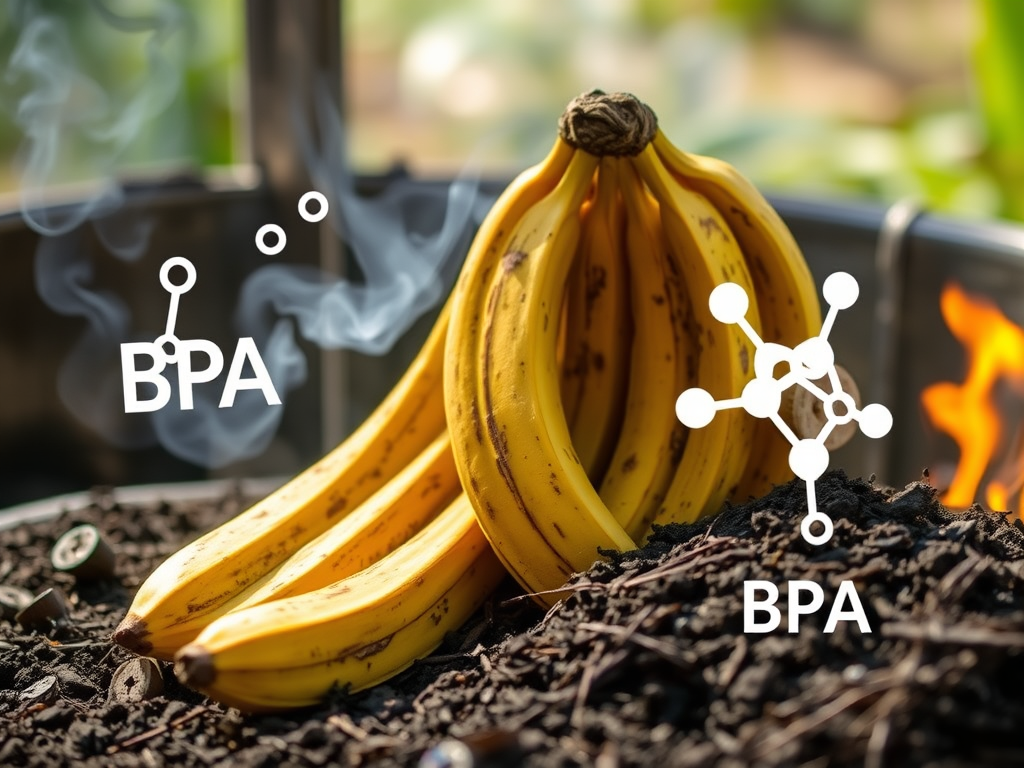
A new study published in Scientific Reports by a team of international researchers including Salah Ud Din, Patrick T. Ngueagn, and others, demonstrates a sustainable and effective method for removing the persistent chemical bisphenol-A (BPA) from wastewater. The research, which compared raw banana peels to biocharBiochar is a carbon-rich material created from biomass decomposition in low-oxygen conditions. It has important applications in environmental remediation, soil improvement, agriculture, carbon sequestration, energy storage, and sustainable materials, promoting efficiency and reducing waste in various contexts while addressing climate change challenges. More derived from them, found that the biochar significantly enhanced the removal of BPA, achieving a maximum monolayer adsorption capacity of 135.2 mg/g. These findings position discarded banana peels as a promising, low-cost adsorbent for a critical environmental and public-health problem.
The continuous release of chemical substances like endocrine disruptor bisphenol-A can cause harmful health and environmental effects in humans, wildlife, and aquatic organisms. BPA is a widely produced chemical used in the manufacturing of plastics, resins, and epoxy resins, and it contaminates water bodies through landfill runoff, domestic sewage, and industrial waste. BPA can accumulate in aquatic organisms, causing developmental abnormalities, behavioral changes, and reproductive dysfunction. Prolonged human exposure to BPA has been linked to health issues including diabetes, heart disease, breast cancer, and reproductive problems. Due to its persistent and pervasive usage, the removal of BPA from aqueous solutions has become an important area of concern for researchers.
Conventional methods for removing BPA from water, such as chemical precipitation, ion exchange, and membrane filtration, have drawbacks including high operational costs, secondary waste generation, and an inability to completely remove a wide spectrum of contaminants. Adsorption, however, is a versatile and effective technique due to its operational simplicity, minimal sludge generation, and cost-effectiveness. The high cost of activated carbonActivated carbon is a form of carbon that has been processed to create a vast network of tiny pores, increasing its surface area significantly. This extensive surface area makes activated carbon exceptionally effective at trapping and holding impurities, like a molecular sponge. It is commonly More, the most widely used adsorbent, has led researchers to explore agricultural wastes as a promising and affordable alternative. Biochar, a carbonaceous material derived from biomassBiomass is a complex biological organic or non-organic solid product derived from living or recently living organism and available naturally. Various types of wastes such as animal manure, waste paper, sludge and many industrial wastes are also treated as biomass because like natural biomass these More, is an eco-friendly and promising adsorbent for removing various pollutants from the environment due to its high surface area and diverse functional groups. Bananas are the fourth most cultivated fruit globally, and their discarded peels can be converted into biochar, serving as an eco-friendly solution in wastewater treatment.
The study prepared biochar by pyrolyzing banana peels under a nitrogen atmosphere at 600°C. The biochar exhibited a higher BET surface area of 114.25 m2/g compared to 84.21 m2/g for the raw banana sample, which enhanced its adsorption potential. Scanning Electron Microscopy (SEM) images showed that the biochar had a porous network with visible cavities and voids, providing a high surface area for adsorption. After BPA adsorption, these pores appeared smoother and partially filled, indicating that BPA molecules successfully adsorbed onto the surface and into the internal pores of the biochar.
The study found that the optimum adsorption for the treated biochar occurred at a pHpH is a measure of how acidic or alkaline a substance is. A pH of 7 is neutral, while lower pH values indicate acidity and higher values indicate alkalinity. Biochars are normally alkaline and can influence soil pH, often increasing it, which can be beneficial More of 8.0, an initial BPA concentration of 240 mg/L, a dosage of 0.4 g, and a contact time of 150 minutes. The treated biochar reached equilibrium faster than the raw banana peel, demonstrating faster kinetics and higher capacity. The amount of BPA adsorbed by both the raw and treated banana peels increased as the BPA concentration increased, a trend attributed to a greater concentration gradient that acts as a driving force.
From the kinetic study, the pseudo-second-order model best described the treated peels’ data, indicating a chemisorption mechanism, while the pseudo-first-order model best explained the kinetic data for the raw sample, pointing to a physisorption mechanism. The thermodynamic characteristics for both the raw and treated peels indicated a spontaneous and endothermic process. The Langmuir isotherm model best described the raw banana peel, while the Freundlich model confirmed the adsorption of BPA by the treated biochar was a heterogeneous surface process. The treated banana peel had a higher maximum monolayer adsorption capacity (Qmax) of 135.2 mg/g compared to the raw peel’s 91.3 mg/g, inferring that biochar treatment greatly enhances the adsorbent’s capacity.
The FTIR analysis confirmed that BPA molecules successfully interacted with the banana biochar surface functional groups. The study concluded that both physical interactions (physisorption) and specific functional group associations (chemisorption) contribute to BPA uptake, which is consistent with the kinetic and thermodynamic data. A desorption study showed that banana biochar exhibited better reusability, with desorption efficiency starting at 79.3% in the first cycle and gradually declining to 66.7% after five cycles. The study concluded that banana peel biochar is a low-cost, effective, and sustainable adsorbent for BPA removal.
Source: Din, S. U., Ngueagn, P. T., Al-Ahmary, K. M., AlMohamadi, H., Al-Mhyawi, S. R., Elamin, N. Y., Alshdoukhi, I. F., Alrashood, J. S., & Ofudje, E. A. (2025). Adsorption of Bisphenol-A by banana biochar: kinetic, isotherms and thermodynamics. Scientific Reports, 15(31659), 1–16.




Leave a Reply