
The key claim of biocharBiochar is a carbon-rich material created from biomass decomposition in low-oxygen conditions. It has important applications in environmental remediation, soil improvement, agriculture, carbon sequestration, energy storage, and sustainable materials, promoting efficiency and reducing waste in various contexts while addressing climate change challenges. More is its ability to sequester carbon for an extended period. But how? Why does biochar last for centuries in the soil when a log or pile of mulch rots away in a few years? The secret lies in its chemical transformation.
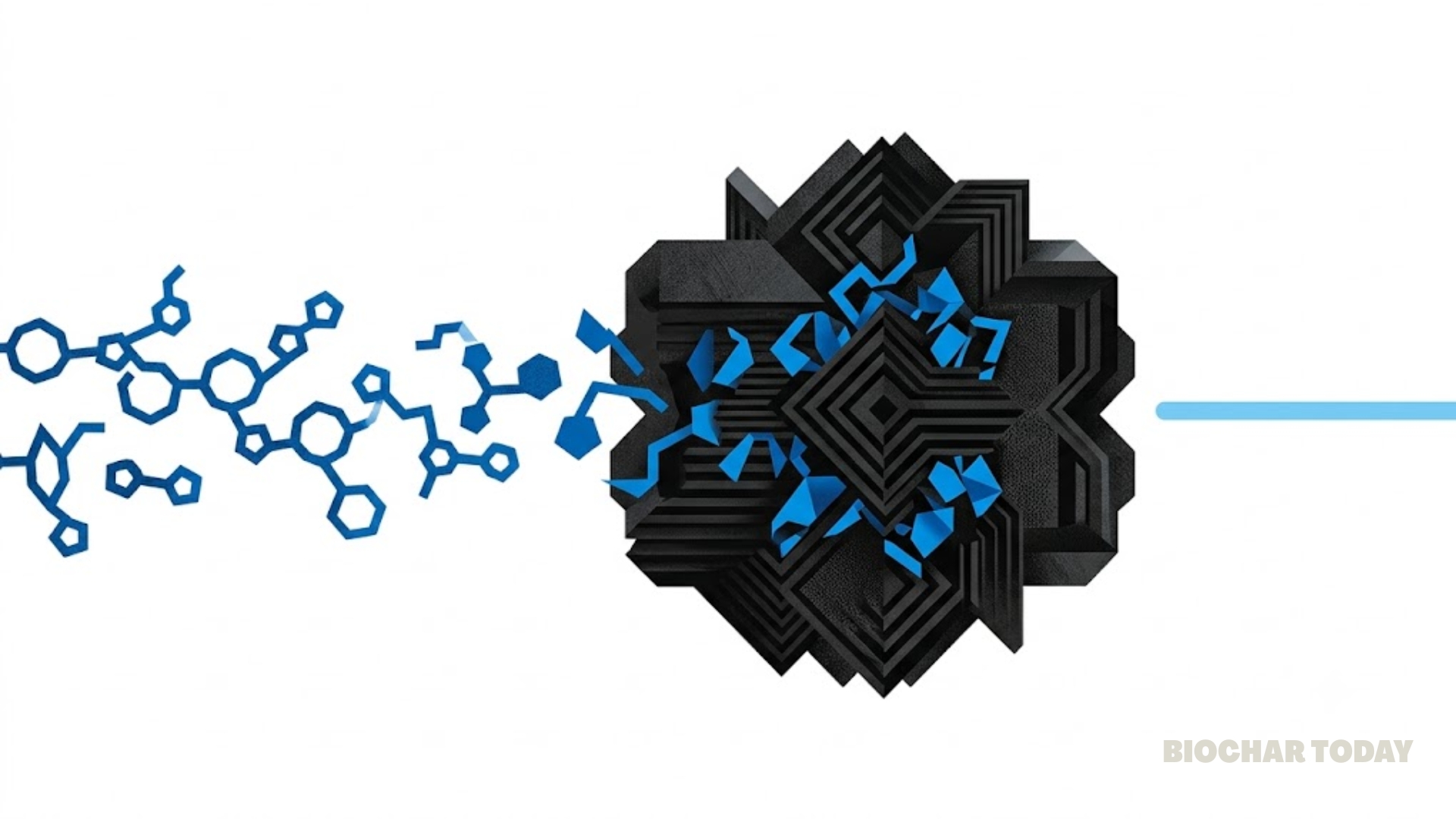
A piece of raw wood is composed of long, stringy fibers, such as cellulose and lignin. For soil microbes, this is a readily available food source. Biochar is created through pyrolysis—heating biomassBiomass is a complex biological organic or non-organic solid product derived from living or recently living organism and available naturally. Various types of wastes such as animal manure, waste paper, sludge and many industrial wastes are also treated as biomass because like natural biomass these More in a low-oxygen environment. This process fundamentally alters its structure, driving off volatile materials, including hydrogen and oxygen, and condensing the original carbon, cellulose, and lignin into dense, complex “poly-aromatic carbon structures”. Think of it this way: raw wood is like a loose pile of straw, easy for microbes to pull apart and digest. PyrolysisPyrolysis is a thermochemical process that converts waste biomass into bio-char, bio-oil, and pyro-gas. It offers significant advantages in waste valorization, turning low-value materials into economically valuable resources. Its versatility allows for tailored products based on operational conditions, presenting itself as a cost-effective and efficient More transforms that straw into a solid, condensed brick. This new, dense, and “aromatic” structure is incredibly difficult for soil microbes to decompose.
Not all biochar is created equal. Its stability depends on two key factors. First is the feedstockFeedstock refers to the raw organic material used to produce biochar. This can include a wide range of materials, such as wood chips, agricultural residues, and animal manure. More; woody biomass, rich in tough fibers like lignin, produces a biochar with a higher degree of aromaticity and recalcitrance compared to biochars made from manures or grasses. Second is temperature, which is critical. Studies consistently show that pyrolysis at high temperatures—specifically above 500°C (932°F)—is required to create highly recalcitrant biochar that lasts for centuries.
We can’t wait 1,000 years for a study to finish, so scientists need a reliable proxy to measure stability. The best method, adopted by the International Biochar Initiative (IBI), is the H/Corg ratio. This ratio measures the amount of hydrogen (H) relative to organic carbon (Corg). A high H/Corg ratio means the material is “fluffy” and biologically available, while pyrolysis drives off hydrogen, lowering the ratio and making the carbon more condensed and stable. The scientific benchmark for high-stability biochar is an H/Corg ratio of < 0.7, with ratios < 0.4 being even better, indicating over 70% of the carbon will remain after 100 years. This ratio is the most critical metric for dictating permanence, a topic we cover in a recent “Ask Annie” article from Annie Nichols.
It’s also important to know that biochar isn’t 100% stable carbon. It’s best described as having two distinct “pools”. First is the “labile” pool, a small fraction (one meta-analysis found it was ~3%) that is easily digestible by microbes and breaks down quickly, often within the first year. The second is the “recalcitrant” pool, which is the other 97%—the formidable, aromatic carbon fortress that lasts for centuries to millennia. This two-pool system is why short-term studies can be misleading; they only capture the fast decay of the small “labile” pool, but long-term studies show that decomposition rates slow dramatically after this initial fraction is gone.
Biochar’s stability isn’t magic; it’s a feat of chemical engineering. By pyrolyzing woody biomass at high temperatures (>500°C), we transform it into a dense, polyaromatic carbon structure that microbes can’t break down. By verifying its H/Corg ratio is below 0.7, we can be confident that we are sequestering carbon in a stable vault that will last for millennia.


Leave a Reply