
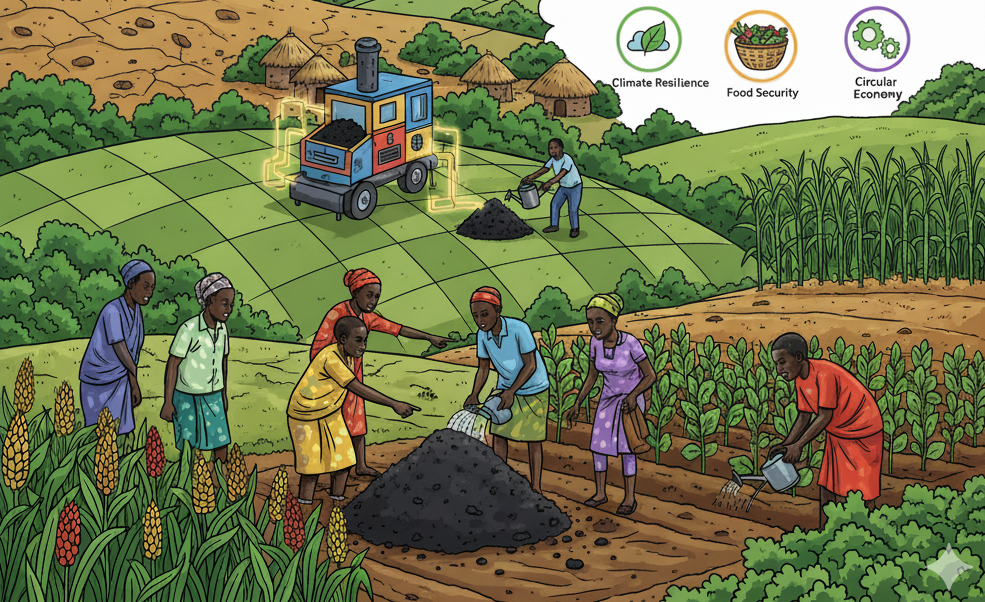
Kenya, a nation where agriculture is the very heartbeat of the economy, stands at a critical crossroads. Faced with the twin challenges of climate change and widespread soil degradation, the country’s food security and economic stability are under immense pressure. But within this crisis lies a transformative, home-grown solution: biocharBiochar is a carbon-rich material created from biomass decomposition in low-oxygen conditions. It has important applications in environmental remediation, soil improvement, agriculture, carbon sequestration, energy storage, and sustainable materials, promoting efficiency and reducing waste in various contexts while addressing climate change challenges. More.
While last week’s “Nations of Biochar” article explored Latvia’s biochar potential in forestry, this week I investigated Kenya’s agricultural residues and their potential role. With a vast supply of residues from crops like coffee, maize, and sugarcane, the nation is perfectly positioned to turn its agricultural waste into a powerful resource. The full article can be reached here.
This isn’t just a niche environmental project; it’s a strategic solution with a “triple-win” for Kenya.
1. A Tool for Climate Resilience and Mitigation
Kenya’s agricultural sector is a significant source of the country’s greenhouse gas emissions. Biochar offers a way to reverse this trend. By converting agricultural waste into a stable carbon material, it sequesters carbon in the soil, preventing it from re-entering the atmosphere. But biochar also acts as a powerful adaptation tool. With over 80% of Kenya’s land classified as arid or semi-arid, the country is highly susceptible to drought. Biochar’s highly porous structure dramatically improves soil water retention, making crops more resilient to the longer, more intense dry spells that are becoming a hallmark of a changing climate.
2. A Path to Increased Crop Yields and Food Security
For Kenya’s millions of smallholder farmers, the spiralling cost of synthetic fertilizers is a major burden. Biochar provides a low-cost, locally produced alternative that acts as a powerful soil conditioner. Its ability to hold water and nutrients makes them more available to plants, directly leading to improved crop productivity. A recent study on maize systems in Kenya found that the use of biochar could result in a gain of over 300,000 metric tons of maize over just four years. For a nation grappling with food supply deficits, this is a critical step towards achieving food security.
3. A Catalyst for a Circular Economy
Biochar production is a perfect example of a circular economy in action. Instead of burning crop residues or letting them decompose and release harmful methane, they are transformed into a high-value product. This not only creates new local economies and jobs in rural areas but also generates by-products like syngasSyngas, or synthesis gas, is a fuel gas mixture consisting primarily of hydrogen and carbon monoxide. It is produced during gasification and can be used as a fuel source or as a feedstock for producing other chemicals and fuels. More that can be used as a clean energy source.
From Pilot Projects to a National Movement
What makes Kenya’s biochar journey so exciting is the country’s entrepreneurial spirit. Companies like Bio-Logical and Biosorra are already at the forefront, turning agricultural waste from large-scale operations into high-quality bio-fertilizer. Biosorra, a winner of the XPRIZE Carbon Removal competition, is proving that Kenyan companies are capable of meeting global standards and becoming leaders in the biocarbon market.
The potential for a decentralized, community-led movement is also immense. Mobile pyrolysisPyrolysis is a thermochemical process that converts waste biomass into bio-char, bio-oil, and pyro-gas. It offers significant advantages in waste valorization, turning low-value materials into economically valuable resources. Its versatility allows for tailored products based on operational conditions, presenting itself as a cost-effective and efficient More units, costing as little as $10,000-$15,000, are being developed, offering a localized approach that empowers smallholder farmers directly. With a supportive government policy environment—including the Kenya Climate Smart Agriculture Strategy—the stage is set for biochar to become a cornerstone of the nation’s climate and food strategies.
However, as highlighted in my full article, success hinges on an equitable approach. This technology must be co-created with, and remain accessible to, the very communities it aims to serve. The biggest risk is that this innovative solution becomes intellectualised beyond the reach of the smallholder farmers who need it most.
For a deeper dive into the data and the full scope of Kenya’s biochar potential, read the full, in-depth article, available to our members.
Which nation should we profile next in our “Nations of Biochar” series? Send your suggestions to ralph@biochartoday.com !


Leave a Reply