
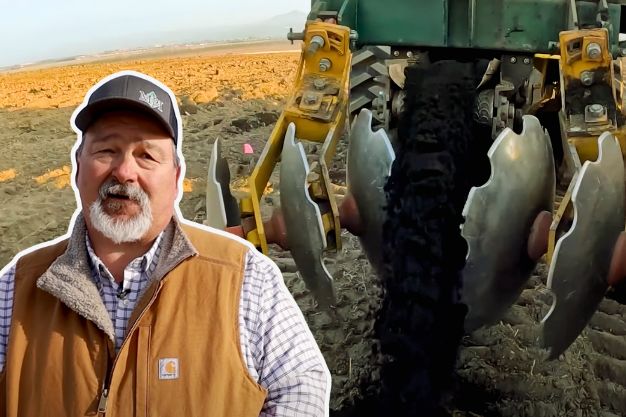
In the vineyards of California, a quiet revolution in sustainable agriculture is underway. Jeff Lehar, a seasoned vineyard equipment innovator with deep roots in both farming and fabrication, has developed a breakthrough in biocharBiochar is a carbon-rich material created from biomass decomposition in low-oxygen conditions. It has important applications in environmental remediation, soil improvement, agriculture, carbon sequestration, energy storage, and sustainable materials, promoting efficiency and reducing waste in various contexts while addressing climate change challenges. More application that may change the trajectory of soil health and carbon sequestration in commercial agriculture.
From welder to innovator
Jeff’s journey began not in a lab, but on the land. Raised in Arizona and seasoned in California’s Salinas Valley—the Salad Bowl of the World—he grew up immersed in agriculture. After years as a welder and fabricator, he found his way into the vineyard industry, ultimately becoming a key figure at Monterey Pacific. His role evolved from shop supervisor to company-wide equipment overseer and R&D leader.
That mechanical and agricultural fluency has served him well. “I could look at something and either modify it or envision what its capabilities were,” he says. That mindset led to his signature contribution: the development of a machine that applies compost and biochar deep into the soil while actively blending it with native earth.
The problem with traditional biochar application
As biochar gains attention for its ability to sequester carbon and improve soil health, a major obstacle remains: effective application.
“Most people just drop it on the surface, run a disc over it, or dig a trench and dump it in,” Jeff explains. These methods barely scratch the surface—literally. Amendments penetrate only a few inches and often degrade or blow away. Worse, improperly applied compost can turn septic, damaging plant roots.
Through experimentation and collaboration with soil scientists like Dr. Doug Beck, Jeff learned the critical role of inoculation—mixing biochar with compost and letting it sit for 14 to 30 days. This allows the biochar to absorb microbial life and nutrients before it hits the soil.
Engineering a better way
Driven by poor soil conditions on Monterey Pacific’s Oasis property, Jeff envisioned a new way to inject compost—and later biochar—into the root zone at depths of 18 to 36 inches. Working with a fabricator, he built a specialized soil injector. Key to its innovation is a vortex-like mechanism: the machine creates a void in the soil and strategically releases the amendment where the soil’s natural turbulence pulls it back in. This actively mixes the biochar with native soil, avoiding harmful concentration pockets.
The first machine was built to work between vineyard rows. Later, Jeff developed a larger unit for vineyard development, capable of applying up to 77 tons per acre. “It’s so simple, it’s stupid,” he says modestly. But the design is elegant in its effectiveness and scale.
Simplicity, scalability, and impact
Jeff and Monterey Pacific partnered to form Soil AmendmentA soil amendment is any material added to the soil to enhance its physical or chemical properties, improving its suitability for plant growth. Biochar is considered a soil amendment as it can improve soil structure, water retention, nutrient availability, and microbial activity. More Injection LLC, with an eye toward licensing rather than manufacturing. “I don’t have time to oversee production, sales, or distribution,” Jeff says. Instead, he’s working with global equipment makers to scale the innovation internationally.
Unlike complicated machinery dependent on AI or GPS, Jeff’s design is hydraulically simple and durable. It doesn’t just work in California’s vineyards. Modular designs are being prototyped for vegetable crops, orchards, and even strip-till and no-till row crops.
Rethinking trials and the biochar industry
Jeff is passionate about putting biochar to work at scale. He critiques current trends where grant-funded projects focus on small organic farms, which he calls “symbolic but ineffective.” Real change, he argues, comes from proving value to large-scale growers.
“You’ve got to make it make sense financially,” he says. “Done right, you reduce inputs. But you only get one chance to make a first impression.”
With Dr. Beck from Monterey Pacific and Jessica Bronner from Sitos Group, Jeff is helping to design trials that are scientifically sound, track soil health metrics, and produce data that large growers can trust. These aren’t theoretical case studies—they’re real, on-the-ground experiments to prove that biochar, when applied properly, delivers agronomic value.
Soil first, politics second
Jeff doesn’t label himself a climate activist. “I’ve been called a climate denier,” he laughs, noting that climate predictions have come and gone over the decades. But what matters to him is the soil.
“I look at it from an agronomic standpoint. Soil isn’t dead—it’s alive. We’ve abused it, and it’s time we let it do what it does best: grow plants.”
His approach—minimal tillage, root pruning to promote growth, and soil biome enhancement—is as pragmatic as it is ecological. Biochar just happens to be a tool that aligns perfectly with this philosophy.
The road ahead
Interest in Jeff’s system is global, with inquiries from Africa, New Zealand, and Eastern Europe. His team is now prototyping equipment for vegetable production and refining in-row vineyard application to be tractor-compatible without major modifications.
For those in the biochar world, Jeff’s work is a game-changer. Not because it’s flashy or high-tech, but because it works, and it’s scalable.
“This isn’t about trends,” he says. “It’s about getting the amendment where it needs to be and letting the soil do the rest.”


Leave a Reply