
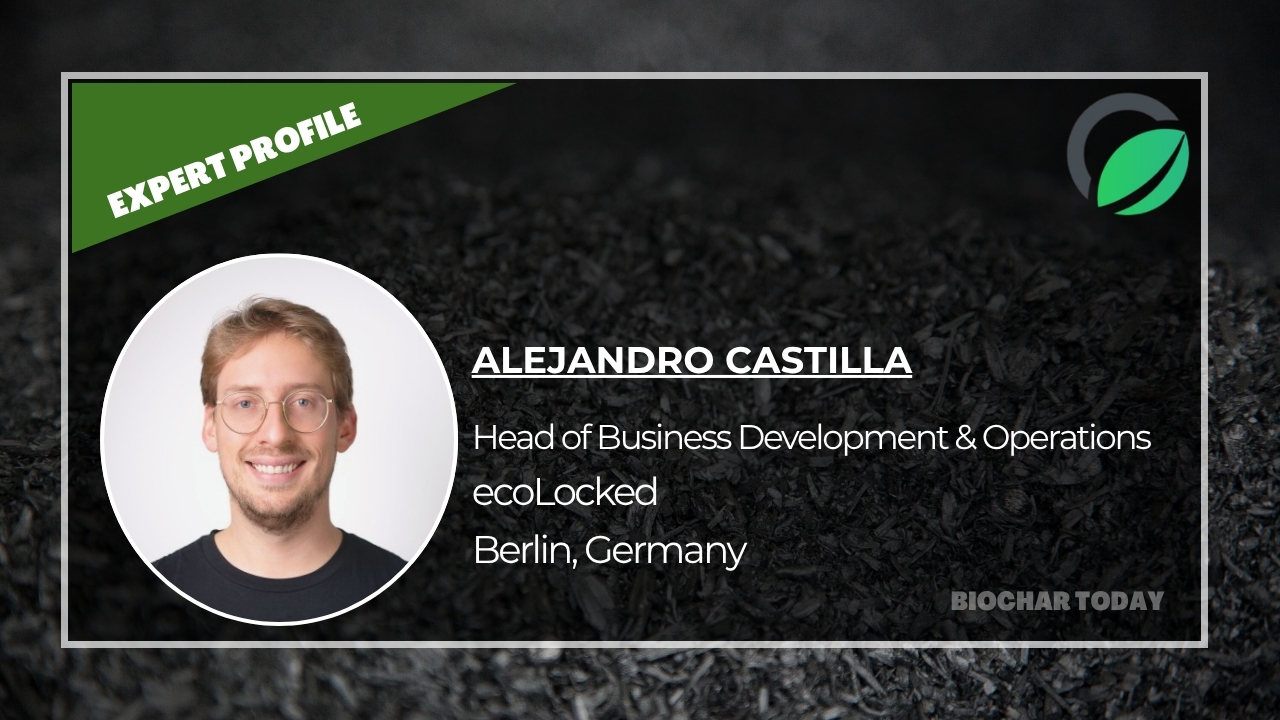
Alejandro Castilla is a business development professional with a strong focus on advancing the commercialization of biochar-based solutions. Originally from Colombia and now based in Germany, he works at ecoLocked, where he helps bridge the gap between biocharBiochar is a carbon-rich material created from biomass decomposition in low-oxygen conditions. It has important applications in environmental remediation, soil improvement, agriculture, carbon sequestration, energy storage, and sustainable materials, promoting efficiency and reducing waste in various contexts while addressing climate change challenges. More production, carbon removal, and the construction industry through partnerships, supply chain development, and carbon accounting. With a background in industrial engineering and sustainability, complemented by a master’s degree specializing in soil science and waste management, Alejandro has developed expertise across the biochar value chain—from feedstockFeedstock refers to the raw organic material used to produce biochar. This can include a wide range of materials, such as wood chips, agricultural residues, and animal manure. More sourcing and biochar production to techno-economic analysis, licensing, and consortium building. His recent participation as a panelist at the Biochar Summit 2026 highlighted the importance of trust and collaboration in accelerating the growth of the biochar industry. As he expands his work into Latin America, he continues to contribute to practical approaches that connect innovation with market adoption. It is my pleasure to introduce Alejandro Castilla to our readers as part of the Biochar Today Biochar Expert Profile series.
Shanthi Prabha: Your career has taken you from industrial engineering and sustainability to business development in the biochar sector. What sparked your interest in biochar, and what convinced you that this was an industry worth building a career in?
Alejandro Castilla: Before biochar, I sold thermal technology for treating industrial hazardous waste. The value I was creating there was limited. Essentially turning something hazardous into something non-hazardous, and lowering the cost of disposal. The by-products were, in theory, recovered resources, but in practice it was hard to bring them back into the economy in any meaningful way. There was a ceiling on the value I could create.
Then at a conference in Birmingham, someone told me something like “pyrolysisPyrolysis is a thermochemical process that converts waste biomass into bio-char, bio-oil, and pyro-gas. It offers significant advantages in waste valorization, turning low-value materials into economically valuable resources. Its versatility allows for tailored products based on operational conditions, presenting itself as a cost-effective and efficient More helps remove CO2 from the atmosphere, permanently”. Something clicked when I heard this. I had spent years working with a technology that reduced harm, while pyrolysis reversed it.
That is what convinced me. Prioritizing gigaton-scale decarbonization technology that is already available today, not something we are waiting on, is a no brainer. That is an industry worth building a career in.
SP: You often work at the point where technology meets the market. From your experience, what separates biochar projects that successfully reach commercialization from those that struggle to move beyond the pilot stage?
AC: People. That is the real driver behind every project that actually gets built. Specifically, the ability to detach from optimizing your own slice of the cake, and instead stay open to figuring out what the right size of the cake is for everyone, right now, while this industry is still finding its place in the market.
The projects that operate alone have a rougher path. The ones willing to partner up across the value chain, biomassBiomass is a complex biological organic or non-organic solid product derived from living or recently living organism and available naturally. Various types of wastes such as animal manure, waste paper, sludge and many industrial wastes are also treated as biomass because like natural biomass these More owners, pyrolysis tech providers, off-takers, move faster and more reliably.
SP: ecoLocked focuses on incorporating biochar into concrete. What opportunities do you see for biochar-based construction materials to contribute to long-term carbon removal while also delivering value to the construction industry?
AC: Beyond the clear climate benefit, biochar-in-concrete has real technical benefits once you look at it closely. Depending on dosage and post-processing, we are seeing benefits like faster curing time, higher compressive strength, and better insulation.
The industry is still in its infancy, though. There is a mismatch between what biochar producers can deliver and what concrete producers actually need, especially on quality and consistency. Real exploration only starts once concrete producers can rely on the material behaving the same way every time. No surprises, no unpredictable material.
So the climate benefit linked to biochar is the door opener, it gets you in the room. But once you are in, you have to walk the room and prove the technical benefits stand on their own.
SP: At the Biochar Summit 2026 in Vienna, you spoke about trust being a greater bottleneck than technology. Could you elaborate on what you mean by this, and how the industry can build stronger trust among producers, buyers, investors, and policymakers?
AC: At the Summit I was talking specifically about biochar-in-concrete. Trust is the bottleneck because bringing biochar into concrete is never a single-actor decision. A concrete producer looking at a new material is looking at a new supplier, a new unknown, and they carry real risk if it goes wrong. Water, sand, aggregates, and cement earned their spot in the recipe over centuries (if not millennia). We are the new ingredient, so the bar is higher for us, not lower, because nobody owes us trust yet.
Through joint work with concrete producers, I have seen how doubt spreads faster than trust does. One actor in the chain, a general contractor, a structural engineer, has a technical doubt, and nobody else wants to be the one who said “it’s fine” if it later goes wrong, so they stay quiet. Doubt wins not because someone proved a point, but because nobody wanted to take responsibility for disagreeing.
That is why the real work is mapping every actor in the chain and educating them one by one, instead of pitching the direct customer and hoping the rest follows. It is not a product you are selling, it is trust.

SP: You have worked across different parts of the biochar value chain—from feedstock sourcing to partnerships and carbon accounting. Which part of the value chain currently requires the greatest attention, and why?
AC: Finding safe, verifiable storage for biochar. That is the elephant in the room. Everyone talks about production capacity and carbon credits, but very little attention goes to what happens to the physical material once it is out of the reactor, how it is stored, tracked, and verified in a way that credit issuers and buyers can actually trust. Today that gap sits quietly underneath a lot of carbon credit claims, and it deserves more scrutiny than it gets.
SP: Carbon removal is attracting increasing global interest, but many businesses still find it difficult to evaluate biochar projects. What are the most common misconceptions you encounter when discussing biochar with potential partners or clients?
AC: The biggest one is that people still see raw biochar that comes out of the reactor as a finished product. The reality is that once you intend to put biochar into concrete or metallurgy, you become a manufacturer of an industrial product. That means quality control, certification, logistics, and customer support, on top of an already complex operation: biomass conditioning, energy production, carbon credits.
The second is treating biochar projects as mission-driven rather than bankable. Banks and investors need proof of repayment capacity, not proof of good intentions. Historically, energy or syngasSyngas, or synthesis gas, is a fuel gas mixture consisting primarily of hydrogen and carbon monoxide. It is produced during gasification and can be used as a fuel source or as a feedstock for producing other chemicals and fuels. More offtake has been the first revenue stream anyone could actually lock in, and people are often surprised the physical biochar market itself is still being built.
The third is assuming carbon credits alone are a safe long-term revenue model. A small number of large players deliver most of the verified removal volume today. That concentration is a systemic fragility, not a strength, and long-term dependence on credits without a diversified revenue base is a red flag.
SP: As someone involved in techno-economic analysis and partnership development, what key factors should organizations consider before investing in or adopting biochar-based technologies?
AC: Everything starts with the biomass available and its full valorization potential, not just its biochar yield. I am starting to think more in what some people call a molecule-first approach, looking at every molecule in that biomass and what it could become, not just the biochar. Then you also need to understand the environment the project sits in. Are there industries that could use the gas outputs? Is there a district heating network nearby? Are there concrete producers, metallurgy players, other local off-takers? Biochar projects are fundamentally a local business. Mapping those two variables, biomass and the local environment, before anything else, is the key step.
SP: You mentioned plans to expand your work in Latin America. What opportunities do you see for the region in biochar production and utilization, and what challenges will need to be addressed for wider adoption?
AC: Right now, Global South projects are scaling faster than European ones, and the numbers back it up. We are seeing projects in the 5,000 to 25,000 tonnes per year range using Asian equipment manufacturers, compared to 500 to 5,000 tonnes per year in Europe. Biomass is available at low or no cost, permitting can be fast and pragmatic, and the business case sometimes even works when giving away the physical biochar for free.
Europe is the opposite on almost every count. Biomass competition at real cost, strict and lengthy permitting, which means the business case depends on utilizing the gases and actually selling the physical biochar product.
For Latin America specifically, that combination, abundant low-cost biomass and underdeveloped renewable energy infrastructure, is a real opportunity to scale production fast. The challenge is building the market and infrastructure side quickly enough to match that production growth: storage, certification, local off-take, and access to capital.
SP: Looking ahead over the next five to ten years, which developments—whether technological, commercial, or policy-related—do you believe will have the greatest influence on the future of the global biochar industry?
AC: Technologically, we are already in a strong place. Multiple pyrolysis technologies are at TRL 9. The bigger shift I see coming is commercial: a move away from institutional investors financing projects purely through carbon credit purchases, toward insetting models, where hard-to-abate industries like construction decarbonize their own supply chain.
SP: Many young professionals are interested in entering the biochar and carbon removal sectors. Based on your own career journey, what skills, experiences, or mindset would you recommend they develop?
AC: Perseverance. Connect with others genuinely, and do not hold things back or hoard information, this industry moves faster when people share. Be brutally honest, with partners and with yourself. And stay focused on the actual goal. The road is bumpy. Do not let the bumps become the story.
SP: If you could change one aspect of today’s biochar ecosystem to accelerate its growth and impact, what would it be, and why?
AC: This is not an easy one, because I genuinely think the community around this industry is extraordinary. The people I work with are truly committed to the cause, and that makes us more powerful and more visionary than a lot of other, more competitive industries where business as usual still wins. That same vision might be exactly what breaks down the walls slowing our pace right now.
But if I had to pick one thing, I would implement education programs aimed directly at biomass owners, to make them aware of the gold mine they are sitting on, and the decarbonization potential we could unlock together if they partnered up with the rest of the chain instead of sitting on the resource alone.
SP: Finally, where can our readers learn more about your work, connect with you professionally, and follow your latest activities? If you have a preferred LinkedIn profile, company page, personal website, or other professional platform, please share the links you would like us to include with this interview.
AC: The best place to follow what I am doing is LinkedIn. That is where I share most of my thinking, out loud and in real time.
Keep an eye out too. Something is cooking that I am genuinely excited about, a way to get local biochar producers and industrial off-takers of biochar-based products talking directly, including the commercial terms most in the industry avoid discussing openly. More on that soon.



Leave a Reply