
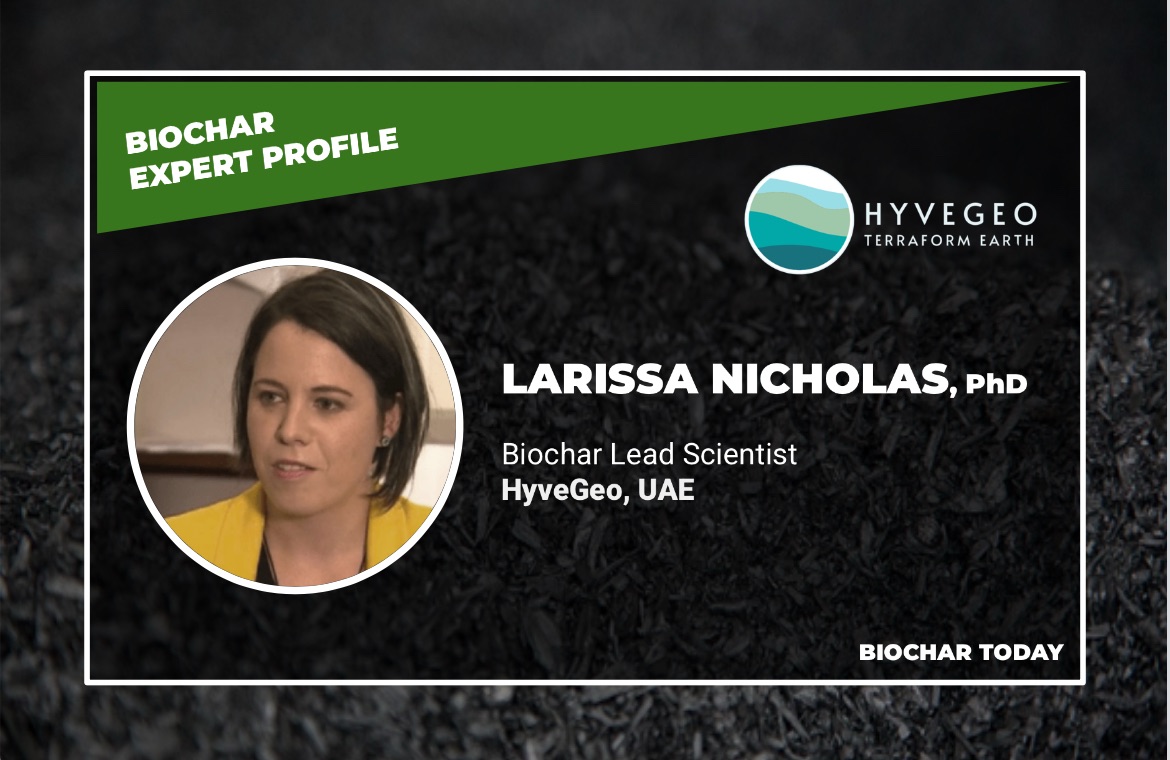
This is the seventh in the series of Biochar Expert Profiles, where we celebrate those who have dedicated their passion, expertise, and innovation to advancing the biocharBiochar is a carbon-rich material created from biomass decomposition in low-oxygen conditions. It has important applications in environmental remediation, soil improvement, agriculture, carbon sequestration, energy storage, and sustainable materials, promoting efficiency and reducing waste in various contexts while addressing climate change challenges. More field. These experts come from all walks of life: renowned scientists whose groundbreaking research has redefined possibilities, emerging researchers whose fresh perspectives are shaping the future, industry leaders who are growing the market through new technologies and business models, and unsung heroes who work tirelessly to enrich soils with biochar. Whether it’s their pioneering techniques, insightful discoveries, or unwavering dedication, these individuals are the heart and soul of the biochar revolution. By highlighting their contributions and sharing their knowledge, this series aims to inspire the biochar community at large.
Dr. Larissa Nicholas is a leading expert in biochar science and currently serves as Lead Scientist at HyveGeo, where she drives the research and development of practical biochar-based solutions. Holding a PhD in Chemistry from Swansea University, UK, she also has a strong foundation in environmental science with a Master’s degree in Climate Change and Environmental Dynamics.
Dr. Nicholas specializes in transforming agricultural waste into high-value biochar products, focusing on real-world applications in soil regeneration, water conservation, and crop improvement, particularly in challenging environments. Her expertise encompasses biochar production optimization, soil-microbe dynamics, and biostimulant integration, all geared toward achieving scalable and sustainable outcomes in the agricultural sector. Dr. Nicholas’s work is driven by a passion for creating tangible impact and advancing biochar’s role in a more sustainable future.
Biochar Today readers will find this conversation to be very insightful, and I’m happy to share it.
Shanthi Prabha: Your PhD journey delved into faecal sludge biochar. What were the most surprising or impactful discoveries you made, and how did they shape your current perspective on biochar’s potential?
Larissa Nicholas: One of the biggest discoveries early on in my biochar journey, was that biochar is not a one-size-fits-all approach. Its effectiveness depends on the feedstockFeedstock refers to the raw organic material used to produce biochar. This can include a wide range of materials, such as wood chips, agricultural residues, and animal manure. More it’s made from and the specific soil it’s applied to. For example, biochar derived from faecal sludge tends to be highly alkaline, which worked really well in the acidic soils I tested in Wales. But it also underscored how critical it is to match biochar properties to soil conditions. Applying the “wrong” biochar could easily do more harm than good.
During COVID lockdown, without access to labs or greenhouses, I shifted my focus to the social acceptance side of faecal sludge biochar. One of the most interesting—and surprising—findings was that older respondents were much more likely to view faecal sludge biochar positively compared to younger age groups. There was also a real “disgust effect” that still exists around using human waste products in agriculture, and it highlighted the importance of communication, education, and public trust. If we want to mainstream sewage or faecal sludge biochar, we have to address the psychological barriers alongside the technical ones.
For biochar to reach its full potential—beyond just sewage or faecal sludge biochar—we need a strong communication strategy. This means prioritizing outreach, building relationships with growers, and engaging communities early on in every biochar project.
SP: What was it like transitioning from academia to leading R&D in a start-up?
LN: Its been incredibly exciting. In academia, you’re often working toward publications, but in a start-up, the focus is on real-world tangible impact. I get to contribute directly to the large-scale production and implementation of biochar products and develop solutions that will regenerate degraded soils and ‘green the desert’ which is pretty awesome.
I would say that start-up life isn’t for everyone—initially it was a steep learning curve as it’s fast-paced, unpredictable, and requires a lot of flexibility. One week you’re shovelling soil and weighing tomatoes the next you’re pitching to potential investors. I love the challenge that comes with innovating, having to problem-solve on the fly, and to design with both science and scalability in mind. These days I look at potential solutions to problems and think “can it be done at scale”, so my mindset has definitely changed.
SP: HyveGeo is tackling the ambitious goal of greening the desert in the UAE. Can you paint us a picture of what that looks like on the ground, and what’s the most exciting or challenging aspect of your team’s role in this arid endeavor?
LN: It is an ambitious goal – over 2 billion hectares of land worldwide are degraded, and climate change is only accelerating the pace of desertification. In the UAE 85% of food is imported and over 70% of freshwater goes to agriculture. This where we come in with biochar-based soil solutions to regenerate arid, degraded soil while also reducing water use and reliance on chemical fertilizers. On the ground, that means testing our engineered biochar in extreme conditions. We’re out there digging trial plots under 42°C sun—it’s hot, dusty, messy, and honestly, the UAE mosquitoes are unfortunately very fond of me. But it’s all worth it the moment that first tomato ripens, and the data starts coming in. That’s when it gets exciting— our biochar blend isn’t just theory—it’s outperforming conventional fertilizer. You can actually see it: plants are bushier, taller, and loaded with more fruit. And then we analyse the results and see real, measurable impacts—like a 147% increase in tomato yield or 42% increase in basil plant height. The numbers validate what we’re observing in the field and makes up for the hot, sweaty days and mosquito bites!
SP: What’s the most surprising difference you’ve encountered applying your biochar expertise in the UAE compared to your experiences in the UK?
LN: The biggest differences are in the soils, climate and feedstock supply. In the UK, soils tend to have a wide range of soil textures and pHpH is a measure of how acidic or alkaline a substance is. A pH of 7 is neutral, while lower pH values indicate acidity and higher values indicate alkalinity. Biochars are normally alkaline and can influence soil pH, often increasing it, which can be beneficial More levels, plus regular rainfall. In the UAE, the soils are sandy, alkaline, and experience almost no rainfall. It’s a completely different starting point. This means biochar needs to be tailored to the environment. Factors like pH, surface area, porosityPorosity of biochar is a key factor in its effectiveness as a soil amendment and its ability to retain water and nutrients. Biochar’s porosity is influenced by feedstock type and pyrolysis temperature, and it plays a crucial role in microbial activity and overall soil health. Biochar More, and pyrolysisPyrolysis is a thermochemical process that converts waste biomass into bio-char, bio-oil, and pyro-gas. It offers significant advantages in waste valorization, turning low-value materials into economically valuable resources. Its versatility allows for tailored products based on operational conditions, presenting itself as a cost-effective and efficient More temperature all play a big role in how effective it is.
Feedstock availability is another key difference. In the UK, you often have access to forestry residues. But in the UAE, woody biomassBiomass is a complex biological organic or non-organic solid product derived from living or recently living organism and available naturally. Various types of wastes such as animal manure, waste paper, sludge and many industrial wastes are also treated as biomass because like natural biomass these More is limited. Instead, we work with what’s local—such as date palm waste, I’d say feedstock choices are more constrained in the UAE but this also pushes us to be more innovative and think outside the box.
SP: What unique challenges do arid and saline environments present for biochar application, and what specific properties are you engineering into your biochar to overcome them?
LN: Arid soils tend to be very low in organic matter, have poor water and nutrient retention, and are often alkaline with varying levels of salinity. Applying the wrong type of biochar in these contexts can worsen the problem. Standard biochar might help one issue such as water holding capacityWater holding capacity is the amount of water that soil can retain. Biochar can significantly increase the water holding capacity of soil, improving its ability to withstand drought conditions and support plant growth. More but then exacerbate another (like raising already-high pH).
We engineer our biochar by selecting feedstocks and pyrolysis temperatures to produce biochar with moderate pH and low ashAsh is the non-combustible inorganic residue that remains after organic matter, like wood or biomass, is completely burned. It consists mainly of minerals and is different from biochar, which is produced through incomplete combustion. Ash Ash is the residue that remains after the complete More content. We need to strike a balance between surface area, porosity, and chemical stability without pushing pH too high. But its not all about biochar, we are looking at synergistic blends. So integrating bioactive compounds which act as biostimulants or natural fertilizersto promote root development, improve nutrient uptake, and increase plant resilience.
SP: How does HyveGeo’s biochar blend with algae and compost work, and what makes it special?
LN: Biochar provides a structural backbone: it improves soil texture, increases water holding capacity, and provides a habitat for soil microorganisms. But biochar alone isn’t enough; regenerating arid and saline soil requires more than one input—it needs synergy. That’s where biostimulants come in which improve root growth and resilience to abiotic stress and compost which provides the much-needed organic matter.
What makes our approach special is how we integrate these components into our tailored synergistic biochar blends, so we are not only focused on increasing yield in the short term but regenerating soil and improving soil health and fertility in the long-term. We want to plant the seeds today so our descendants can sit in the shade tomorrow.
SP: From your experience, what are the hardest parts of scaling biochar—and how can we overcome them?
LN: Scaling biochar is not as easy as it seems. It’s not about making more of it—it’s about making the right kind of biochar in the right location, at the right time, for the right soil type. Feedstock supply is definitely one of the biggest challenges in the UAE. It’s a desert nation, so unlike temperate regions, there aren’t large volumes of forestry waste. But what the UAE does have is date palm waste and other agricultural wastes. We’ve focused on understanding how to best utilize these waste streams for biochar production.
Also it is not enough to focus solely on scaling up biochar production-adoption is just as critical. Without meaningful uptake, we risk ending up with large quantities of biochar sitting around gathering dust. Awareness of the benefits of biochar still remains low, with farmers often skeptical about its cost-effectiveness and impact. To address this, we need targeted communication, farmer education, and strong community engagement. Building trust through local evidence and partnerships is key—without it, even the best biochar won’t reach its full potential.
SP: Can you break down what a “systems-based approach” means in the context of your biochar work and why it’s so effective?
LN: A systems-based approach means seeing every input, output, and byproduct as interconnected. In our biochar work, this aligns perfectly with circular economy principles: designing out waste, keeping resources in use, and regenerating ecosystems.
We start with waste that most people treat as a problem and convert it into stable carbon in the form of biochar. That’s carbon locked away for hundreds of years, while the biochar itself goes back into the soil to improve structure, fertility, and water retention. It’s a waste-to-wealth model that creates a closed-loop system: waste becomes resource, soils get healthier, and carbon stays out of the atmosphere.
And it doesn’t stop with the biochar. The pyrolysis process also generates other co-products such as heat and bio-oil. Heat can be re-used in different ways for example drying feedstocks prior to pyrolysis and bio-oil has potential as a renewable fuel or chemical feedstock. All of this supports the idea of ‘waste to wealth’—extracting the maximum value from every input.
When we work in circular ways, we do more than sustain nature—we begin actively regenerating it. Instead of taking and depleting, we create systems that give back, leaving the land healthier and more abundant than we found it.
SP: There’s growing interest in biochar for carbon removal. How do you see its role in the climate space?
LN: Biochar stands out as one of the few carbon removal solutions that’s both technically ready today and packed with co-benefits—that’s what makes it so valuable. We’re taking waste biomass, locking its carbon into a stable form that persists for centuries or even millennia, while simultaneously regenerating soils. But it’s not simply about carbon storage—it’s about creating cascading value. The ability to harness pyrolysis co-products—like syngasSyngas, or synthesis gas, is a fuel gas mixture consisting primarily of hydrogen and carbon monoxide. It is produced during gasification and can be used as a fuel source or as a feedstock for producing other chemicals and fuels. More and bio-oils—makes the economics far more viable than many other CO₂ removal strategies currently available.
Another key aspect of biochar is its versatility. While agriculture is the natural fit—improving soil health while sequestering carbon—its applications go way beyond farming. It’s already being used for wastewater filtration, as a replacement for carbon-intensive construction materials, and even to enhance asphalt durability. Cutting-edge research is now exploring biochar-derived carbon quantum dots for chemical sensing and bioimaging— we’re still just scratching the surface of what biochar can do.
As someone who lives and breathes biochar, I’ll always be its biggest champion— just ask my friends and family about my biochar obsession! But I’m also realistic : biochar isn’t a silver bullet. We need every carbon removal tool in our arsenal—from direct air capture to enhanced rock weathering to ocean alkalinity enhancement—to solve the challenge of climate change.
For us at HyveGeo, working with arid and saline soils and food insecurity, biochar is the obvious solution. It’s one of the few tools that can address land degradation and climate change at the same time—while also unlocking new innovations across sectors. I think biochar has to be a part of any serious climate strategy.
SP: How important is collaboration in scaling the impact of biochar?
LN: Collaboration is not only important—it’s essential. Biochar sits at the intersection of so many critical issues: agriculture, climate, waste management, water efficiency, and food security. That means no single person,university or company can solve the whole puzzle alone. To truly scale the impact of biochar, we need strong, cross-sector partnerships that bring together researchers, farmers, policymakers, start-ups, and communities.
At HyveGeo, we’ve been incredibly fortunate to work alongside forward-thinking partners who share our vision. Our biochar is currently being trialled in partnership with the Abu Dhabi Food and Agricultural Safety Authority, and Silal, the UAE’s leading agri-tech food company. These trials are critical for validating our product in real-world conditions—showing not just the science, but the outcomes: improved yields, better water retention, and increased plant resilience under extreme heat.
We’re also collaborating with Zayed University in the UAE, as well as the BioHub at Swansea University in the UK. Collaborating with academic institutions is essential for advancing our R&D efforts enabling us to explore how biochar influences soil microbial communities over time and refining our understanding of biochar’s physicochemical properties.
SP: What advice would you give to someone just starting their biochar journey?
LN: Biochar is a very broad field, it’s one of the most multi-disciplinary spaces out there—it intersects with soil science, climate tech, materials, engineering, circular economy, social sciences and more. And it’s not all about agriculture, biochar’s applications range from wastewater filtration to cutting-edge materials. My advice would be: take the time to read, explore different avenues, be curious and don’t be afraid of new ideas—even the crazy ones. I find the crazy ideas are usually the best. Also connect with others working in the space. Don’t be afraid to reach out—most people are pretty friendly and encouraging. Climate change is a massive challenge which is not going to be solved by one person or one discipline, but by all of us from different backgrounds and disciplines working together.
SP: To allow our readers to explore your fascinating work further, could you share a link to your professional profile, research page, or the HyveGeo website where they can learn more about your biochar research and initiatives?
LN: Certainly! You can explore my work further at the HyveGeo website: https://hyvegeo.com/
and find more details on my professional background on my LinkedIn profile: https://www.linkedin.com/in/larissa-nicholas-phd-b6741666/


![Eucalyptus Wood Waste-Derived Biochar Achieves a Ninety-Eight Percent Removal Efficiency for Benzo[ghi]perylene in Vehicle-Wash Wastewater](https://biochartoday.com/wp-content/uploads/2026/10/SCIENCE-BLOGS-2026-2026-10-19T160523.703.jpg)

Leave a Reply