
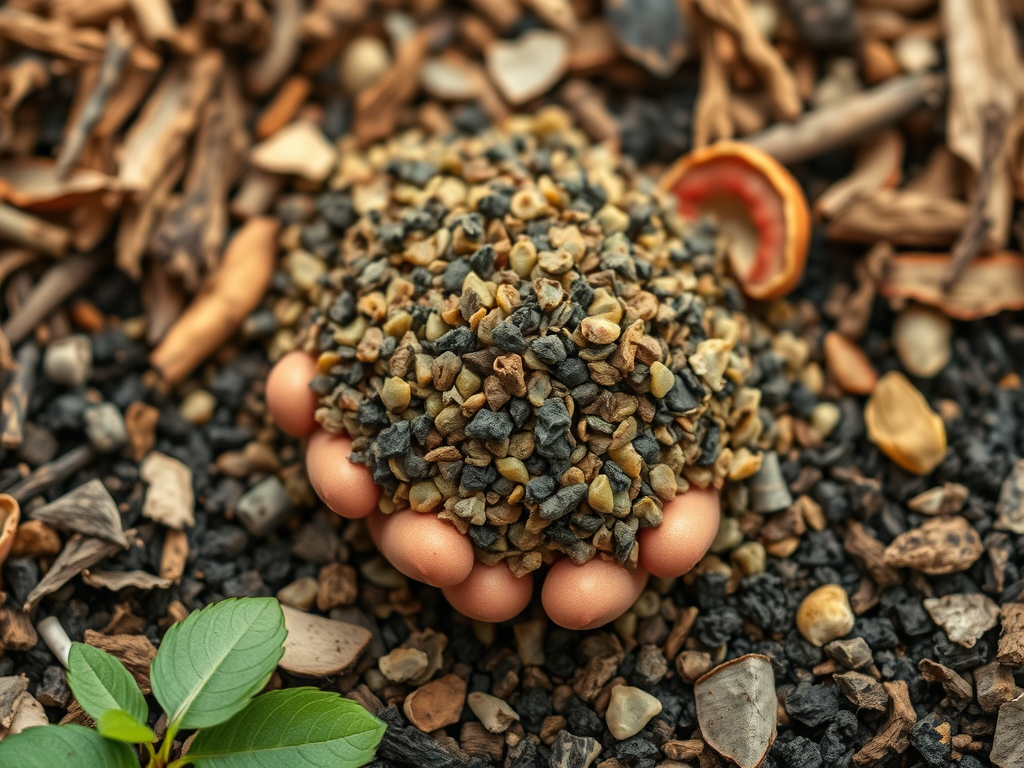
BiocharBiochar is a carbon-rich material created from biomass decomposition in low-oxygen conditions. It has important applications in environmental remediation, soil improvement, agriculture, carbon sequestration, energy storage, and sustainable materials, promoting efficiency and reducing waste in various contexts while addressing climate change challenges. More has already emerged as a tool for environmental sustainability. Several studies and real world experiments highlights the material’s production, properties, modifications, and wide-ranging applications in environmental mitigation. From waste management to climate change, biochar offers a promising and sustainable path forward.
One of biochar’s key advantages is its versatility, which begins with the wide variety of feedstocks that can be used for its production. These include agricultural waste, forest waste, municipal waste, and animal manure, among others. The quality of the final biochar product is heavily influenced by the type of feedstockFeedstock refers to the raw organic material used to produce biochar. This can include a wide range of materials, such as wood chips, agricultural residues, and animal manure. More and the thermal conversion process used. Lignocellulosic biomassBiomass is a complex biological organic or non-organic solid product derived from living or recently living organism and available naturally. Various types of wastes such as animal manure, waste paper, sludge and many industrial wastes are also treated as biomass because like natural biomass these More, such as wood and agricultural waste, is often preferred over non-lignocellulosic biomass like sewage sludge because it has a higher carbon content and fewer contaminants.
Biochar can be produced through several thermochemical processes, including pyrolysisPyrolysis is a thermochemical process that converts waste biomass into bio-char, bio-oil, and pyro-gas. It offers significant advantages in waste valorization, turning low-value materials into economically valuable resources. Its versatility allows for tailored products based on operational conditions, presenting itself as a cost-effective and efficient More, gasificationGasification is a high-temperature, thermochemical process that converts carbon-based materials into a gaseous fuel called syngas and solid by-products. It takes place in an oxygen-deficient environment at temperatures typically above 750°C. Unlike combustion, which fully burns material to produce heat and carbon dioxide (CO2), gasification More, torrefaction, and hydrothermal carbonization (HTC). Pyrolysis, which occurs in the absence or with a limited supply of oxygen, is a particularly promising technique. It can be performed at different speeds—slow, fast, or flash—to control the final product yield. Slow pyrolysis, for instance, operates at lower temperatures (300 to 550°C) and for longer durations, resulting in a higher biochar yield, sometimes as high as 35%. In contrast, fast and flash pyrolysis, which use higher temperatures and shorter residence times, are designed to maximize bio-oil and syngasSyngas, or synthesis gas, is a fuel gas mixture consisting primarily of hydrogen and carbon monoxide. It is produced during gasification and can be used as a fuel source or as a feedstock for producing other chemicals and fuels. More production.
Biochar’s effectiveness in environmental applications is due to its unique physical and chemical properties. Key physical properties include a large specific surface area, particle size, pore size, and pore volume. These properties are crucial for applications like adsorption, where the pores act as binding sites for pollutants. For example, a biochar made from fruit shells using slow pyrolysis at high temperature offer large surface area and a pore volume. The chemical properties are also essential, with factors like pHpH is a measure of how acidic or alkaline a substance is. A pH of 7 is neutral, while lower pH values indicate acidity and higher values indicate alkalinity. Biochars are normally alkaline and can influence soil pH, often increasing it, which can be beneficial More and the presence of functional groups determining its suitability for specific tasks. The O/C ratio is a key indicator of biochar’s stability; a lower ratio (less than 2) can increase its half-life to over 1000 years.
To further enhance these properties, biochar can be modified through physical, chemical, or biological activation. Physical methods like steam/gas treatment, microwaves, and ball milling can increase porosityPorosity of biochar is a key factor in its effectiveness as a soil amendment and its ability to retain water and nutrients. Biochar’s porosity is influenced by feedstock type and pyrolysis temperature, and it plays a crucial role in microbial activity and overall soil health. Biochar More and surface area. Chemical activation uses substances such as acids or alkalis to create micropores and improve removal efficiency.
These engineered properties make biochar a powerful tool for a variety of environmental applications. In soil enrichment, biochar is considered “black gold” as it improves soil fertility by enhancing physical and chemical properties. It increases soil porosity and water-holding capacity, with one study showing a 5 to 25% addition of biochar can increase water holding capacityWater holding capacity is the amount of water that soil can retain. Biochar can significantly increase the water holding capacity of soil, improving its ability to withstand drought conditions and support plant growth. More by 260 to 370%. Biochar also acts as a carbon sink, sequestering stable carbon that would otherwise be released into the atmosphere. For wastewater treatment, its high carbon content, large surface area, and porous structure make it an effective adsorbent for toxic pollutants like heavy metals and dyes.
Biochar’s utility extends to the biofuel and construction industries. In anaerobic digestion, adding biochar can enhance biogas production by 22 to 40% and reduce the lag time for methanogenic bacteria by 28 to 64%. In construction, it can be used as a partial replacement for cement, a process that is highly energy-intensive and responsible for 4-7% of global greenhouse gas emissions. Finally, when added to compost, biochar can significantly reduce greenhouse gas emissions, including a 98% reduction in ammonia gas, an 80% reduction in methane, and a 50% reduction in volatile organic compounds (VOCs).
Despite its numerous benefits, large-scale biochar production faces challenges, including high costs, feedstock inconsistency, and technological barriers. Addressing these issues requires new cost-effective production methods and government incentives to promote market growth. By overcoming these challenges, biochar can pave the way for a more sustainable future by offering a versatile and effective solution for waste management and environmental protection.



Leave a Reply