
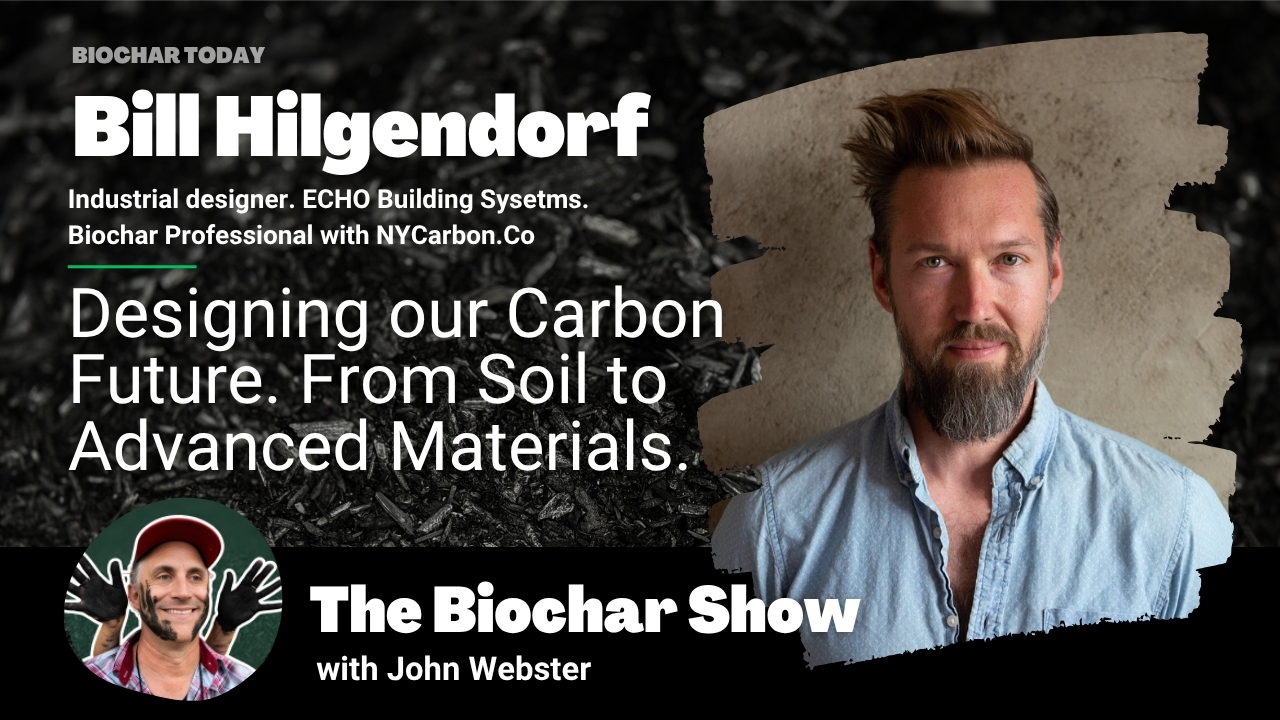
In this episode of The BiocharBiochar is a carbon-rich material created from biomass decomposition in low-oxygen conditions. It has important applications in environmental remediation, soil improvement, agriculture, carbon sequestration, energy storage, and sustainable materials, promoting efficiency and reducing waste in various contexts while addressing climate change challenges. More Show, John Webster speaks with Bill Hilgendorf about his journey from industrial design to climate innovation and discuss how biochar is changing the way we think about waste, carbon, and resource management. Bill explains how principles of product design and circular economy naturally align with biochar production, where agricultural and forestry residues are transformed into a stable carbon material with applications across agriculture, environmental remediation, and the built environment. The conversation explores how biochar contributes to carbon removal, improves soil health, captures contaminants, and creates new opportunities for utilizing biomassBiomass is a complex biological organic or non-organic solid product derived from living or recently living organism and available naturally. Various types of wastes such as animal manure, waste paper, sludge and many industrial wastes are also treated as biomass because like natural biomass these More that would otherwise become an environmental liability. Bill also shares his perspective on scaling biochar adoption and why collaboration between designers, farmers, engineers, researchers, and entrepreneurs will be essential for building a regenerative carbon economy.
Whether you are involved in biochar production, sustainable design, agriculture, carbon markets, or climate policy, this episode provides valuable insights into the growing role of biochar in addressing global environmental challenges.
Listen on Podbean : https://www.podbean.com/media/share/pb-iyjte-1ae7c72?download=1
ABOUT THE GUEST
Bill Hilgendorf (Founder, NYCarbon.CO)is an industrial designer, entrepreneur, and biochar advocate whose work bridges design thinking, circular economy principles, and climate action. Trained in industrial design, Bill has spent much of his career exploring ways to transform discarded materials into products with renewed value and purpose. His interest in material innovation eventually led him to biochar—a technology he describes as the ultimate form of upcycling.
Through NYCarbon.CO, Bill works to advance biochar as a practical climate solution by converting biomass residues into stable carbon through pyrolysisPyrolysis is a thermochemical process that converts waste biomass into bio-char, bio-oil, and pyro-gas. It offers significant advantages in waste valorization, turning low-value materials into economically valuable resources. Its versatility allows for tailored products based on operational conditions, presenting itself as a cost-effective and efficient More. His work emphasizes not only carbon sequestration but also soil restoration, pollutant remediation, and the development of low-carbon building materials. Bill believes that biochar represents one of the most effective pathways for turning waste streams into valuable resources while supporting regenerative agriculture and long-term environmental sustainability.
ABOUT THE HOST
Since 2019, John Webster has run Go Biochar, a leading source for bulk biochar sales & service, biochar technical consulting, field demonstrations, and product development across agriculture, forestry, fuels, and carbon markets. John serves as Director of Development for BiocharOnSite and was formerly the Director of Communications for the US Biochar Initiative. Through these roles, he has helped expand awareness, shape national conversations, and move the industry toward commercial adoption. John brings deep experience and a storyteller’s approach to the program. His mission is to connect the dots between local practices and global carbon goals. For him, biochar is more than a product. It’s a key to rebuilding resilient soils, slashing emissions, and creating circular economies. Nature pulls carbon from the sky. Biochar helps us keep it in the ground!
SUBSCRIBE TO THE BIOCHAR SHOW
Join us as Bill Hilgendorf shares how design, innovation, and biochar can work together to transform waste into one of the world’s most promising climate solutions.


Leave a Reply