
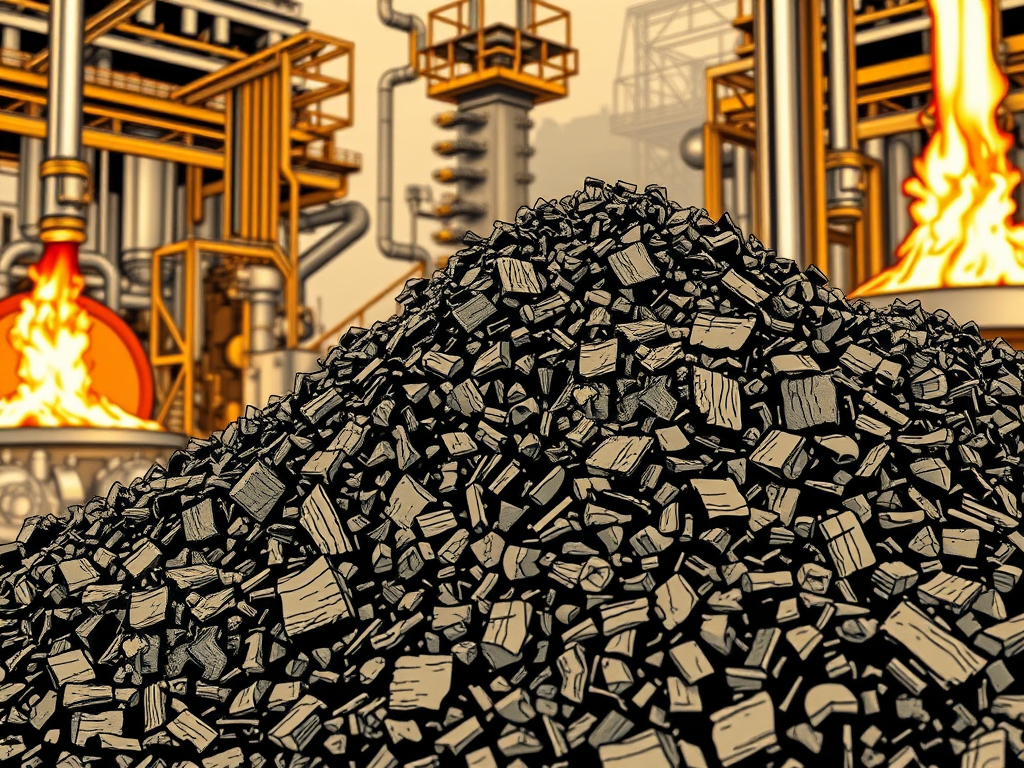
The steel industry, a major contributor to global carbon dioxide (CO2) emissions, is actively seeking sustainable alternatives to fossil fuels like coal and coke. One promising option is biocharBiochar is a carbon-rich material created from biomass decomposition in low-oxygen conditions. It has important applications in environmental remediation, soil improvement, agriculture, carbon sequestration, energy storage, and sustainable materials, promoting efficiency and reducing waste in various contexts while addressing climate change challenges. More, a carbon-rich material produced from biomassBiomass is a complex biological organic or non-organic solid product derived from living or recently living organism and available naturally. Various types of wastes such as animal manure, waste paper, sludge and many industrial wastes are also treated as biomass because like natural biomass these More through pyrolysisPyrolysis is a thermochemical process that converts waste biomass into bio-char, bio-oil, and pyro-gas. It offers significant advantages in waste valorization, turning low-value materials into economically valuable resources. Its versatility allows for tailored products based on operational conditions, presenting itself as a cost-effective and efficient More. However, the quality of biochar, and thus its suitability for demanding applications like steelmaking, depends heavily on the type of feedstockFeedstock refers to the raw organic material used to produce biochar. This can include a wide range of materials, such as wood chips, agricultural residues, and animal manure. More and the specific pyrolysis conditionsThe conditions under which pyrolysis takes place, such as temperature, heating rate, and residence time, can significantly affect the properties of the biochar produced. More. In a recent conference paper, Rafiandy Dwi Putra and team investigated the optimization of biochar production from waste wood and green cuttings for potential use in steelmaking processes.
The researchers employed a Design of Experiments (DoE) approach to analyze how key pyrolysis parameters—temperature, heating rate, and residence time—influence critical biochar properties such as fixed carbon content, ashAsh is the non-combustible inorganic residue that remains after organic matter, like wood or biomass, is completely burned. It consists mainly of minerals and is different from biochar, which is produced through incomplete combustion. Ash Ash is the residue that remains after the complete More content, and initial oxidation temperature. These properties are crucial for steelmaking, where high fixed carbon is needed to dissolve into molten steel rather than burning off, and low ash content helps minimize slag formation in the electric arc furnace (EAF).
The study revealed that the type of precursor material and the pyrolysis temperature are the most significant factors influencing biochar quality. Biochar derived from waste wood consistently demonstrated superior properties. For instance, the fixed carbon content of biochars from waste wood ranged from 84.5 wt.%-db to an impressive 94.5 wt.%-db, with the highest content achieved at 800°C, 10 K/min heating rate, and 1 hour residence timeResidence time refers to the duration that the biomass is heated during the pyrolysis process. The residence time can influence the properties of the biochar produced. More. In contrast, biochars from green cuttings had fixed carbon contents ranging from 78.7 wt.%-db to 84.4 wt.%-db. This higher fixed carbon in waste wood biochar is attributed to its structural composition, which contains more lignin and less ash-forming mineral matter.
Ash content is another critical factor, as high ash content negatively impacts steelmaking by increasing slag formation. Green cuttings biochars exhibited significantly higher ash content, reaching up to 10.3 wt.%-db, while waste wood biochars had much lower ash content, ranging from 3.0 wt.%-db to 3.7 wt.%-db. This stark difference highlights the substantial impact of the precursor on the final ash content of the biochar.
The initial oxidation temperature, which indicates oxidative durability and high-temperature suitability, also favored waste wood biochars. They consistently showed higher initial oxidation temperatures, peaking at 453.7°C, whereas green cuttings biochars ranged between 359.7°C and 408.9°C. The optimal pyrolysis conditions suggested by the Design-Expert software were 800°C, 8 K/min, and 4 hours for waste wood, yielding a high desirability of 0.97. For green cuttings, the optimal conditions were 700°C, 14 K/min, and 3 hours, but with a much lower desirability of 0.21.
When comparing the optimal waste wood biochar properties to commercial coke used in EAFs, the results are promising. Waste wood biochar achieved a fixed carbon content of 94.5 wt.%-db, higher than coke’s 88.9 wt.%-db, and a lower ash content of 3.72 wt.%-db compared to coke’s 10.24 wt.%-db. However, a challenge remains: waste wood biochar exhibits higher oxidation reactivity (lower initial oxidation temperature of 454°C compared to coke’s 502°C). This higher reactivity is likely due to the catalytic effect of mineral components like alkali and alkaline earth metals in the ash.
This research underscores that while biochar offers a viable pathway to decarbonize steelmaking, optimizing its production based on feedstock type and pyrolysis conditions is crucial. Future work will focus on validating the optimization model and further characterizing the biochar’s reactivity in a CO2 atmosphere, which simulates the reduction reaction environment in steelmaking.
Source: Putra, R. D., Schedl, A., & Mutlu, Ö. (2025, June). OPTIMISATION OF BIOCHAR PRODUCTION PROCESS USING DESIGN OF EXPERIMENT FOR THE UTILISATION IN STEELMAKING. Conference Paper.



Leave a Reply