
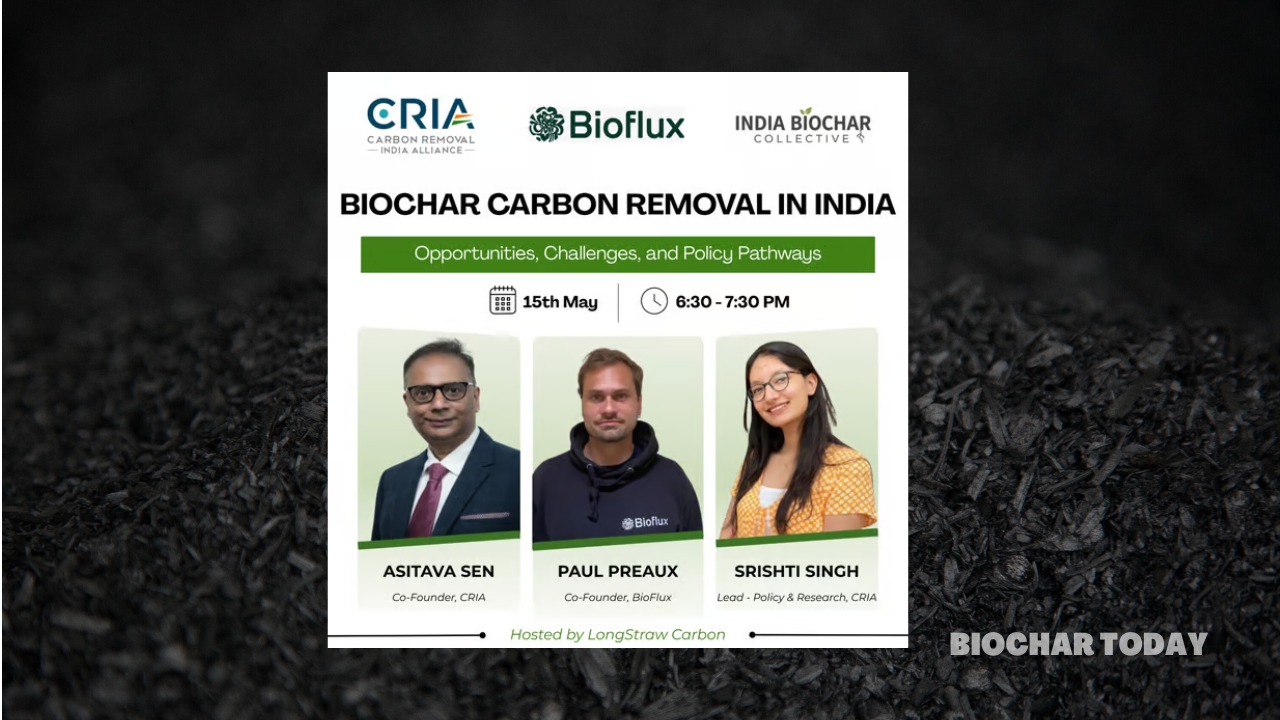
The India BiocharBiochar is a carbon-rich material created from biomass decomposition in low-oxygen conditions. It has important applications in environmental remediation, soil improvement, agriculture, carbon sequestration, energy storage, and sustainable materials, promoting efficiency and reducing waste in various contexts while addressing climate change challenges. More Collective(IBC), in collaboration with the Carbon Removal India Alliance(CRIA) and BioFlux EU, has announced a specialized webinar focused on the strategic role of biochar within India’s evolving carbon removal landscape. Scheduled for May 15, the event will feature prominent industry experts including Asitava Sen and Srishti Singh from CRIA, and Paul Préaux from BioFlux EU. The session is designed to explore the intersection of climate opportunities and market potential, specifically addressing how biochar technology can be integrated into the national strategy for environmental sustainability and carbon sequestration.
The primary challenge addressed by this initiative is the current fragmentation of the biochar sector in India and the lack of a clear, scalable policy framework. While India possesses vast quantities of agricultural residue, much of it is managed through inefficient practices like open-field burning, which contributes to severe air pollution and lost economic value. The industry currently faces hurdles in navigating the complexities of the voluntary carbon market and establishing standardized protocols that would attract significant investment and allow small-to-medium scale developers to reach industrial capacity.
The proposed solution involves a multi-stakeholder dialogue to align technological development with robust policy pathways and market mechanisms. By bringing together researchers, investors, and project developers, the IBC aims to define the necessary regulatory structures that could unlock large-scale biochar production. The focus is on leveraging the voluntary carbon market (VCM) to provide the financial incentives required to convert biomassBiomass is a complex biological organic or non-organic solid product derived from living or recently living organism and available naturally. Various types of wastes such as animal manure, waste paper, sludge and many industrial wastes are also treated as biomass because like natural biomass these More waste into stable carbon. This collaborative approach seeks to bridge the gap between European market standards—represented by BioFlux EU—and the specific logistical and agricultural realities of the Indian subcontinent.
The anticipated outcomes of this event include a more informed community of practitioners capable of accelerating carbon removal projects across the country. By clarifying policy requirements and market dynamics, the federation expects to catalyze increased investment in biochar infrastructure, leading to enhanced soil health and measurable atmospheric carbon reduction. Furthermore, the collaboration establishes a foundation for India to become a major contributor to the global biochar market, transforming agricultural waste management from an environmental liability into a verified carbon removal asset.



Leave a Reply