
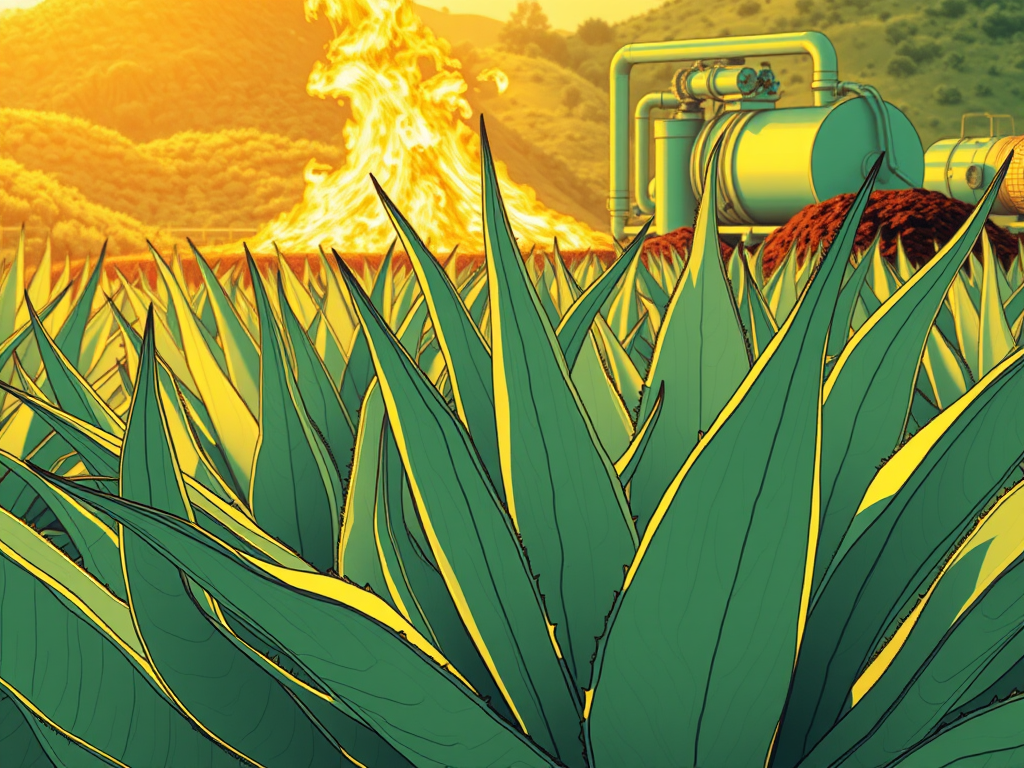
In a recent article published in BiomassBiomass is a complex biological organic or non-organic solid product derived from living or recently living organism and available naturally. Various types of wastes such as animal manure, waste paper, sludge and many industrial wastes are also treated as biomass because like natural biomass these More Conversion and Biorefinery, researchers Habila Yusuf Thomas, José Demétrio Nery Cavalcante, Carlos Eduardo de Araújo Padilha, Everaldo Silvino dos Santos, Fabiano Perin Gasparin, Lúcia Allebrandt da Silva Ries, Aldo Torres Sales, Rômulo Simões Cezar Menezes, and Emmanuel Damilano Dutra explored a compelling solution for agricultural waste: converting lignocellulosic agave residues into biocharBiochar is a carbon-rich material created from biomass decomposition in low-oxygen conditions. It has important applications in environmental remediation, soil improvement, agriculture, carbon sequestration, energy storage, and sustainable materials, promoting efficiency and reducing waste in various contexts while addressing climate change challenges. More for water purification. Their work focuses on turning an underutilized byproduct of sisal fiber production into a valuable adsorbent for methylene blue dye removal. This approach tackles environmental concerns associated with improper waste disposal and creates an additional revenue stream from agave cultivation.
Agave, particularly Agave sisalana, is an economically significant plant known for its fibers, with Brazil being a major global producer. However, the process of extracting these fibers generates a substantial amount of residue, accounting for 80-90% of the plant’s biomass. This residue, often disposed of improperly, poses environmental challenges. The researchers investigated slow pyrolysisPyrolysis is a thermochemical process that converts waste biomass into bio-char, bio-oil, and pyro-gas. It offers significant advantages in waste valorization, turning low-value materials into economically valuable resources. Its versatility allows for tailored products based on operational conditions, presenting itself as a cost-effective and efficient More as a method to convert this waste into biochar, a carbon-rich material known for its adsorbent properties.
The study utilized three hybrid agave varieties: Hybrid Itaporanga, Hybrid Bahia, and Mutant-1. Initial analyses showed that while lignin and ashAsh is the non-combustible inorganic residue that remains after organic matter, like wood or biomass, is completely burned. It consists mainly of minerals and is different from biochar, which is produced through incomplete combustion. Ash Ash is the residue that remains after the complete More content were similar across varieties (12.1-13.2% and 10.3-13.9% respectively), there were notable differences in holocellulose (31.4-42.4%) and extractives (23.2-33.4%). Interestingly, despite these compositional differences, the thermal degradation profiles and surface functional groups of the resulting biochars were quite similar across the agave varieties.
A key finding concerned the effect of pyrolysis temperature on biochar properties and performance. Increasing the pyrolysis temperature from 400∘C to 800∘C led to higher biochar yields and significantly increased surface area, with the Hybrid Itaporanga biochar showing a more than 14-fold increase in surface area when produced at 800∘C compared to 400∘C. Micropore volume also increased substantially with higher temperatures. This might seem counterintuitive for dye adsorption, as lower temperatures generally preserve more oxygen-containing functional groups crucial for electrostatic interactions with cationic dyes like methylene blue. Indeed, the study confirmed that despite the larger surface area, the biochars produced at 600∘C had a reduced capacity for methylene blue adsorption compared to those made at 400∘C.
The Hybrid Itaporanga biochar produced at 400∘C emerged as the most effective adsorbent. In static (batch) adsorption experiments, it achieved an adsorption capacity of 80 mg/g, while in dynamic (fixed-bed column) experiments, it demonstrated an impressive capacity of 180 mg/g. The adsorption kinetics were best described by the pseudo-second-order model, suggesting that chemisorption is the rate-limiting step. Furthermore, the biochar showed good reusability, maintaining high removal efficiency (95% after four cycles) when regenerated with an acidic solution.
This research highlights the potential of thermochemical valorization of agave residues, transforming an agricultural waste product into a cost-effective and environmentally friendly adsorbent for removing textile dyes from contaminated water. The findings suggest that optimizing pyrolysis conditionsThe conditions under which pyrolysis takes place, such as temperature, heating rate, and residence time, can significantly affect the properties of the biochar produced. More, specifically maintaining a lower temperature around 400∘C, is crucial for preserving the active functional groups necessary for efficient dye adsorption.
Source: Thomas, H. Y., Cavalcante, J. D. N., Padilha, C. E. D. A., dos Santos, E. S., Gasparin, F. P., da Silva Ries, L. A., Sales, A. T., Menezes, R. S. C., & Dutra, E. D. (2025). Valorization of lignocellulosic agave residues via pyrolysis and its use as adsorbent for methylene blue removal. Biomass Conversion and Biorefinery.


Leave a Reply