
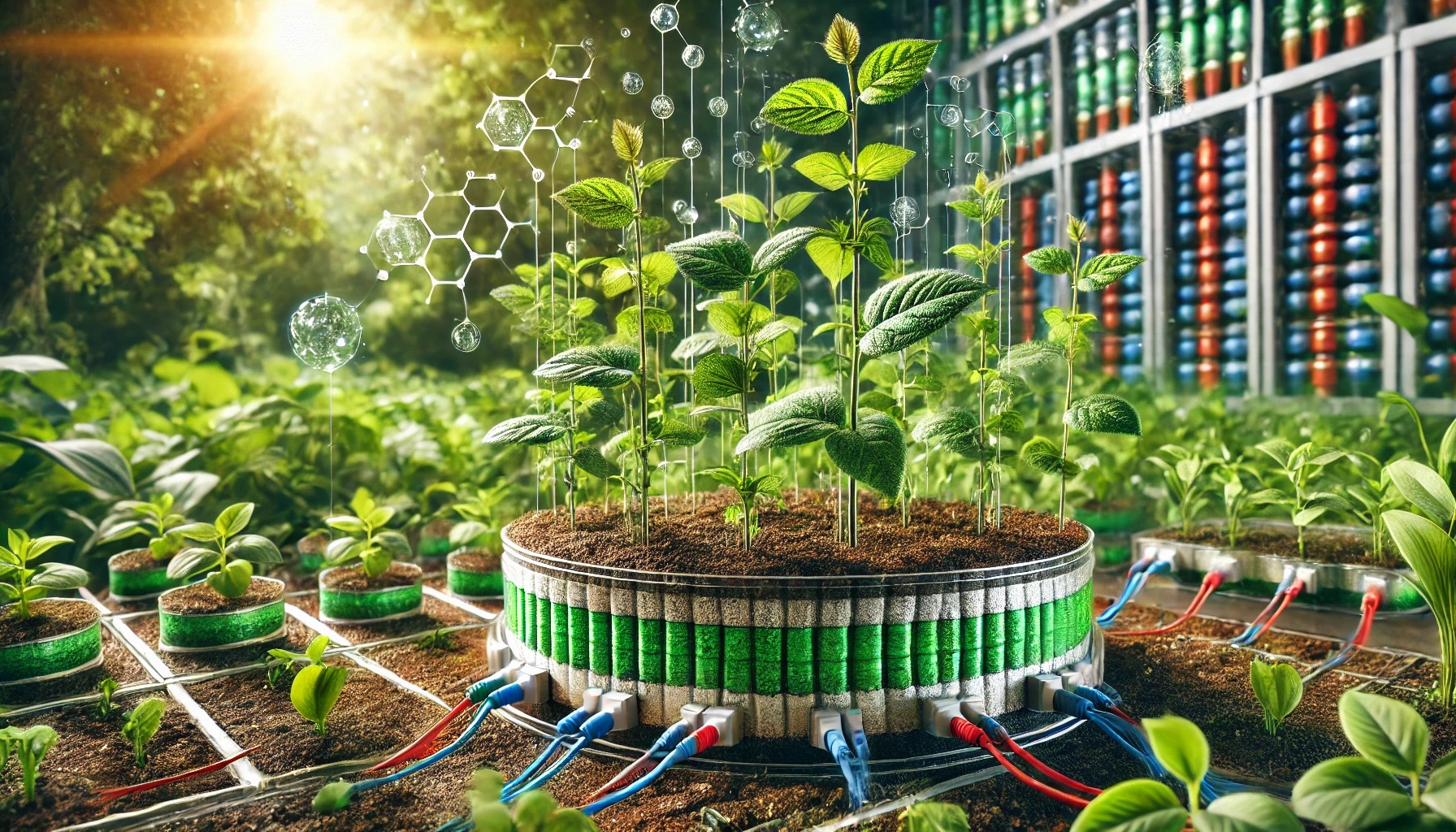
Recent research explores the potential of integrating biocharBiochar is a carbon-rich material created from biomass decomposition in low-oxygen conditions. It has important applications in environmental remediation, soil improvement, agriculture, carbon sequestration, energy storage, and sustainable materials, promoting efficiency and reducing waste in various contexts while addressing climate change challenges. More into plant microbial fuel cells (PMFCs) to address environmental and energy challenges. Biochar, a carbon-rich material derived from organic matter through pyrolysisPyrolysis is a thermochemical process that converts waste biomass into bio-char, bio-oil, and pyro-gas. It offers significant advantages in waste valorization, turning low-value materials into economically valuable resources. Its versatility allows for tailored products based on operational conditions, presenting itself as a cost-effective and efficient More, has garnered attention for its carbon-neutrality and ability to enhance soil properties. By combining biochar with PMFCs, scientists aim to boost soil water retention, improve soil health, and generate bioelectricity, presenting a promising approach to sustainability.
Understanding the System
PMFCs use plants and associated microbial activity to produce bioelectricity. Microbes in the soil break down organic matter, releasing electrons captured by electrodes in the PMFC setup. Biochar, known for its porous structure and high cation exchange capacity, can further optimize this process. It improves soil water retention, enhances microbial activity, and supports sustainable electricity production, particularly in unsaturated soils where water and air coexist in the soil pores.
Key Findings
The study evaluated the impact of biochar amendments on granular soil’s suction properties and bioelectricity generation. Suction, a critical factor in unsaturated soil mechanics, influences water movement, microbial activity, and electrochemical reactions within the PMFCs. The experiment involved varying biochar concentrations (0%, 5%, and 10% by soil mass) and measured the effects on soil water content, bulk density, electric current, and voltage.
Results showed that biochar significantly enhanced the PMFC performance. For instance:
- Electrical Output: Biochar-amended PMFCs produced up to 30 times more electricity under unsaturated conditions compared to non-amended systems.
- Soil Properties: Biochar improved water retention and reduced soil shrinkage, crucial for maintaining soil health in drought-prone environments.
Machine Learning Insights
The researchers also employed machine learning (ML) to model and predict soil suction behavior under different conditions. Eight ML techniques, including Gradient Boosting (GB), Support Vector Machine (SVM), and Random Forest (RF), were used to analyze the relationships between soil parameters and PMFC performance. GB and SVM models demonstrated the highest accuracy, achieving over 97% predictive success. This technological integration provides a cost-effective tool for understanding and optimizing PMFC systems.
Practical Applications
The findings highlight several potential applications:
- Agriculture: Biochar-enhanced PMFCs could improve soil health, water retention, and crop resilience, particularly in regions facing water scarcity.
- Energy: The bioelectricity generated can power low-energy devices, offering a sustainable alternative in rural or off-grid areas.
- Environmental Restoration: The combination of biochar and PMFCs supports soil reclamation and combats degradation caused by salinity or shrinkage.
Future Directions
While promising, further research is needed to optimize biochar production methods, determine ideal amendment ratios, and explore long-term effects on soil ecosystems. Advances in ML can enhance the predictive capabilities of PMFC systems, enabling tailored solutions for specific environments.
In conclusion, integrating biochar into PMFCs represents an innovative step toward sustainable energy and environmental stewardship. By leveraging natural processes and cutting-edge technology, this approach holds potential to address pressing global challenges.
SOURCE: Onyelowe, K.C., Ebid, A.M., Ramos Jiménez , R.B. et al. Modeling suction of unsaturated granular soil treated with biochar in plant microbial fuel cell bioelectricity system. Sci Rep15, 1439 (2025). https://doi.org/10.1038/s41598-025-85701-z





Leave a Reply