
Key Takeaways
- Massive Performance Boost: Modifying basic biocharBiochar is a carbon-rich material created from biomass decomposition in low-oxygen conditions. It has important applications in environmental remediation, soil improvement, agriculture, carbon sequestration, energy storage, and sustainable materials, promoting efficiency and reducing waste in various contexts while addressing climate change challenges. More (made from agricultural waste) with potassium permanganate (KMnO4) increases its capacity to capture ammonia pollution by 400%.
- A Simple, Effective Solution for Pollution: The modified biochar can capture up to 68 mg of ammonia per gram of material, making it an effective, sustainable tool to prevent excess nitrogen fertilizer from washing into groundwater.
- Structure is More Important Than Surface: The study found that maximizing the porous structure (creating deeper, richer pores) is a far more effective way to capture ammonia than simply adding chemical groups to the biochar’s surface.
- Waste to Resource: The starting material is biogas residue (a common agricultural waste), confirming that industrial waste streams can be efficiently converted into high-value environmental cleanup materials.
The problem of excess nitrogen runoff, a major driver of agricultural non-point source pollution, demands highly effective, sustainable solutions. Raw biochar, derived from organic waste like biogas residue, has long been recognized for its potential as a natural adsorbent. However, its limited adsorption capacity, often only 3−7 mg g−1, restricts its widespread application, leaving farmland at risk of nitrogen migration into groundwater. A recent study published in Biochar by Cong et al. (2025) presents a breakthrough: modifying biogas residue biochar with common chemical agents significantly enhances its ability to capture ammonium nitrogen (NH4+-N), with potassium permanganate (KMnO4) increasing the maximum adsorption capacity by nearly 400%.
The researchers systematically tested three different chemical modifications—hydrogen peroxide (H2O2), sodium hydroxide (NaOH), and potassium permanganate (KMnO4)—on biogas residue biochar (RB). Their goal was to identify which modification method best increased the biochar’s capacity and to understand the underlying mechanism for each treatment. At the highest test concentration of 150 mg L−1 of NH4+-N, all three modified biochars (MB) showed superior performance compared to the raw biochar. Specifically, RB-H2O2, RB-NaOH, and RB-KMnO4 demonstrated adsorption increases of 3.0, 3.2, and 4.0 times that of the raw material, respectively.
The most compelling finding relates to the maximum theoretical adsorption capacity predicted by the Langmuir isotherm model. While raw biochar’s capacity was 9.08 mg g−1 , the capacities for the modified versions rose dramatically. RB-H2O2 reached 13.93 mg g−1, RB-NaOH hit 41.00 mg g−1, and RB-KMnO4 achieved an exceptional maximum capacity of 68.15 mg g−1. This fourfold increase confirms that KMnO4 modification is the most effective strategy for boosting NH4+-N adsorption.
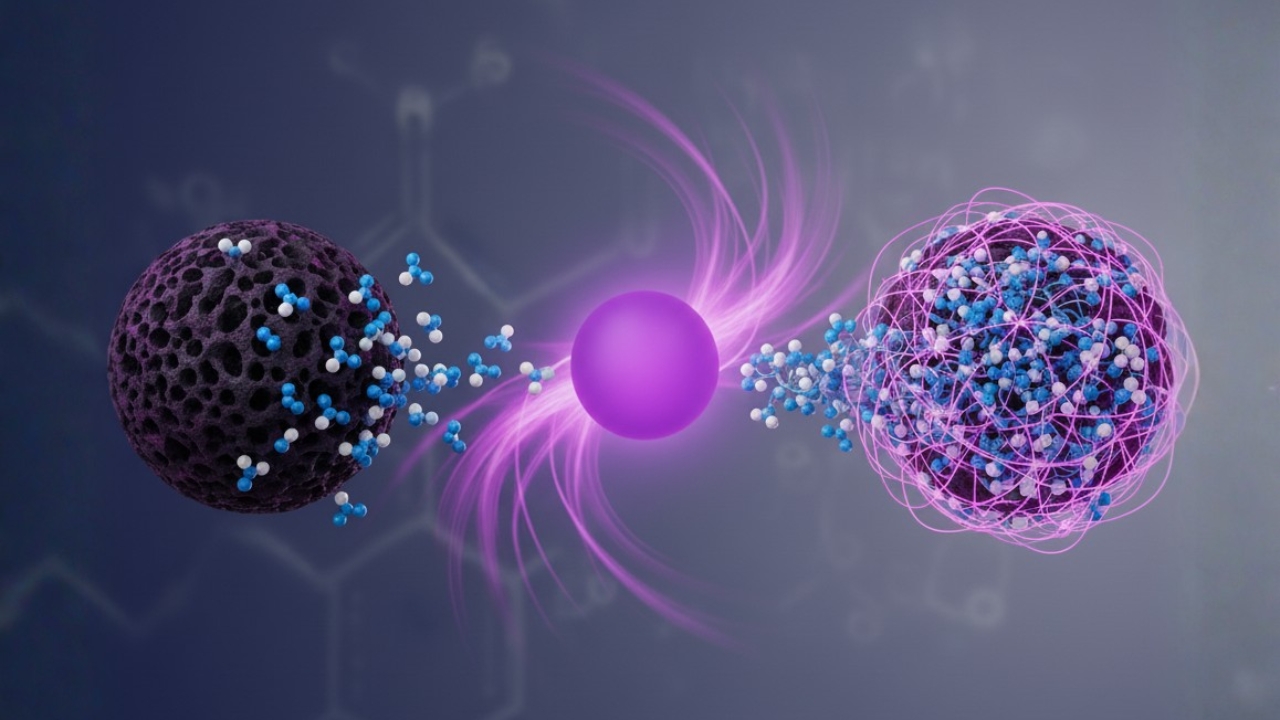
The study successfully elucidated the distinct mechanisms driving this enhanced performance, confirming that not all modifications work the same way. RB-KMnO4 achieved its superior efficiency primarily through pore-based adsorption. The KMnO4 treatment significantly enhanced the specific surface area and pore volume of the biochar, creating richer, deeper pores that strongly immobilize a large amount of NH4+-N. The researchers highlighted that this pore structure optimization plays a critical role in boosting ammonium adsorption capacity.
In contrast, the enhanced adsorption observed in RB-H2O2 and RB-NaOH was attributed mainly to functional group-based adsorption. These strong chemical treatments substantially increased the concentration of surface functional groups, particularly −C−O groups, which increase the negative charge density on the biochar surface. This negative charge enhances the electrostatic attraction to the positively charged NH4+ cation. RB-NaOH also slightly introduced Fe−O functional groups. However, the results show that for NH4+-N, pore-based adsorption (RB-KMnO4) is more advantageous than surface functional group adsorption (RB-NaOH and RB-H2O2).
Overall, the adsorption process for the modified biochars was found to be a multifaceted mechanism involving liquid membrane diffusion, surface adsorption, and intra-particle diffusion. The study’s kinetic analysis, best described by the intra-particle diffusion model, showed that the rich, deep pores of RB-KMnO4 facilitated a higher intra-particle diffusion rate.
These findings confirm that chemical modification is a highly effective, necessary step for transforming raw biogas residue biochar into an industrial-grade adsorbent capable of mitigating non-point source nitrogen pollution. By optimizing the pore structure with KMnO4, scientists have unlocked biochar’s true potential, providing a vital tool for environmental safety, soil health, and the development of green, low-carbon agriculture.
Source: Cong, P., Song, S., Zhu, Y., Ji, X., Liu, S., Kuang, S., Xu, Y., Hou, Q., Zheng, X., & Song, W. (2025). Improved adsorption capacity of ammonium from aqueous solution by modified biogas residue biochar. Biochar, 7(97).


![Eucalyptus Wood Waste-Derived Biochar Achieves a Ninety-Eight Percent Removal Efficiency for Benzo[ghi]perylene in Vehicle-Wash Wastewater](https://biochartoday.com/wp-content/uploads/2026/10/SCIENCE-BLOGS-2026-2026-10-19T160523.703.jpg)


Leave a Reply