
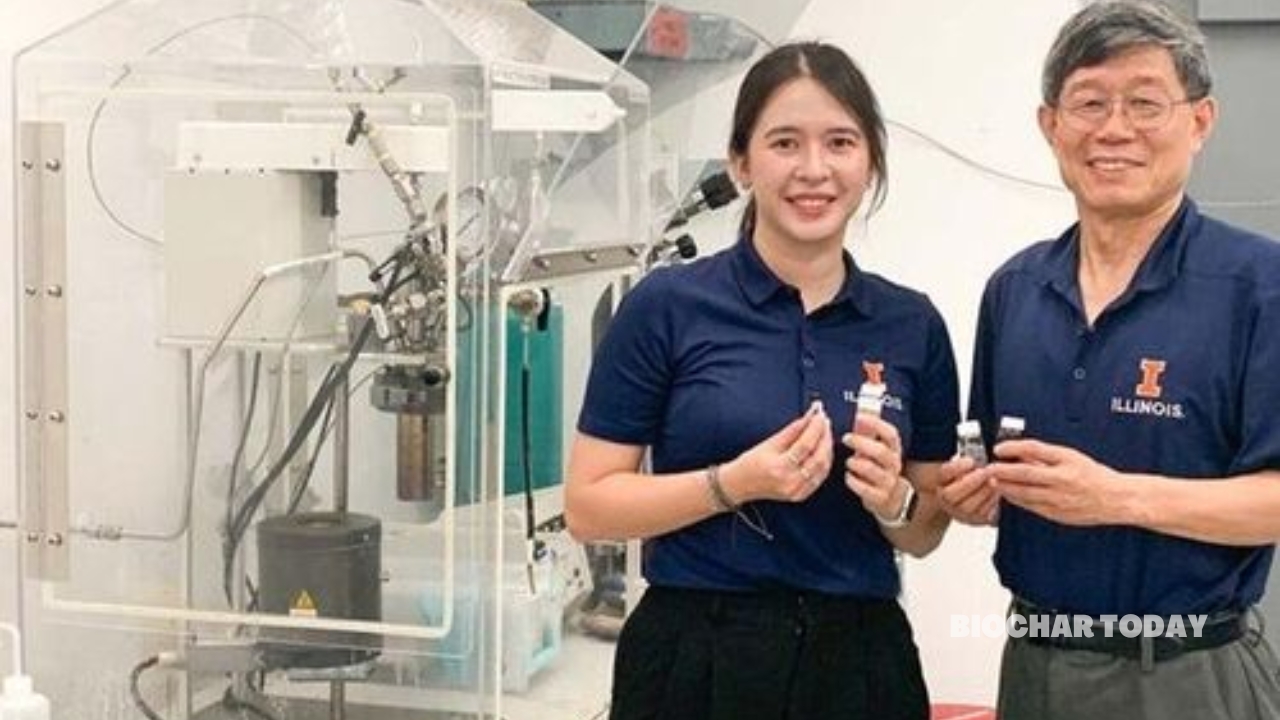
A research team at the University of Illinois Urbana-Champaign in the United States has published a study in Nature Sustainability outlining a pathway to convert food waste into sustainable aviation fuel (SAF). Using hydrothermal liquefaction (HTL), the researchers successfully transformed food waste feedstockFeedstock refers to the raw organic material used to produce biochar. This can include a wide range of materials, such as wood chips, agricultural residues, and animal manure. More into crude oil, which was subsequently refined with a catalyst and distilled into jet-grade fuel. The study utilized techno-economic and lifecycle analyses to validate a 50-50 fuel blend that complies with international aviation standards. This research marks an analytical advancement toward integrating municipal organic streams into a circular bioeconomy.
The primary obstacle addressed by the university researchers concerns the logistical and structural bottlenecks inherent to waste reclamation and processing. Most municipal food waste is currently diverted to landfills or standard wastewater treatment facilities where it degrades into sludge, presenting immense supply chain constraints for SAF recovery. Furthermore, while the HTL process effectively handles wet organic feedstocks, it yields a highly toxic, nutrient-rich byproduct known as hydrothermal liquefaction aqueous phase (HTL-AP). Managing this wastewater byproduct without escalating operational expenses or causing secondary environmental degradation has historically hindered the scaling of such biorefinery models.
To overcome these constraints, the researchers developed a streamlined refining approach prioritizing distillation over high catalytic intensity, reducing both production costs and environmental impacts. To address the toxic wastewater byproduct, the team explored electrochemical (EC) treatment technologies to recover valuable acids and nutrients directly from the HTL-AP. The investigation analyzed three distinct processing scenarios: a standard baseline model routing HTL-AP to traditional wastewater facilities, an integrated setup incorporating EC technology for nutrient valorization, and a projected future configuration utilizing advanced, cost-optimized electrochemical systems.
The evaluation indicates that incorporating current electrochemical treatment methods increases per-gallon production costs nearly threefold compared to baseline configurations due to elevated capital expenditures. However, projected technological iterations are expected to normalize these operating costs over time. Significantly, both the baseline and the advanced electrochemical recovery scenarios achieved negative carbon emissions during lifecycle testing. This confirms that integrating municipal food waste conversion with specialized wastewater processing yields a lower global warming potential, establishing a scalable mechanism for the aviation sector to mitigate greenhouse gas emissions.



Leave a Reply