
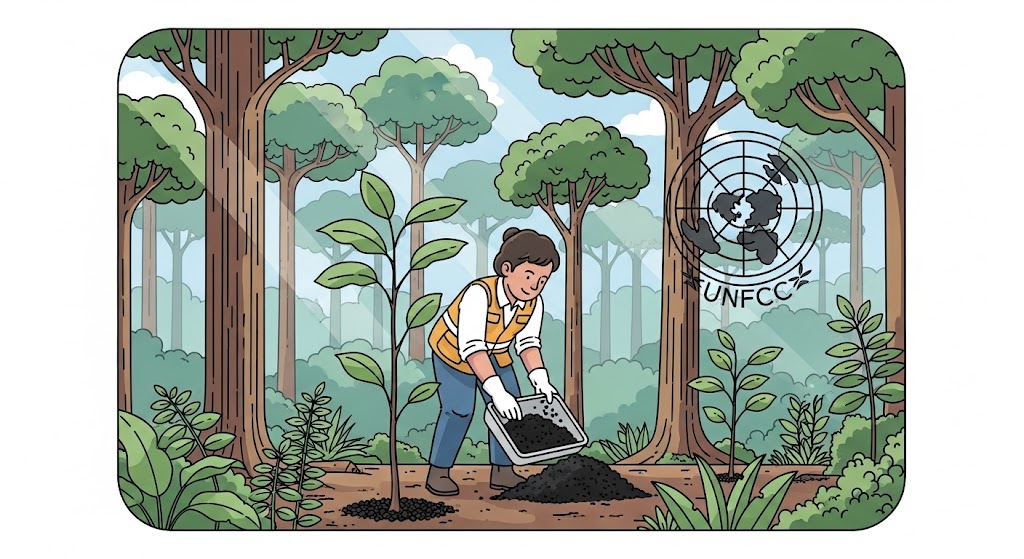
A recent report by the UNFCCC has provided a technical assessment of Colombia’s 2024 submission for its proposed Forest Reference Emission Level (FREL). The FREL serves as a baseline for measuring a country’s performance in reducing emissions from deforestation and forest degradation, a crucial part of the REDD+ (Reducing Emissions from Deforestation and Forest Degradation) framework. This framework is vital for countries seeking results-based payments for their climate mitigation efforts. The UNFCCC recommending improved forest management for carbon stocks likely indicates a redirection of focus for policy and investment, which – considering its growing role in removing carbon – opens an opportunity for biocharBiochar is a carbon-rich material created from biomass decomposition in low-oxygen conditions. It has important applications in environmental remediation, soil improvement, agriculture, carbon sequestration, energy storage, and sustainable materials, promoting efficiency and reducing waste in various contexts while addressing climate change challenges. More projects.
Colombia’s submission, which covers the period from 2013-2022, was a significant step toward demonstrating its commitment to forest conservation and sustainable land management. The initial FREL proposed specific emission levels in tonnes of carbon dioxide equivalent (tCO2eq) for the years 2023 through 2027.
Following a thorough technical assessment, the UNFCCC assessment team found that Colombia’s data and information were mostly transparent and complete, and in overall accordance with international guidelines. As a result of the facilitative process during the technical assessment, the UNFCCC officially recommended a modified FREL. This adjustment changed the baseline emissions for the period of 2023 to 2027, reflecting the collaborative and scientifically rigorous nature of the review process. The new recommended FREL values will now be used for the country to measure its progress and receive results-based payments.
The report also identified a few areas for future technical improvement, underscoring the “step-wise” approach encouraged by the UNFCCC, where countries can continuously enhance their FRELs by incorporating better data and methodologies over time. This successful assessment is a positive development for Colombia’s efforts to protect its forests and secure international funding to support these critical climate actions, which could include biochar as a soil-enhancing and carbon-sequestering tool. This would be in keeping with their Colombia’s recent strategic investment into coffee regions for improved scientific research in 5 different Universities. The total investment is worth $98 billion pesos, and biochar has been identified as a strategic priority, so watch this space.



Leave a Reply