
Key Takeaways
- Green” fuels are expensive: Making e-fuels for planes and ships is a promising way to fight climate change, but the high cost of the main ingredient, renewable hydrogen, makes them hard to scale.
- The standard process wastes hydrogen: The typical method uses expensive hydrogen twice: first to turn CO2 into an intermediate (CO), and then again to turn that intermediate into fuel.
- BiocharBiochar is a carbon-rich material created from biomass decomposition in low-oxygen conditions. It has important applications in environmental remediation, soil improvement, agriculture, carbon sequestration, energy storage, and sustainable materials, promoting efficiency and reducing waste in various contexts while addressing climate change challenges. More offers a clever shortcut: The new study proposes using biochar (a solid carbon) to turn CO2 into the intermediate. This skips the first hydrogen-wasting step, saving large amounts of the costly gas.
- This shortcut cuts costs and emissions: In the best-case scenario, this biochar method cut the total production cost by 10% and the carbon footprint by 11%.
- It’s a “win-win-win”: The new process also reduced damage to human health (by 17%), ecosystems (by 10%), and resource scarcity (by 13%), proving it’s possible to make a process both cheaper and cleaner.
To decarbonize long-distance transportation, such as aviation and shipping, many are turning to electrofuels, also known as “e-fuels.” These are synthetic liquid fuels produced by combining renewable hydrogen (H2) with captured carbon dioxide (CO2). The problem is their price. E-fuels are incredibly expensive, primarily because their key ingredient, electrolytic hydrogen, is costly to produce. A new paper in ACS Sustainable Chemistry & Engineering by Marina T. Chagas, Juan D. Medrano-García, and Gonzalo Guillén-Gosálbez, however, proposes a clever workaround that significantly cuts both the cost and the carbon footprint by strategically using biochar.
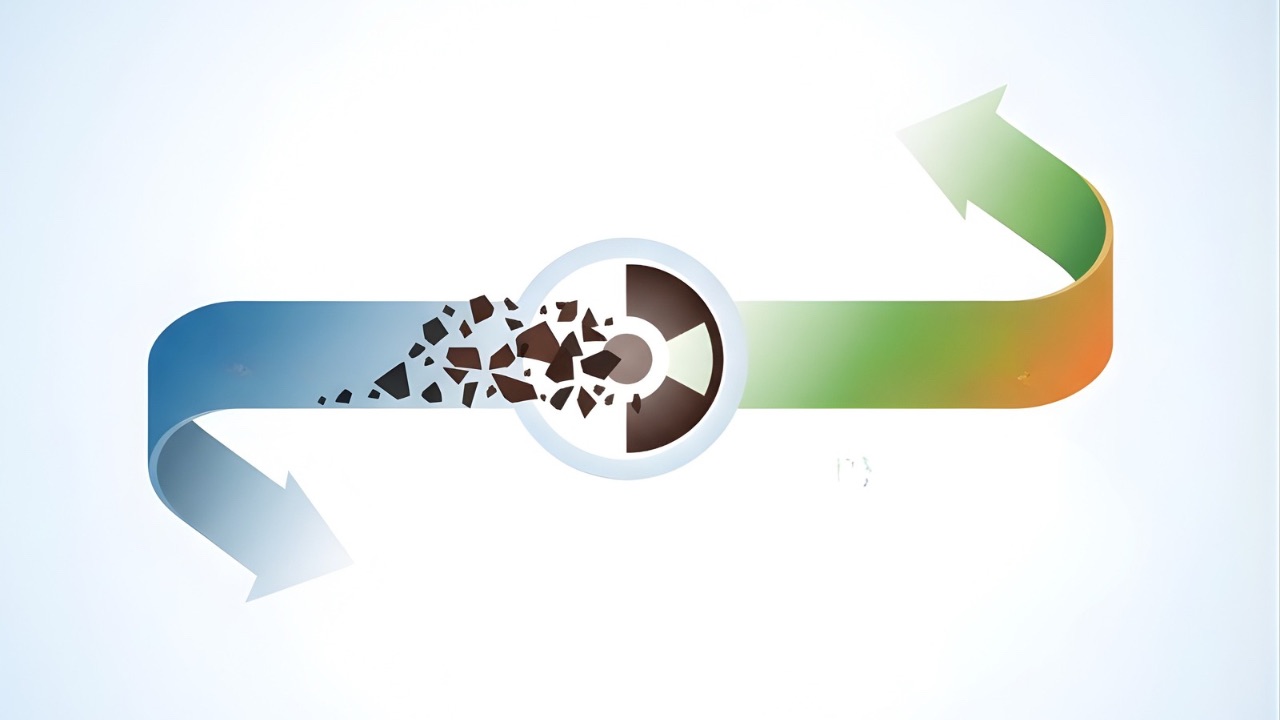
The challenge lies in the first step of the standard e-fuel process. To make liquid fuels via the common Fischer-Tropsch (FT) synthesis, you first need a mixture of carbon monoxide (CO) and hydrogen, known as syngasSyngas, or synthesis gas, is a fuel gas mixture consisting primarily of hydrogen and carbon monoxide. It is produced during gasification and can be used as a fuel source or as a feedstock for producing other chemicals and fuels. More. The typical method to get this syngas is the reverse water-gas shift (RWGS) reaction, which uses CO2 and H2 to make CO and water. This means you are using your most expensive input—hydrogen—just to prepare your CO2 for the actual fuel-making reaction. The new study proposes replacing this hydrogen-hungry step entirely. Instead of RWGS, it uses the reverse Boudouard reaction, where CO2 reacts directly with the solid carbon in biochar to produce two molecules of CO (C+CO2→2CO). This change completely eliminates the need for hydrogen in the syngas production step, saving a massive amount of the costly gas.
The researchers conducted a detailed techno-economic and life-cycle assessment to see if this swap was truly better. To ensure a fair comparison, they used a “system expansion” approach. Since their new process uses biochar, they had to account for what that biochar would have been used for otherwise. In their “best case scenario,” they assumed the biochar’s alternative job was to be burned for industrial heating (IH). They compared the standard process (using H2 for RWGS + burning biochar for heat) against their new process (using biochar for fuel + using H2 for heat).
The results were a clear win-win. The new Boudouard route reduced the total production cost by 10% and the global warming impact, or carbon footprint, by 11%. Furthermore, it led to significant reductions in all other major environmental damage categories, including a 17% reduction in damage to human health, a 10% drop in damage to ecosystem quality, and a 13% drop in resource scarcity . This outcome demonstrates a pathway that is simultaneously cheaper and less harmful to the planet.
The team also analyzed a second scenario where the biochar’s alternative use was being buried for carbon dioxide removal (CDR). In this case, using the biochar for fuel meant the carbon removal had to be replaced by expensive Direct Air Carbon Capture and Storage (DACCS). The new process was still cheaper (by 6%) and had a 10% smaller carbon footprint. However, it introduced a trade-off. While human health and ecosystem impacts still improved, the “resource scarcity” impact worsened by 6%. This was because the DACCS replacement requires natural gas, a fossil resource. This finding highlights a critical point: the environmental benefits of a new technology can depend heavily on the system boundaries you draw.
Ultimately, the study proves that by intelligently integrating processes—using a material like biochar to save on a more expensive one like hydrogen—we can unlock significant economic and environmental gains. While e-fuels still face a long road to compete with cheap fossil fuels, a 10% cost reduction is a critical step forward in making green fuels for aviation and shipping a large-scale reality.
Source: Chagas, M. T., Medrano-García, J. D., & Guillén-Gosálbez, G. (2025). Biochar Enhances Fischer-Tropsch Electrofuels from CO2 and Renewable Energy. ACS Sustainable Chemistry & Engineering.



Leave a Reply