
Key Takeaways
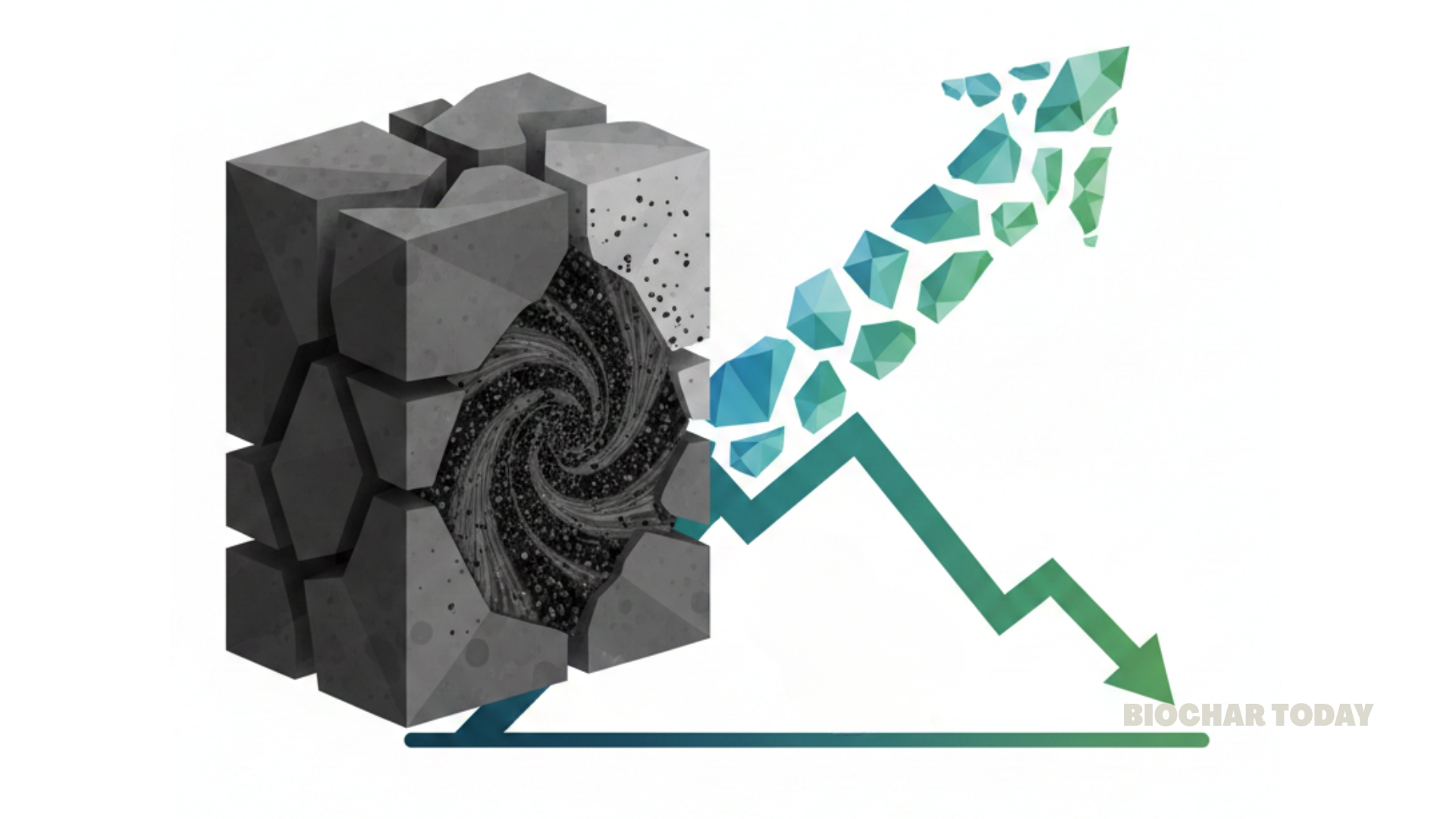
- Replacing a small portion of cement with charcoalCharcoal is a black, brittle, and porous material produced by heating wood or other organic substances in a low-oxygen environment. It is primarily used as a fuel source for cooking and heating. More made from city trash makes concrete stronger.
- Using this special charcoal significantly lowers the health risks and medical costs caused by air pollution from construction.
- While making this new concrete costs slightly more up front, the massive environmental and social benefits far outweigh the price.
- This approach helps solve two problems at once by reducing construction pollution and finding a useful way to recycle municipal waste.
The findings published in the Journal of Cleaner Production by Teklit Gebregiorgis Ambaye, Tao Liu, Charilaos Paraskevoulakos, Ruichang Mao, Zheng Lu, Ashal Tyurkay, Georgia Psyrri, and Ana T. Lima reveal a transformative path for the construction industry. By integrating social, economic, and environmental data, the researchers demonstrated that concrete modified with biocharBiochar is a carbon-rich material created from biomass decomposition in low-oxygen conditions. It has important applications in environmental remediation, soil improvement, agriculture, carbon sequestration, energy storage, and sustainable materials, promoting efficiency and reducing waste in various contexts while addressing climate change challenges. More derived from municipal solid waste outperforms traditional mixes in nearly every sustainability category. The study highlights that cement production is currently one of the most carbon-intensive processes in the world. However, by diverting organic waste from landfills and processing it into a stable, carbon-rich biochar, builders can create a material that is both physically superior and socially responsible.
The most striking result of this research is the dramatic improvement in social sustainability, specifically regarding human health. Traditional concrete manufacturing releases significant air pollutants that contribute to respiratory and cardiovascular diseases. The study found that using biochar concrete reduces health-related damages by approximately forty-five percent. When these health impacts were monetized using a societal willingness-to-pay framework, the cost to society dropped from over six thousand dollars to roughly thirty-five hundred dollars per unit of concrete. These social factors were found to be the dominant force in the overall sustainability assessment, accounting for nearly the entire gap between traditional and green concrete.
From a technical perspective, the research proved that sustainability does not have to come at the expense of structural integrity. At a substitution level of five percent by weight, the biochar concrete actually showed higher compressive strength than conventional mixes. The biochar particles act as a micro-filler, plugging tiny pores within the concrete and facilitating a denser, more robust internal structure. This specific concentration was identified as the optimal balance; while higher levels of biochar can further reduce the carbon footprint, they eventually begin to weaken the material by interfering with the chemical reaction that binds the concrete together.
Environmentally, the benefits of biochar are twofold. First, it directly replaces cement, which is responsible for massive carbon dioxide emissions during its manufacturing. Second, biochar functions as a negative-emission technology by locking away carbon that would otherwise be released as trash decomposes. The study noted a consistent reduction in global warming potential, ozone depletion, and terrestrial acidification when biochar was used. Even when considering the extra energy required to process the waste into charcoal, the net environmental profile remains significantly more favorable than that of standard Portland cement.
Economically, the research found that biochar concrete remains competitive. Although production costs increased by about nine percent due to the energy needed for the waste-to-charcoal conversion, this is considered a moderate penalty when weighed against the massive social and environmental gains. The researchers point out that as recycling technology scales up and integrates with renewable energy sources, these initial costs are likely to decrease. Currently, the cost per unit of strength for biochar concrete is only about three and a half percent higher than traditional concrete, making it a viable alternative for modern construction projects.
Ultimately, the study makes a compelling case for the immediate adoption of low-level biochar substitution in the building sector. By moving toward a circular economy where city waste is transformed into a high-performance building additive, the construction industry can achieve deep decarbonization while protecting public health. The research serves as a robust scorecard for stakeholders, proving that biochar concrete is the most sustainable solution available when the well-being of people and the planet are considered alongside profit.
Source: Ambaye, T. G., Liu, T., Paraskevoulakos, C., Mao, R., Lu, Z., Tyurkay, A., Psyrri, G., & Lima, A. T. (2026). Decarbonizing concrete with biochar: Insights from life cycle sustainability assessment. Journal of Cleaner Production, 547, 147839.



Leave a Reply