
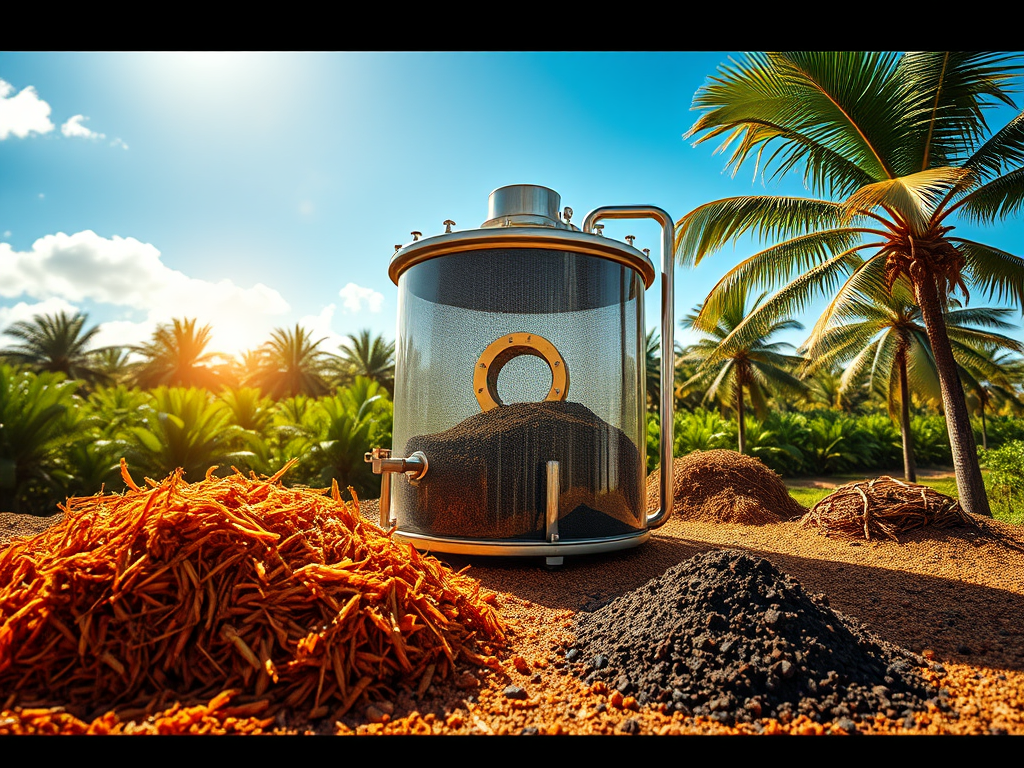
In a recent article published in the Journal of Advanced Research in Fluid Mechanics and Thermal Sciences, researchers Alia Syafiqah Abdul Hamed, Muhammad Syarifuddin Yahya, Nurul Adilah Abdul Latiff, Syamsul Ma’arif, and Nur Farizan Munajat explored a sustainable method for converting waste from the palm oil industry into a valuable product. They used solar pyrolysisPyrolysis is a thermochemical process that converts waste biomass into bio-char, bio-oil, and pyro-gas. It offers significant advantages in waste valorization, turning low-value materials into economically valuable resources. Its versatility allows for tailored products based on operational conditions, presenting itself as a cost-effective and efficient More to produce biocharBiochar is a carbon-rich material created from biomass decomposition in low-oxygen conditions. It has important applications in environmental remediation, soil improvement, agriculture, carbon sequestration, energy storage, and sustainable materials, promoting efficiency and reducing waste in various contexts while addressing climate change challenges. More from empty fruit bunches (EFB) and analyzed its characteristics and potential applications. This process leverages Malaysia’s abundant solar energy to address the environmental challenge posed by the over 21.3 million tons of EFB produced annually in the country.
The study’s methodology involved drying, grinding, and sieving EFB feedstockFeedstock refers to the raw organic material used to produce biochar. This can include a wide range of materials, such as wood chips, agricultural residues, and animal manure. More to a particle size of less than 3 mm. A 0.3-gram sample was then placed in a reactor at the focal point of a Fresnel lens, which concentrated sunlight to pyrolyze the biomassBiomass is a complex biological organic or non-organic solid product derived from living or recently living organism and available naturally. Various types of wastes such as animal manure, waste paper, sludge and many industrial wastes are also treated as biomass because like natural biomass these More. The process maintained an inert atmosphere by purging argon gas at a rate of 10 ml/min. The research team conducted multiple trials and characterized the resulting biochar using thermogravimetric analysis (TGA), X-ray diffraction (XRD), and scanning electron microscopy (SEM).
The results from the TGA analysis revealed that the biochar exhibited significantly enhanced thermal stability compared to the raw EFB. At 500°C, the biochar retained 47.8% of its mass, while the raw EFB retained only 11.9%. This superior stability is attributed to the removal of volatile content during the pyrolysis process. Similarly, at 800°C, the biochar retained 47.8% of its weight, while the raw EFB stabilized at 11.9%, which represents its residual ashAsh is the non-combustible inorganic residue that remains after organic matter, like wood or biomass, is completely burned. It consists mainly of minerals and is different from biochar, which is produced through incomplete combustion. Ash Ash is the residue that remains after the complete More content. This performance exceeds that of EFB biochar produced by conventional pyrolysis, which retains approximately 40% of its final weight at 550°C.
The XRD analysis showed a significant structural transformation from the raw EFB to the biochar. The raw EFB showed a dominant peak at a 2θ value of 21.82°, a characteristic of crystalline cellulose. In contrast, the biochar displayed a major peak at 28.25°, which indicates the transformation of the EFB into a predominantly amorphous, carbon-rich biochar due to the breakdown of cellulose and hemicellulose during the pyrolysis process. The reduced crystallinity makes the biochar more suitable for applications such as adsorbents or soil amendments.
Scanning electron microscopy (SEM) imaging further confirmed the structural changes. Raw EFB exhibited a fibrous and intact lignocellulosic structure. The biochar, however, displayed a porous morphology resulting from the degradation of its components during pyrolysis. The median particle size was reduced from 9.928±4.571μm in the raw EFB to 8.000±3.683μm in the biochar, a decrease attributed to devolatilization and fragmentation under high heat flux conditions. This reduced particle size and enhanced porosityPorosity of biochar is a key factor in its effectiveness as a soil amendment and its ability to retain water and nutrients. Biochar’s porosity is influenced by feedstock type and pyrolysis temperature, and it plays a crucial role in microbial activity and overall soil health. Biochar More improve the biochar’s functional properties, such as its adsorption capacity and reactivity, making it suitable for industrial and environmental applications.
The study concludes that solar pyrolysis is an effective and sustainable method for converting EFB into high-quality biochar. The process optimizes the material’s properties, improving its thermal stability, structural characteristics, and potential for applications in soil amendmentA soil amendment is any material added to the soil to enhance its physical or chemical properties, improving its suitability for plant growth. Biochar is considered a soil amendment as it can improve soil structure, water retention, nutrient availability, and microbial activity. More, energy storage, and environmental remediation.
Source: Hamed, A. S. A., Yahya, M. S., Latiff, N. A. A., Ma’arif, S., & Munajat, N. F. (2025). Solar Pyrolysis of Empty Fruit Bunch (EFB): Biochar Characterization and Potential Applications. Journal of Advanced Research in Fluid Mechanics and Thermal Sciences, 133(2), 185-194.



Leave a Reply