
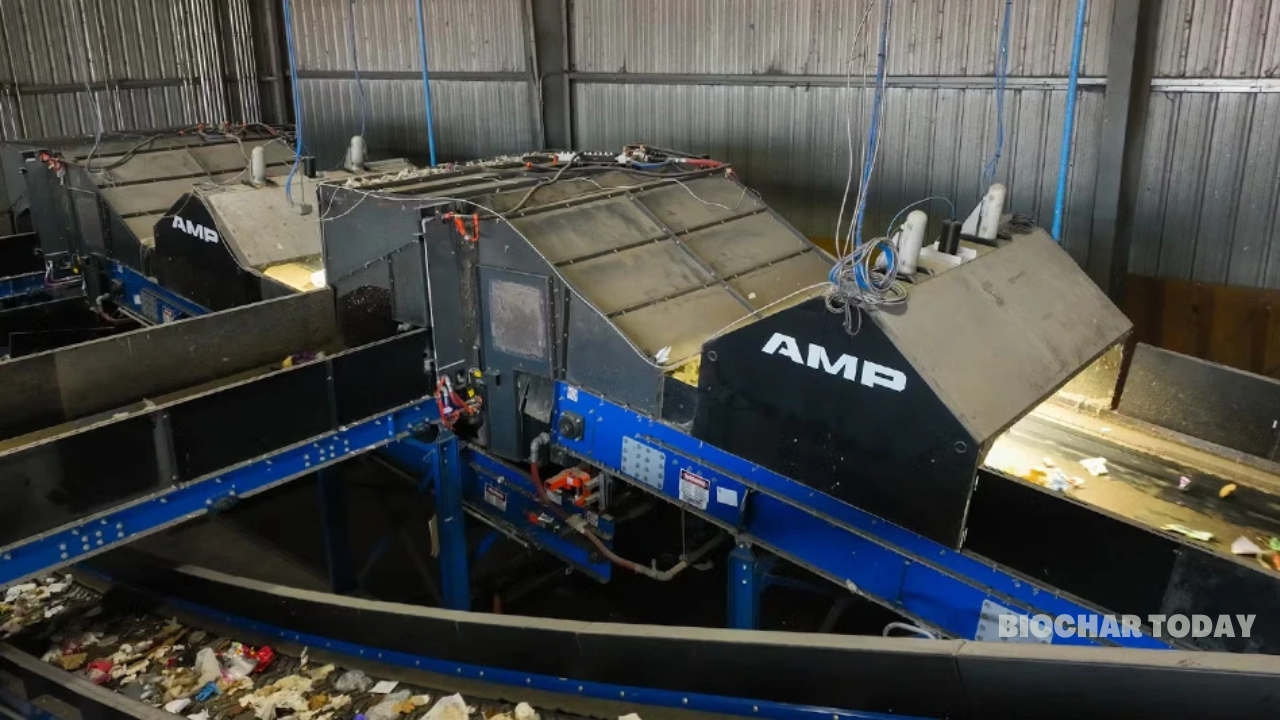
In the United States, AMP Robotics Corporation, through its affiliate Commonwealth Sortation LLC, has significantly expanded its mixed waste processing capacity in Portsmouth, Virginia. This expansion is part of a 20-year partnership with the Southeastern Public Service Authority (SPSA), which serves approximately 1.2 million residents across eight member communities. The facility’s current capacity has reached 108,000 tons of municipal solid waste (MSW)Municipal Solid Waste (MSW) is the everyday trash or garbage produced by households and businesses. It includes a variety of materials, such as food scraps, paper, plastics, and yard waste. MSW forms a potential feedstock category for biochar production provided that it should be free More annually, with plans to scale the integrated system to handle up to 540,000 tons per year. A critical component of this regional infrastructure is the extraction and conversion of organic waste into biocharBiochar is a carbon-rich material created from biomass decomposition in low-oxygen conditions. It has important applications in environmental remediation, soil improvement, agriculture, carbon sequestration, energy storage, and sustainable materials, promoting efficiency and reducing waste in various contexts while addressing climate change challenges. More, supported by recent carbon credit agreements.
The primary challenge addressed by this partnership is the looming capacity limit of the Regional Landfill, which was previously estimated to reach full capacity by 2060. Traditional waste management in the South Hampton Roads region struggled with low diversion rates and the economic difficulty of sorting recyclables and organics from bagged municipal trash. Furthermore, stagnant national recycling rates and the high cost of manual sortation created a need for a more efficient, technology-driven approach to capture lost resources from the waste stream before they are permanently interred in a landfill.
To solve these issues, AMP has deployed an AI-powered sortation system that utilizes robotics, cameras, and pneumatic jets to identify and recover recyclables and organic materials. The organic fraction is directed to a specialized management system where it undergoes indirect heating to be transformed into biochar. This conversion process is bolstered by a carbon removal agreement with Google, which intends to purchase 200,000 metric tonnes of CO2e credits by 2030. This financial backing enables AMP to establish the necessary biochar production capacity to handle large volumes of diverted organic matter.
The outcomes of this initiative are substantial for both the local environment and the biochar industry. The partnership is designed to divert at least 50% of the regional waste from the landfill, with 30% of that diversion attributed specifically to organics processing. By converting five million tons of organic waste into biochar over the next two decades, the project will significantly extend the life of the Regional Landfill and generate high-value carbon credits. Additionally, the expansion has created approximately 100 local jobs and established Virginia as a hub for advanced waste-to-value technologies.



Leave a Reply