
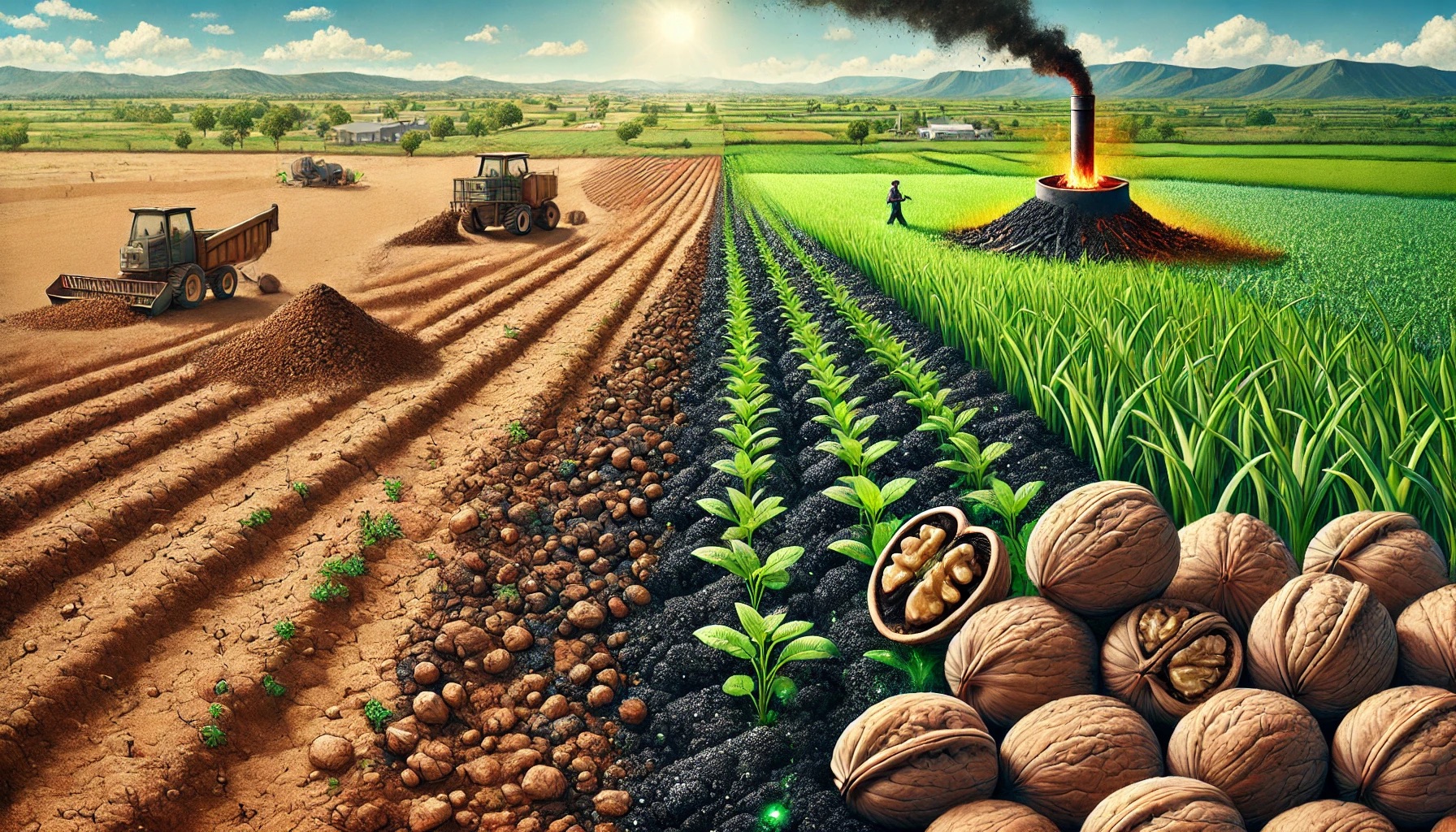
Nisa & Bhaduri (2024) Synthesis and Chemical Modification of Walnut Shell BiocharBiochar is a carbon-rich material created from biomass decomposition in low-oxygen conditions. It has important applications in environmental remediation, soil improvement, agriculture, carbon sequestration, energy storage, and sustainable materials, promoting efficiency and reducing waste in various contexts while addressing climate change challenges. More for Enhancing Water Retention Capacity of Sandy Soil. ACS Sustainable Resource Management. https://doi.org/10.1021/acssusresmgt.4c00174.
The Jammu region of India faces agricultural challenges due to its sandy soil, which has low water retention capacity. At the same time, this region generates significant walnut shell waste. A recent study explored the potential of converting walnut shells into biochar through thermochemical processes to address both issues.
Biochar was produced under three conditions: limited oxygen, nitrogen, and vacuum atmospheres. The results showed that biochar synthesized in limited oxygen retained the highest water. To further improve water retention, chemical treatments using acids and bases were applied. Among these, sodium carbonate-treated biochar synthesized under vacuum showed the most promising results, enhancing water retention by 11% when mixed with soil at a 5% ratio.
The study also found that biochar improved soil hydraulic conductivity, meaning water movement through soil was more controlled, which could reduce erosion and nutrient loss. Furthermore, incorporating biochar into soil can contribute to carbon sequestration and reduce agricultural waste, supporting sustainable farming.
While vacuum-synthesized biochar showed the best performance, its production process could be economically limiting. However, biochar produced under simpler limited-oxygen conditions presents a practical, cost-effective alternative for rural communities.
This research highlights the dual benefits of utilizing agricultural waste for soil enhancement and environmental conservation, offering a scalable solution for improving soil health in sandy regions. Further studies on economic feasibility and large-scale applications could make this approach a key tool for sustainable agriculture.



Leave a Reply