
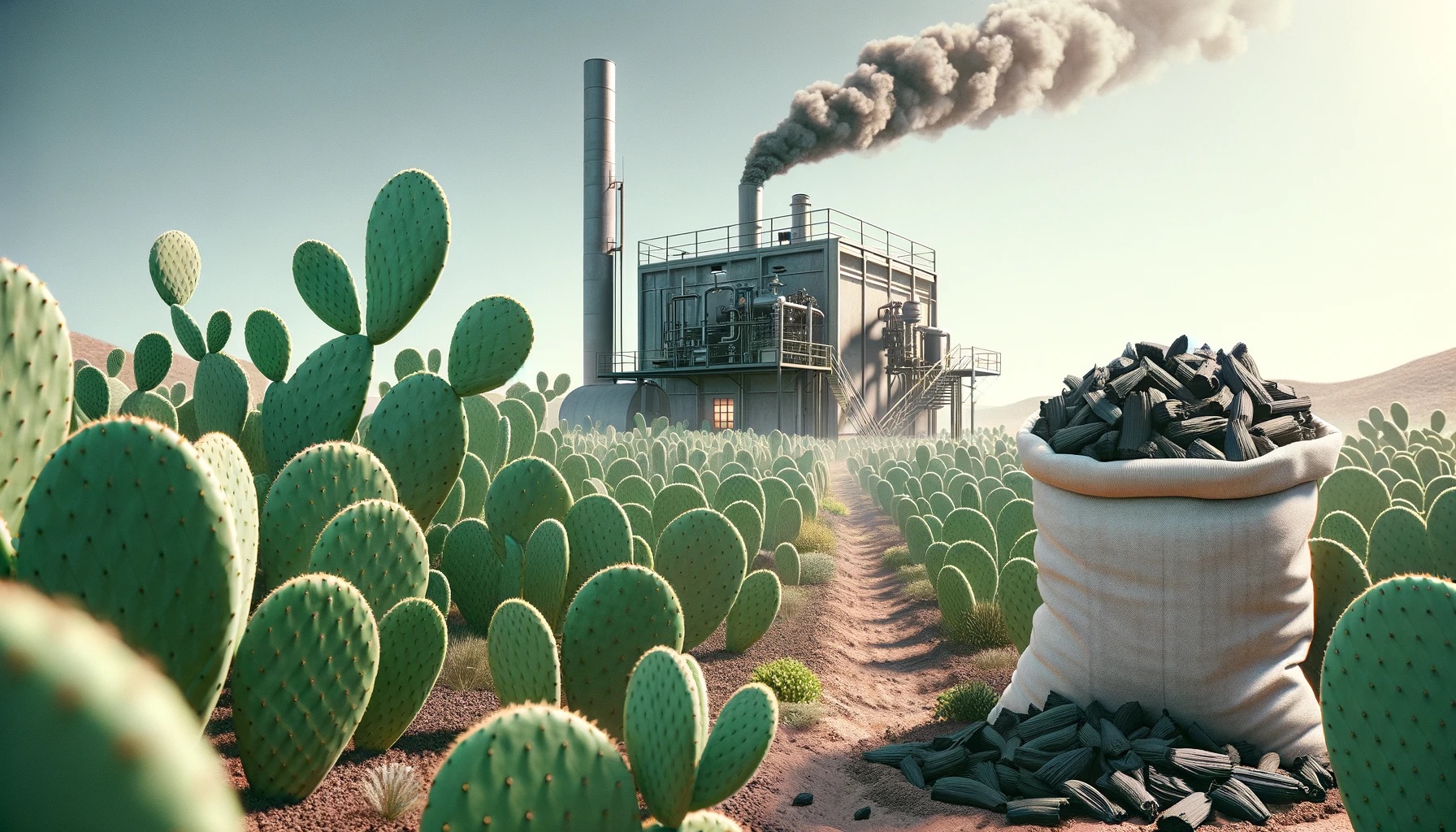

Impact of pyrolysisPyrolysis is a thermochemical process that converts waste biomass into bio-char, bio-oil, and pyro-gas. It offers significant advantages in waste valorization, turning low-value materials into economically valuable resources. Its versatility allows for tailored products based on operational conditions, presenting itself as a cost-effective and efficient More process conditions on the features of the biocharBiochar is a carbon-rich material created from biomass decomposition in low-oxygen conditions. It has important applications in environmental remediation, soil improvement, agriculture, carbon sequestration, energy storage, and sustainable materials, promoting efficiency and reducing waste in various contexts while addressing climate change challenges. More from Opuntia ficus indica fruit peels. BiomassBiomass is a complex biological organic or non-organic solid product derived from living or recently living organism and available naturally. Various types of wastes such as animal manure, waste paper, sludge and many industrial wastes are also treated as biomass because like natural biomass these More Conversion and Biorefinery. https://doi.org/10.1007/s13399-024-05750-8
As the world shifts towards sustainable practices, finding innovative ways to repurpose agricultural by-products is crucial. One such promising approach involves transforming the peels of the Opuntia ficus indica (prickly pear) into valuable products through pyrolysis. This process not only mitigates climate change by reducing greenhouse gas emissions but also supports the transition to a circular economy. A recent study explores the optimal methods for converting Opuntia peels into biochar, a product with numerous practical applications.
The focus of the study is to refine the pyrolysis process of Opuntia peels by experimenting with both slow and fast pyrolysis techniques at temperatures between 500 and 700°C. Two types of reactors are used: a fixed bed reactor for slow pyrolysis and a spouted bed reactor for fast pyrolysis. This dual approach allows the researchers to directly compare the effects of these different pyrolysis methods on biochar production.
Comprehensive characterization of the resulting biochars is a key part of the study. Various analyses are conducted, including elemental, proximate, and chemical composition, thermogravimetric (TG) analysis, X-ray fluorescence (XRF), X-ray diffraction (XRD), Fourier transform infrared spectroscopy (FTIR), CO2 adsorption, and scanning electron microscopy (SEM). These techniques provide detailed insights into the properties of the biochar produced under different conditions.
The findings reveal that slow pyrolysis yields slightly higher amounts of biochar compared to fast pyrolysis, especially at the lower temperature of 500°C. Biochars from fast pyrolysis, however, exhibit higher fixed carbon and ashAsh is the non-combustible inorganic residue that remains after organic matter, like wood or biomass, is completely burned. It consists mainly of minerals and is different from biochar, which is produced through incomplete combustion. Ash Ash is the residue that remains after the complete More content, as well as a more developed porous structure. Specifically, at 700°C, the fast-pyrolysis biochar achieves a specific surface area of 328.61 m²/g and a micropore volume of 0.13 cm³/g. This indicates a significant potential for various practical applications.
The study concludes that biochar produced through fast pyrolysis is particularly suitable for catalytic applications due to its enhanced structural properties. On the other hand, biochar from slow pyrolysis is better suited for adsorption and soil amendmentA soil amendment is any material added to the soil to enhance its physical or chemical properties, improving its suitability for plant growth. Biochar is considered a soil amendment as it can improve soil structure, water retention, nutrient availability, and microbial activity. More applications. Despite these promising uses, the high ash content in the Opuntia-derived biochar renders it unsuitable for power generation purposes.
This research highlights the versatility and potential of converting agricultural waste into valuable resources. By optimizing the pyrolysis process, we can enhance the efficiency and utility of biochar production, contributing to both environmental sustainability and economic development. The practical implications of these findings suggest that with further refinement, biochar could play a significant role in various industries, from agriculture to environmental management. This study paves the way for future research and development in the field of agricultural waste valorization, promoting a more sustainable and circular economy.



Leave a Reply