
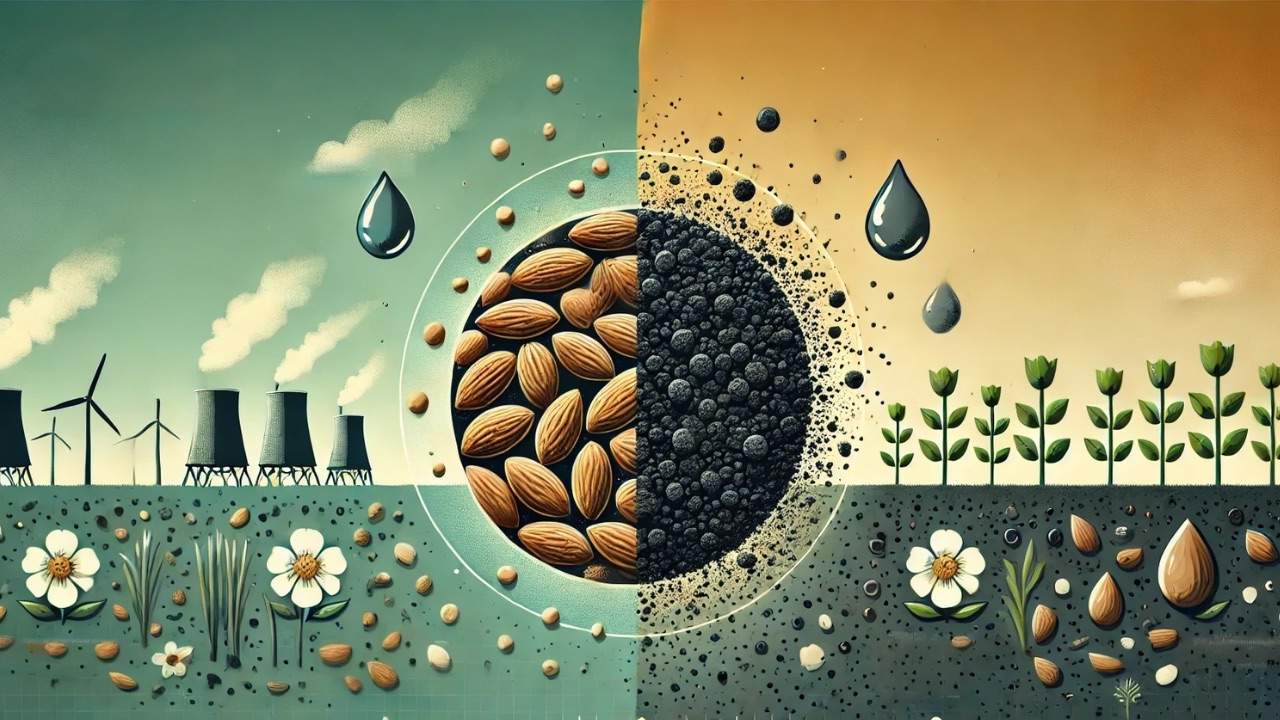
Guo, et al (2025) A novel almond shell biocharBiochar is a carbon-rich material created from biomass decomposition in low-oxygen conditions. It has important applications in environmental remediation, soil improvement, agriculture, carbon sequestration, energy storage, and sustainable materials, promoting efficiency and reducing waste in various contexts while addressing climate change challenges. More modified with FeS and chitosan as adsorbents
for mitigation of heavy metals from water and soil. Separation and Purification Technology. https://doi.org/10.1016/j.seppur.2024.130943
Researchers have developed an innovative biochar using almond shells modified with iron sulfide (FeS) and chitosan to address heavy metal contamination in water and soil. This novel material, FeS-CTS@nBC, demonstrates significant potential as a low-cost, efficient adsorbent for removing toxic metals like cadmium (Cd), lead (Pb), and chromium (Cr).
Prepared through pyrolysisPyrolysis is a thermochemical process that converts waste biomass into bio-char, bio-oil, and pyro-gas. It offers significant advantages in waste valorization, turning low-value materials into economically valuable resources. Its versatility allows for tailored products based on operational conditions, presenting itself as a cost-effective and efficient More and enhanced with FeS and chitosan, the biochar exhibits improved adsorption capabilities. Laboratory tests revealed its ability to immobilize heavy metals in contaminated soil, reducing their bioavailability by 29% for Cd and 23% for Pb. Further, paddy field experiments showed that FeS-CTS@nBC not only mitigated heavy metal uptake by rice plants but also promoted healthier growth, reducing Cd levels in roots and leaves by 28% and 56%, respectively.
The enhanced performance is attributed to the material’s increased porosityPorosity of biochar is a key factor in its effectiveness as a soil amendment and its ability to retain water and nutrients. Biochar’s porosity is influenced by feedstock type and pyrolysis temperature, and it plays a crucial role in microbial activity and overall soil health. Biochar More, higher functional group density, and improved stability. Computational analyses confirmed that oxygen-containing groups on the biochar surface play a crucial role in capturing heavy metals. The study also highlighted the material’s effectiveness across different environmental conditions, including varied pHpH is a measure of how acidic or alkaline a substance is. A pH of 7 is neutral, while lower pH values indicate acidity and higher values indicate alkalinity. Biochars are normally alkaline and can influence soil pH, often increasing it, which can be beneficial More levels.
By utilizing almond shell waste, this approach supports circular economy principles, turning agricultural byproducts into a tool for environmental remediation. FeS-CTS@nBC offers a promising, scalable solution to reduce the environmental and health risks associated with heavy metal contamination.
This advancement underscores the role of biochar in sustainable pollution management, paving the way for wider adoption in agriculture and water treatment systems.



Leave a Reply