
Key Takeaways
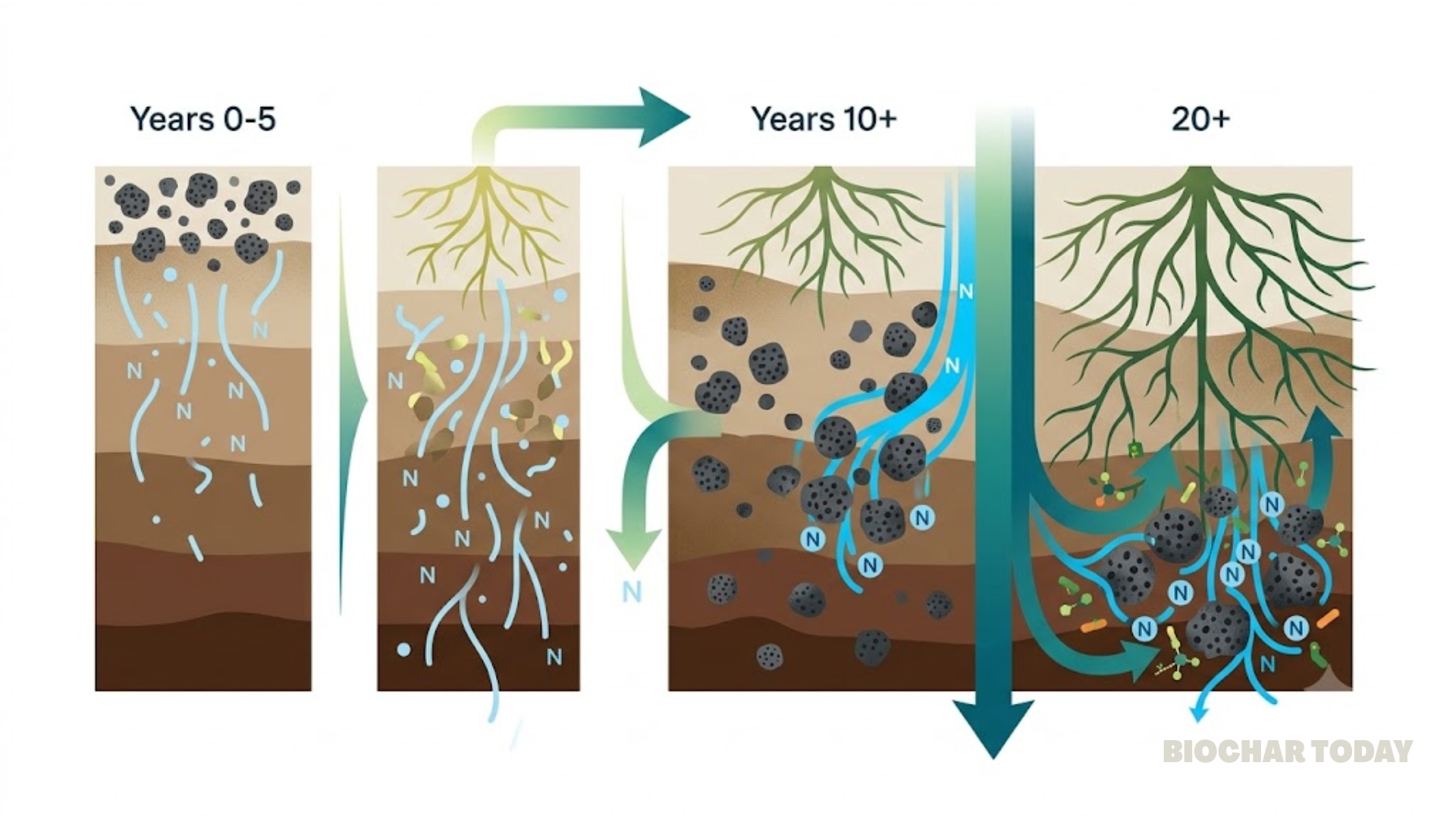
- Applying rice straw biocharBiochar is a carbon-rich material created from biomass decomposition in low-oxygen conditions. It has important applications in environmental remediation, soil improvement, agriculture, carbon sequestration, energy storage, and sustainable materials, promoting efficiency and reducing waste in various contexts while addressing climate change challenges. More over multiple years helps retain beneficial nitrogen in deep soil layers rather than letting it escape into the atmosphere as gas.
- In surface soil layers, biochar boosts all microbial nitrogen processes, but it favors nitrogen loss through gas production over retention.
- In deeper soil levels, biochar raises soil alkalinity and alters chemical balances, which turns off gas-producing pathways and turns up nitrogen-conserving pathways.
- Deep soil ammonium retention reached its highest relative contribution at 91.1 percent in the deepest tested soil layers.
- Managing biochar application requires considering soil depth and initial soil alkalinity to maximize crop fertilizer benefits and protect the surrounding environment.
Nitrogen transformations in agricultural paddy fields play a central role in determining whether added fertilizer stays in the ground to nourish growing crops or escapes into the atmosphere as gas. In paddy soils, dissimilatory nitrate reduction pathways include denitrification, anaerobic ammonium oxidation, and dissimilatory nitrate reduction to ammonium. While denitrification and anaerobic ammonium oxidation drive nitrogen out of the ecosystem as gaseous emissions, dissimilatory nitrate reduction to ammonium converts nitrate into soil-bound ammonium, effectively preserving plant-available nitrogen. Understanding how biochar amendments alter these competing pathways across different soil depths is critical for improving sustainable nutrient management in alkaline crop systems.
In the top layer of soil, annual applications of rice straw biochar stimulate all three nitrate reduction processes. The porous physical structure of biochar provides ideal habitat surfaces for soil bacteria, while its input of dissolved organic carbon fuels biological activity. Within the top twenty centimeters of soil, denitrification rates reached 37.86 nanomoles of nitrogen per gram per hour, dominating total nitrate conversion. The high availability of organic carbon from biochar and plant root exudates gives denitrifying bacteria a competitive edge in surface soils, leading to a higher overall proportion of gaseous nitrogen loss right at the surface.
As soil depth increases down to eighty centimeters, the impact of biochar shifts dramatically. Deep soil layers experience a sharp decline in overall microbial gene abundances, but the relative balance between nitrogen loss and nitrogen retention flips. Long-term biochar amendment progressively elevates deep soil alkalinity past a threshold of pHpH is a measure of how acidic or alkaline a substance is. A pH of 7 is neutral, while lower pH values indicate acidity and higher values indicate alkalinity. Biochars are normally alkaline and can influence soil pH, often increasing it, which can be beneficial More 8.0 and lowers the available ratio of organic carbon to nitrate. These altered edaphic conditions suppress key genes associated with denitrification, such as napA and nosZ, effectively shutting down gaseous nitrogen loss pathways in deeper horizons. Concomitantly, anaerobic ammonium oxidation rates drop to under two percent in the deepest soil profile.
In place of gaseous loss, dissimilatory nitrate reduction to ammonium becomes the primary pathway in deep biochar-amended soil. In the sixty to eighty centimeter soil layer, the proportion of nitrate converted to retained ammonium increased by 37.0 percent under biochar treatment compared to untreated control soils, reaching a peak relative contribution of 91.1 percent. This shift is further supported by biochar increasing available phosphorus and maintaining crucial dissolved iron levels in lower soil strata, both of which protect and support ammonium-yielding pathways even when organic carbon levels are low.
These findings show that long-term biochar management in alkaline paddy fields effectively creates a depth-dependent nitrogen trap. While biochar increases surface microbial activity, its main long-term strength lies in steering deep-soil nitrate reduction away from atmospheric gas loss and toward durable ammonium conservation. Farmers and land managers can use these mechanistic insights to optimize biochar application strategies, ensuring that valuable fertilizer stays in the root zone to enhance crop uptake, lower agricultural run-off risks, and cut environmental greenhouse gas emissions in alkaline agricultural regions.
Source: Yang, Q., Zhang, G., Li, J., Li, H., Van Zwieten, L., & Wang, L. (2026). Long-term biochar amendment increased dissimilatory nitrate reduction to ammonium concomitantly suppressing denitrification and anaerobic ammonium oxidation in deep alkaline paddy soil. Biochar, 8, Article 136.




Leave a Reply