
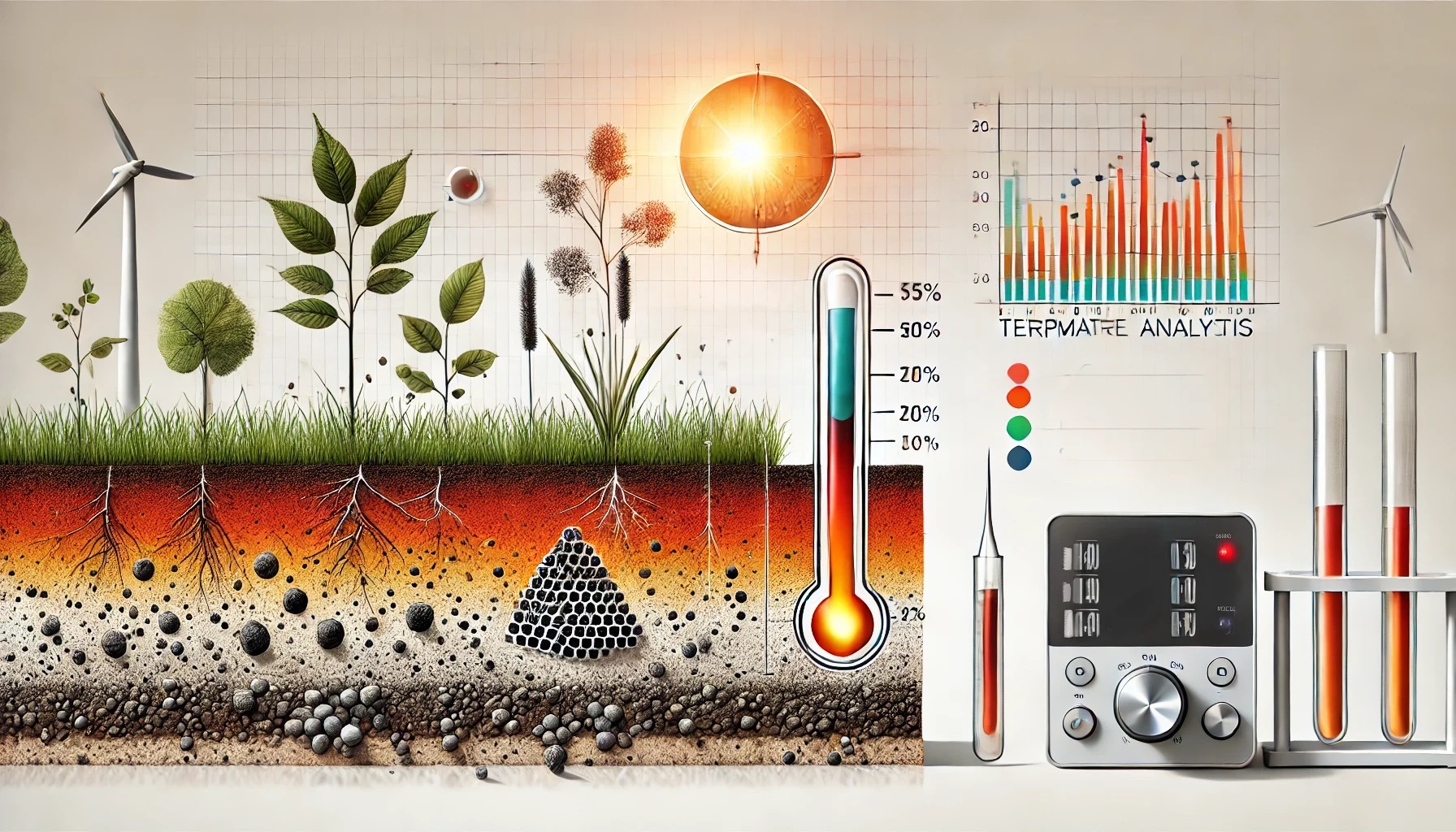
Aubertin, et al (2024) Quantification of biocharBiochar is a carbon-rich material created from biomass decomposition in low-oxygen conditions. It has important applications in environmental remediation, soil improvement, agriculture, carbon sequestration, energy storage, and sustainable materials, promoting efficiency and reducing waste in various contexts while addressing climate change challenges. More in arable land: A new approach based on Rock-Eval® thermal analysis. Geoderma. https://doi.org/10.1016/j.geoderma.2024.116974
Biochar, derived from the incomplete combustion of organic material, plays a significant role in the global carbon cycle and persists in the environment for millennia. Its accurate quantification in soil is crucial for understanding soil carbon stocks and fluxes. This study explores new methods to measure biochar in soil using the Rock-Eval® thermal analysis.
Pyrogenic carbon (PyC) is an essential component of soil organic carbon (SOC) and represents about 15% of SOC globally. Its persistence and transport through erosion can complicate its accurate measurement in soil. Quantifying PyC, particularly biochar, is vital for monitoring soil carbon dynamics and assessing the benefits of biochar as a soil amendmentA soil amendment is any material added to the soil to enhance its physical or chemical properties, improving its suitability for plant growth. Biochar is considered a soil amendment as it can improve soil structure, water retention, nutrient availability, and microbial activity. More.
Various techniques exist to measure biochar in soil, including chemical, optical, and thermal methods. Each has limitations, such as being time-consuming, requiring extensive data, or having difficulties in differentiating biochar from uncharred organic material. The Rock-Eval® thermal method offers a promising alternative due to its direct approach and ability to distinguish biochar emissions during thermal analysis.
The study used six industrial biochars and soils from four agricultural fields, mixed at different ratios. The Rock-Eval® thermal analysis involves consecutive pyrolysisPyrolysis is a thermochemical process that converts waste biomass into bio-char, bio-oil, and pyro-gas. It offers significant advantages in waste valorization, turning low-value materials into economically valuable resources. Its versatility allows for tailored products based on operational conditions, presenting itself as a cost-effective and efficient More and oxidation stages, where carbon emissions are measured continuously. This method identified biochar emissions between 410°C and 610°C during the oxidation stage, allowing for the differentiation of biochar from unamended soil carbon.
Three protocols were tested to quantify biochar in soil mixtures. Protocol 1 measured thermo-resistant organic carbon (CorgTR) from CO2 emissions between 410°C and 610°C. Protocol 2 refined this by using narrower temperature intervals for better accuracy. Protocol 3, the most accurate, subtracted CorgTR from a reference sample to quantify biochar enrichment relative to unamended soil. This protocol proved effective for homogeneous areas like top agricultural soil layers but less so for heterogeneous areas.
The study also compared the Rock-Eval® method with the established BPCA method, finding similar results in long-term soil profiles, suggesting the Rock-Eval® method’s reliability for monitoring biochar over time. However, the effects of biochar weathering on its thermal properties need further investigation.
In conclusion, the Rock-Eval® thermal method effectively quantifies biochar in soil, particularly with protocol 3, which uses a reference sample for accurate measurements. This method is well-suited for homogeneous agricultural fields and can aid in understanding biochar’s role in soil health and carbon sequestration. Further studies should address biochar weathering and its impact on thermal analysis for broader applicability in diverse soil conditions.


Leave a Reply