
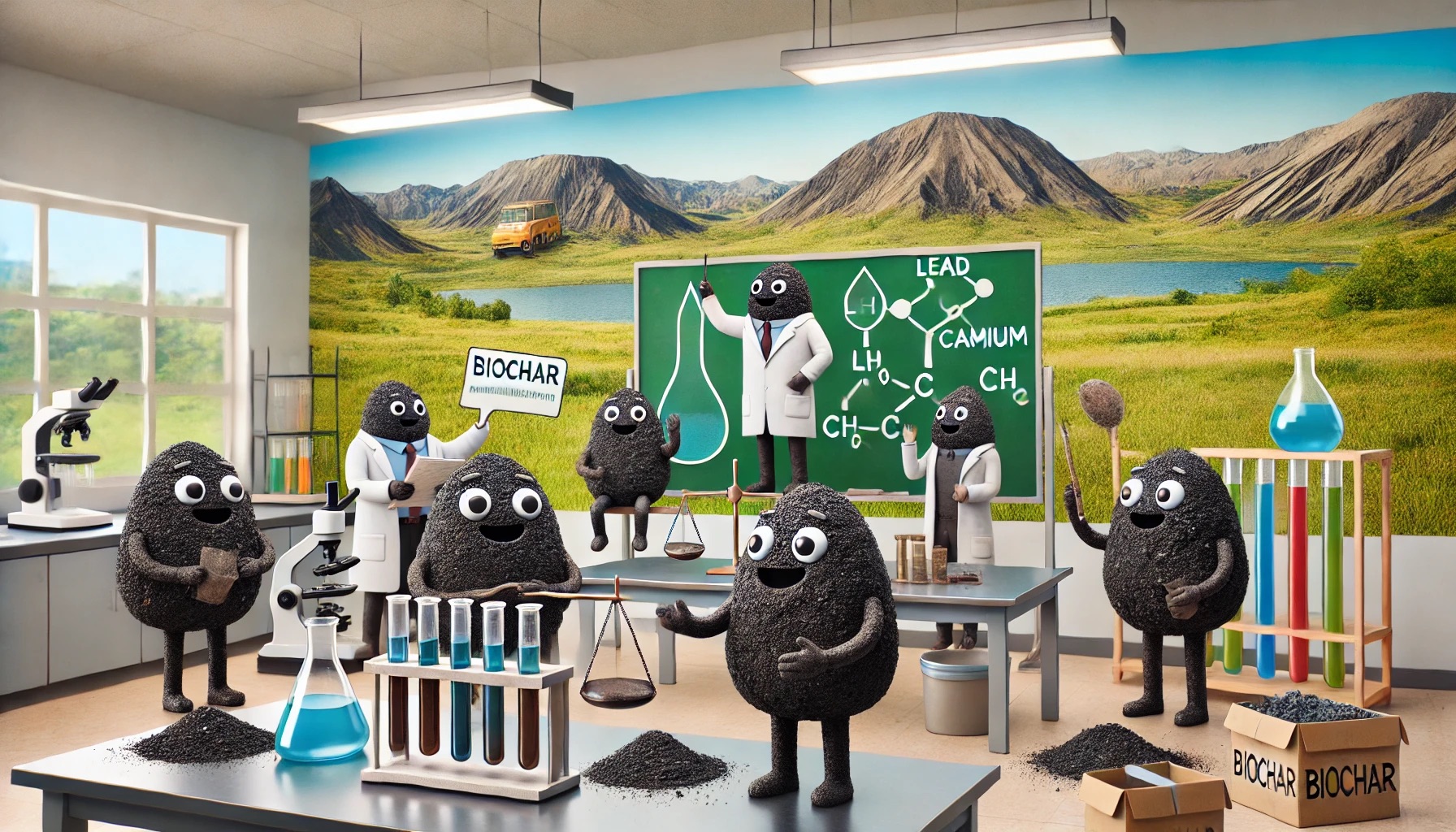
Zhou, et al (2024) The Adsorption Characteristics of Phosphorus-Modified Corn Stover BiocharBiochar is a carbon-rich material created from biomass decomposition in low-oxygen conditions. It has important applications in environmental remediation, soil improvement, agriculture, carbon sequestration, energy storage, and sustainable materials, promoting efficiency and reducing waste in various contexts while addressing climate change challenges. More on Lead and Cadmium. Agriculture. https://doi.org/10.3390/agriculture14071118
The industrialization process has led to severe pollution problems, particularly with heavy metals like lead (Pb) and cadmium (Cd). These metals pose significant risks to human health and the environment due to their high toxicity and persistence. Traditional methods for removing these contaminants from wastewater, such as chemical precipitation and membrane separation, often fall short due to their complexity and cost. Recently, biochar has emerged as a promising and eco-friendly alternative.
Biochar, a carbon-rich material obtained from the pyrolysisPyrolysis is a thermochemical process that converts waste biomass into bio-char, bio-oil, and pyro-gas. It offers significant advantages in waste valorization, turning low-value materials into economically valuable resources. Its versatility allows for tailored products based on operational conditions, presenting itself as a cost-effective and efficient More of biomassBiomass is a complex biological organic or non-organic solid product derived from living or recently living organism and available naturally. Various types of wastes such as animal manure, waste paper, sludge and many industrial wastes are also treated as biomass because like natural biomass these More in the absence of oxygen, has shown potential in adsorbing heavy metals from water. However, unmodified biochar often lacks the high adsorption capacity and selectivity required for effective remediation. Researchers have been exploring various modification techniques to enhance biochar’s performance, and phosphorus modification has garnered significant attention.
A recent study focused on using corn stover, an abundant agricultural waste product, as a precursor for biochar. The corn stover was pre-treated with potassium phosphate before undergoing pyrolysis at different temperatures (350°C, 550°C, and 750°C). This phosphorus-modified biochar was then tested for its ability to adsorb Pb2+ and Cd2+ from wastewater.
The study found that the phosphorus modification significantly improved the physical and chemical properties of the biochar. Among the different preparation conditions, the biochar modified with a 1:2 mass ratio of corn stover to potassium phosphate and pyrolyzed at 550°C (referred to as 2PBC550) exhibited the best adsorption performance. The maximum adsorption capacities for Pb2+ and Cd2+ were 145.48 mg/g and 14.53 mg/g, respectively, which were substantially higher than those of the unmodified biochar.
The adsorption process was found to fit well with the Langmuir isothermal model, indicating that it occurred on a homogeneous surface via monolayer adsorption. Additionally, the quasi-secondary dynamics model suggested that the adsorption was predominantly controlled by chemical interactions rather than physical ones. The study also revealed that 2PBC550 had a higher affinity for Pb2+ compared to Cd2+ in a competitive adsorption scenario, highlighting its potential for selective removal of lead from contaminated water.
Several characterization techniques, including scanning electron microscopy (SEM), Fourier transform infrared spectroscopy (FTIR), X-ray diffraction (XRD), and X-ray photoelectron spectroscopy (XPS), were employed to understand the mechanisms behind the enhanced adsorption. SEM images showed that the phosphorus modification resulted in a more porous and rougher biochar surface. FTIR and XRD analyses indicated the presence of phosphorus functional groups, which played a crucial role in the adsorption process through mechanisms such as complexation, precipitation, and π-electron interactions.
The study demonstrated that the optimal adsorption of Pb2+ and Cd2+ by 2PBC550 occurred at a pHpH is a measure of how acidic or alkaline a substance is. A pH of 7 is neutral, while lower pH values indicate acidity and higher values indicate alkalinity. Biochars are normally alkaline and can influence soil pH, often increasing it, which can be beneficial More of 5. At lower pH levels, the competition between H+ ions and metal ions for adsorption sites reduced the biochar’s efficiency. Conversely, higher pH levels led to the formation of metal hydroxide precipitates, which also hindered the adsorption process.
In competitive adsorption experiments, 2PBC550 showed a higher selectivity for Pb2+ over Cd2+. This selectivity was attributed to the smaller hydration radius and higher hydrolysis constant of Pb2+, making it more likely to interact with the biochar’s surface. The study’s findings suggest that phosphorus-modified biochar, particularly 2PBC550, could be an effective and sustainable solution for removing lead and cadmium from wastewater.
In conclusion, phosphorus modification of corn stover biochar significantly enhances its ability to adsorb heavy metals from wastewater. This approach not only offers a way to manage agricultural waste but also provides a cost-effective and efficient method for treating industrial pollutants. As research in this area progresses, phosphorus-modified biochar could become a vital tool in the global effort to address heavy metal contamination in water resources.


Leave a Reply