
Geoderma, Volume 441, January 2024, 116761
AUTHORS: Elias S. Azzi, Haichao Li, Harald Cederlund, Erik Karltun, Cecilia Sundberg
BiocharBiochar is a carbon-rich material created from biomass decomposition in low-oxygen conditions. It has important applications in environmental remediation, soil improvement, agriculture, carbon sequestration, energy storage, and sustainable materials, promoting efficiency and reducing waste in various contexts while addressing climate change challenges. More has gained traction as a powerful tool in the fight against climate change. This is largely due to its ability to store carbon in the soil, preventing it from entering the atmosphere and contributing to global warming. However, accurately estimating the persistence of this stored carbon has remained a source of scientific debate.
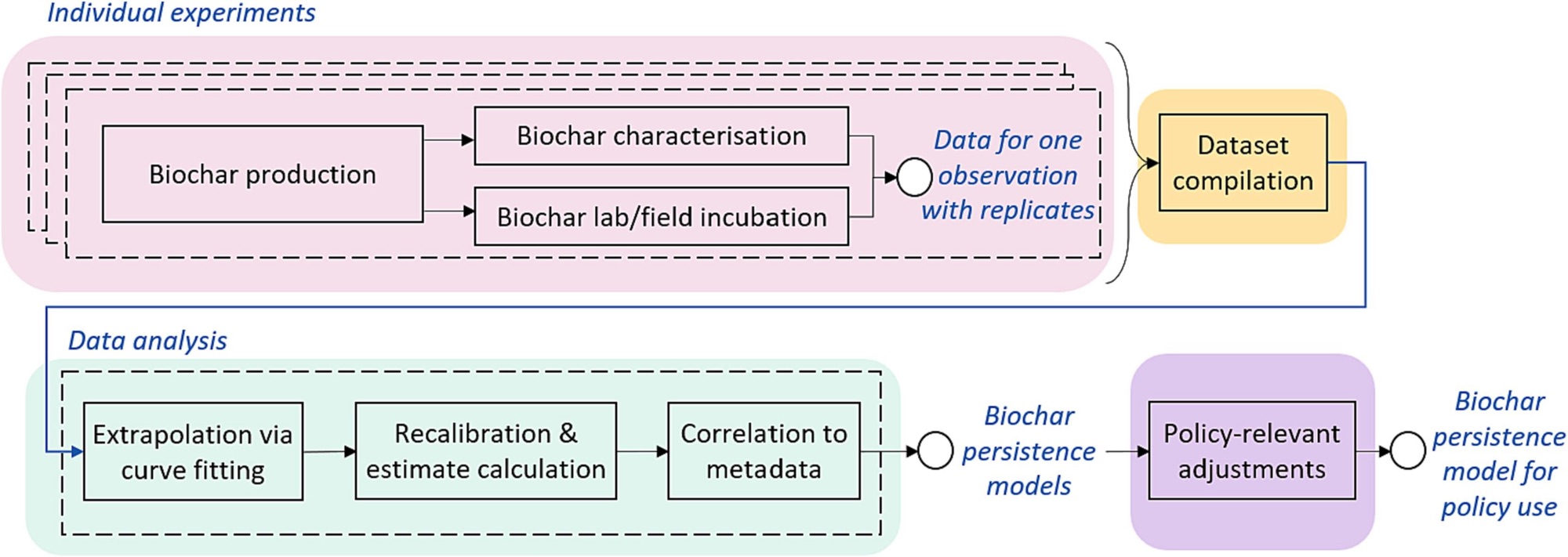
This recent study re-examined the estimations derived from biochar incubation experiments. These experiments mimic real-world soil conditions and measure how quickly biochar decomposes over time. The study aimed to:
- Make incubation data accessible: Publicly sharing a comprehensive dataset of 129 time series, allowing researchers to explore and analyze the data independently.
- Increase transparency: Clearly highlighting the choices made in the modeling process, enabling better understanding of the assumptions and limitations behind the estimations.
- Promote reproducibility: Providing code for data analysis, ensuring that results can be easily replicated and verified by others.
Key findings of the study revealed:
- Data selection and modeling choices significantly impact persistence estimates. Selecting different subsets of data or employing different curve-fitting models could lead to variations in estimations.
- Biochar’s H/C ratio remains the primary predictor of persistence. This aligns with previous research and suggests that biochar with higher H/C ratios decomposes more slowly, thus storing carbon for longer.
- Power models offer a better fit for the relationship between H/C and long-term carbon storage. Compared to linear models, power models provided more accurate predictions of the percentage of biochar carbon remaining after 100 years (BC100).
- Additional information about biochar and its environment had limited impact on the estimations. Factors like pyrolysis conditionsThe conditions under which pyrolysis takes place, such as temperature, heating rate, and residence time, can significantly affect the properties of the biochar produced. More, incubation temperature, and the presence of specific elements in the biochar did not significantly improve the accuracy of predictions.
The study also identified some research gaps:
- Limited data at low H/C ratios. More data is needed for biochar with H/C below 0.2, such as those derived from manure or biosolids.
- Lack of field studies and low-temperature experiments. Real-world conditions and colder environments might influence biochar persistence differently than controlled laboratory settings.
- Limited exploration of alternative pyrolysisPyrolysis is a thermochemical process that converts waste biomass into bio-char, bio-oil, and pyro-gas. It offers significant advantages in waste valorization, turning low-value materials into economically valuable resources. Its versatility allows for tailored products based on operational conditions, presenting itself as a cost-effective and efficient More methods. Studies on biochar produced via methods other than slow pyrolysis would provide a more holistic picture.
These findings offer valuable insights into the complex science of biochar carbon storage. While the study affirms the long-term potential of biochar for carbon sequestration, it emphasizes the need for continued research to address data gaps and refine modeling approaches. Ultimately, collaboration between various disciplines is crucial to develop robust estimations that can inform effective policy decisions and optimize the climate change mitigation potential of biochar.
In essence, this blog post highlights the challenges and progress in accurately estimating the lifespan of biochar-stored carbon. By openly sharing data, methodologies, and limitations, the study fosters transparency and collaboration, paving the way for improved estimations and informed decision-making in the fight against climate change.
SOURCE: https://www.sciencedirect.com/science/article/pii/S001670612300438X



Leave a Reply