
Singh, et al (2024) Bio-oil yield maximization and characteristics of neem based biomassBiomass is a complex biological organic or non-organic solid product derived from living or recently living organism and available naturally. Various types of wastes such as animal manure, waste paper, sludge and many industrial wastes are also treated as biomass because like natural biomass these More at optimum conditions along with feasibility of biocharBiochar is a carbon-rich material created from biomass decomposition in low-oxygen conditions. It has important applications in environmental remediation, soil improvement, agriculture, carbon sequestration, energy storage, and sustainable materials, promoting efficiency and reducing waste in various contexts while addressing climate change challenges. More through pyrolysisPyrolysis is a thermochemical process that converts waste biomass into bio-char, bio-oil, and pyro-gas. It offers significant advantages in waste valorization, turning low-value materials into economically valuable resources. Its versatility allows for tailored products based on operational conditions, presenting itself as a cost-effective and efficient More. AIP Advances. https://doi.org/10.1063/5.0214438
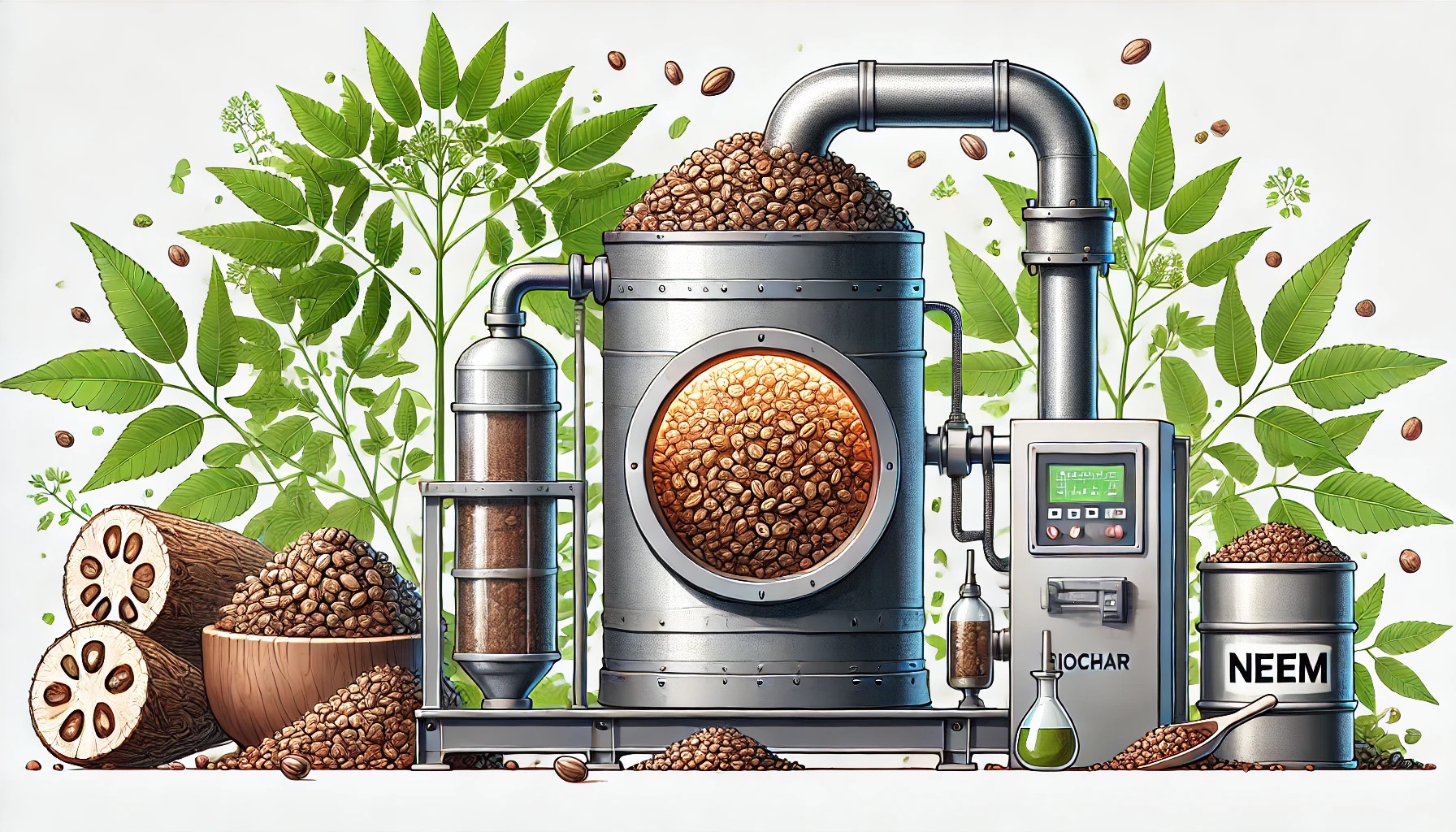
As fossil fuel reserves become increasingly unsustainable and their use drives up carbon dioxide emissions, the search for renewable energy sources has intensified. Biomass, a carbon-based resource similar to fossil fuels, has emerged as a promising alternative. Neem seeds, in particular, have shown potential due to their rich oil content and widespread availability in countries like India. This study explores the optimal conditions for maximizing bio-oil yield from neem biomass through pyrolysis, along with the feasibility of producing biochar.
Biomass, including neem seeds, is considered a renewable energy source that offers environmental benefits like low sulfur and CO2 emissions. The neem tree (Azadirachta indica) produces oil-rich seeds used in various applications such as medicine, personal care, agriculture, and bioenergy. The de-oiled cake, a by-product of oil extraction, is an excellent candidate for bio-oil production due to its high energy density and low sulfur content.
In this study, the researchers used response surface methodology (RSM) and artificial neural network (ANN) models to optimize the pyrolysis parameters for maximum bio-oil yield. The study focused on three key parameters: biomass particle size, temperature, and residence timeResidence time refers to the duration that the biomass is heated during the pyrolysis process. The residence time can influence the properties of the biochar produced. More. The optimal conditions were found to be a particle size of 3 mm, a temperature of 523°C, and a residence timeThis refers to the amount of time that the biomass is heated during the pyrolysis process. The residence time can influence the characteristics of the biochar, such as its porosity and surface area. More of 20 minutes, achieving a maximum bio-oil yield of 47.1%.
Temperature emerged as the most significant factor influencing bio-oil yield, followed by particle size and residence time. Smaller particle sizes favor better heat transfer, leading to higher bio-oil production. However, excessive temperature and prolonged residence time can initiate cracking of volatile matterVolatile matter refers to the organic compounds that are released as gases during the pyrolysis process. These compounds can include methane, hydrogen, and carbon monoxide, which can be captured and used as fuel or further processed into other valuable products. More, reducing bio-oil yield and increasing syngasSyngas, or synthesis gas, is a fuel gas mixture consisting primarily of hydrogen and carbon monoxide. It is produced during gasification and can be used as a fuel source or as a feedstock for producing other chemicals and fuels. More production.
The bio-oil obtained under optimal conditions was further analyzed for its physicochemical properties. The bio-oil’s kinematic viscosity was found to be 12.31 cSt, and its water content was 22.4%. These properties make the bio-oil suitable for use as boiler feedstockFeedstock refers to the raw organic material used to produce biochar. This can include a wide range of materials, such as wood chips, agricultural residues, and animal manure. More and steam generation fuel. The biochar produced during the process was also evaluated, showing potential for various applications.
Comparative analysis of the RSM and ANN models revealed that the ANN model outperformed the RSM model in terms of prediction accuracy. The ANN model demonstrated better fitting ability and predictive capability, making it a valuable tool for optimizing bio-oil production.
This study underscores the potential of neem-based biomass as a renewable energy source. By optimizing the pyrolysis process, it is possible to maximize bio-oil yield and produce valuable by-products like biochar. The findings highlight the importance of temperature, particle size, and residence time in achieving optimal bio-oil production. Moreover, the use of advanced modeling techniques like ANN can significantly enhance the efficiency and accuracy of the optimization process.
In conclusion, the study provides a comprehensive approach to maximizing bio-oil yield from neem biomass. By leveraging the benefits of renewable energy sources and advanced modeling techniques, it is possible to develop sustainable and efficient bioenergy solutions. The insights gained from this study can inform future research and applications in the field of bioenergy, contributing to the global effort to transition towards cleaner and more sustainable energy sources.





Leave a Reply