
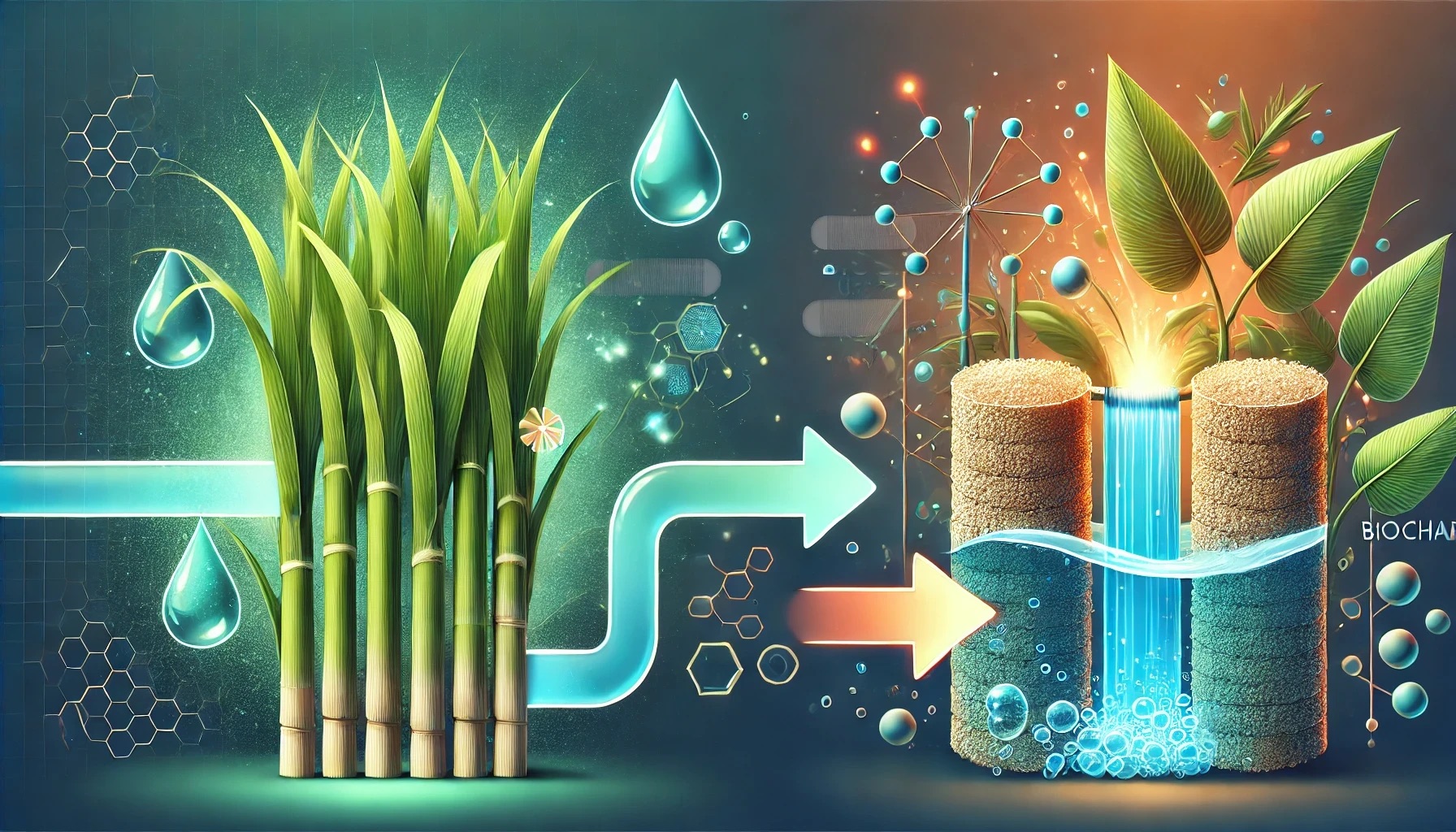
Choudhury, et al (2024) Nanostructured bi-metallic biocharBiochar is a carbon-rich material created from biomass decomposition in low-oxygen conditions. It has important applications in environmental remediation, soil improvement, agriculture, carbon sequestration, energy storage, and sustainable materials, promoting efficiency and reducing waste in various contexts while addressing climate change challenges. More: An innovative approach for arsenic (III) removal from contaminated water. Environmental Chemistry and Ecotoxicology. https://doi.org/10.1016/j.enceco.2024.09.002
In recent years, arsenic contamination in water has become a serious environmental and health issue, particularly in regions like Bangladesh. A new study explores a sustainable solution by developing a nanostructured bi-metallic biochar derived from sugarcane bagasse, impregnated with manganese (Mn) and aluminum (Al). This biochar composite, called Bagasse-Mn-Al, shows promising results for removing arsenic (III) from contaminated water.
The Bagasse-Mn-Al biochar achieved an impressive arsenic removal rate of 89.53% in just 65 minutes under optimal conditions. With a maximum adsorption capacity of 54.945 mg/g, the composite outperforms many existing biochar-based methods. The study highlights that Mn and Al oxides in the biochar facilitate the oxidation of As(III) into As(V), which is more easily adsorbed. The removal efficiency is highly dependent on pHpH is a measure of how acidic or alkaline a substance is. A pH of 7 is neutral, while lower pH values indicate acidity and higher values indicate alkalinity. Biochars are normally alkaline and can influence soil pH, often increasing it, which can be beneficial More, with acidic conditions (pH ~2) proving most effective.
The biochar’s performance was verified through various characterization techniques, including FTIR, SEM-EDS, and XRD. These analyses confirmed the successful impregnation of Mn and Al and the adsorption of arsenic onto the biochar surface. The adsorption process follows pseudo-second-order kinetics, suggesting that chemisorption plays a significant role.
This innovative bi-metallic biochar offers a cost-effective, sustainable method for arsenic removal, with potential applications in treating both groundwater and industrial wastewater. Its development marks a crucial step toward achieving clean water goals in arsenic-affected regions.



Leave a Reply