
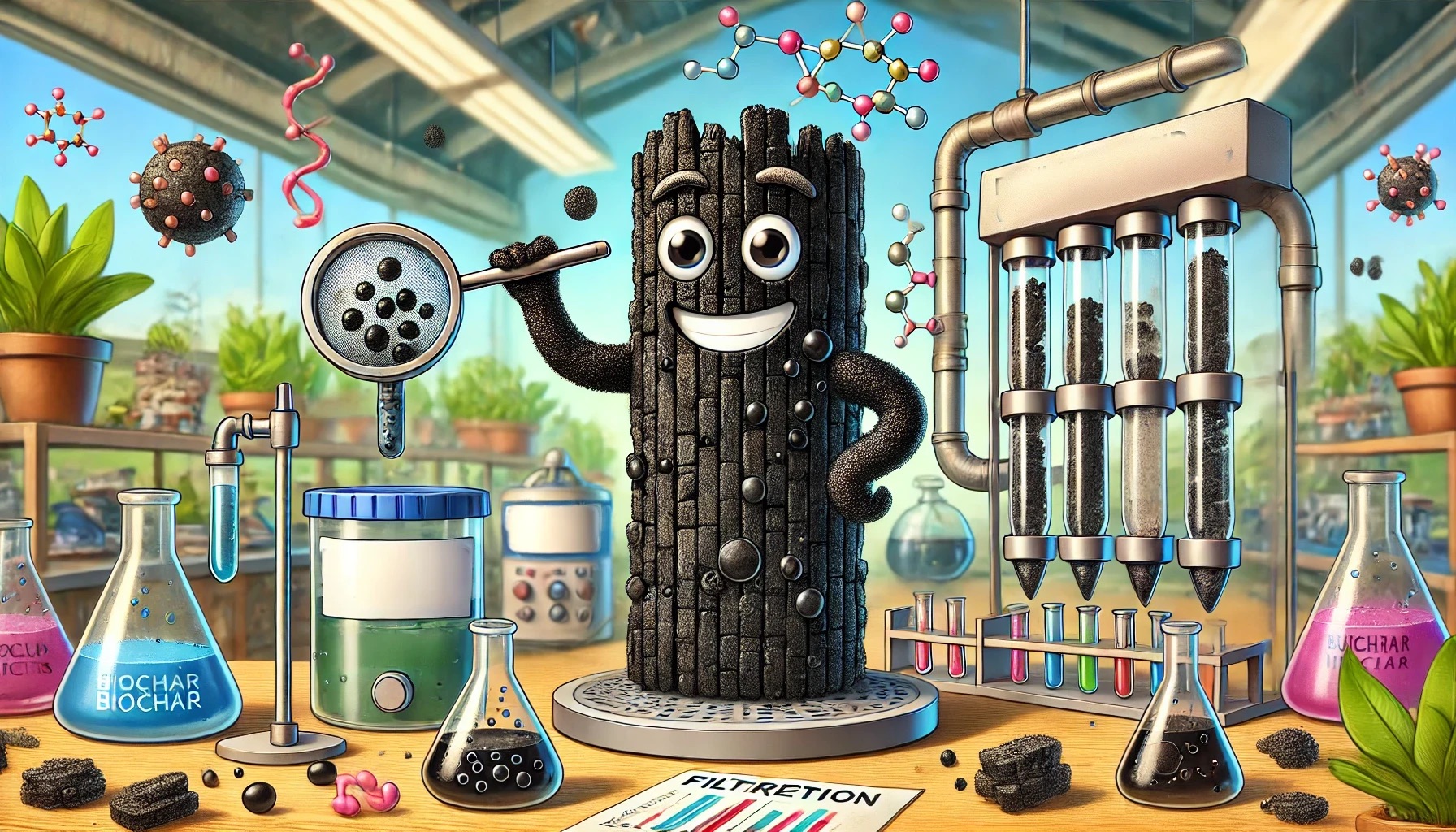
Rajendran, et al (2024) Anti-fouling poly(lactic)acid membrane incorporating titanium dioxide‐coated biocharBiochar is a carbon-rich material created from biomass decomposition in low-oxygen conditions. It has important applications in environmental remediation, soil improvement, agriculture, carbon sequestration, energy storage, and sustainable materials, promoting efficiency and reducing waste in various contexts while addressing climate change challenges. More composites for the separation of lipopeptides from Bacillus subtilisfermentation broth. Journal of Molecular Structure. https://doi.org/10.1016/j.molstruc.2024.139134
A recent study published in the Journal of Molecular Structure introduces an innovative anti-fouling membrane designed for the efficient separation of lipopeptides from Bacillus subtilis fermentation broth. This membrane, composed of poly(lactic)acid (PLA) and titanium dioxide-coated biochar composites, shows promising results in enhancing filtration processes.
Researchers synthesized the PLA/Ti-biochar membrane using the phase inversion technique, resulting in a significant improvement in water flux and hydrophilicity compared to traditional PLA membranes. The membrane demonstrated a 3.7-fold increase in flux and an improved water content of 86.73%, with a contact angle of 62.3°, indicating its hydrophilic nature. This hydrophilicity is crucial for preventing fouling and ensuring efficient separation.
The study focused on purifying lipopeptides, known for their antimicrobial properties, from the Bacillus subtilis fermentation broth. The purified lipopeptides exhibited a minimum inhibitory concentration (MIC) of 1.5 µg/ml against Fusarium oxysporum, significantly lower than the MIC of the crude lipopeptides. This enhanced antimicrobial efficiency highlights the potential of the PLA/Ti-biochar membrane in biocontrol applications.
The membrane’s performance was validated through liquid chromatography and mass spectrometry, confirming the separation and purification efficiency. The composite material’s porous structure and high surface area, combined with the antifouling properties of TiO2, make it a promising candidate for advanced filtration applications.
This research underscores the potential of using sustainable materials like PLA and biochar in membrane technology, offering an eco-friendly and cost-effective solution for separating biological molecules, particularly in the production of biosurfactants and antimicrobial agents.



Leave a Reply