
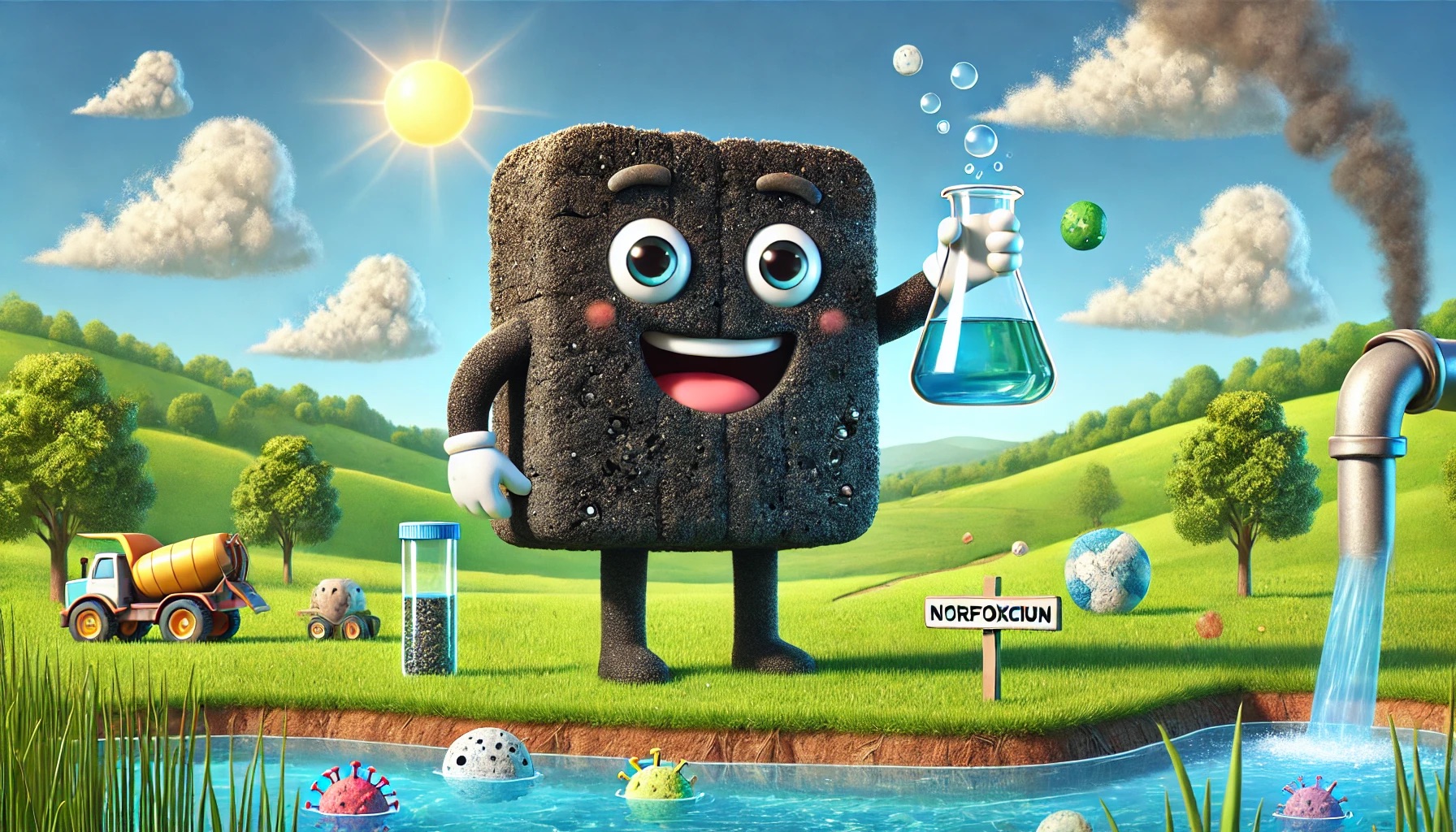

A recent study led by Miaomiao Zhang and colleagues focuses on the development of an efficient and low-cost method for removing norfloxacin (NOR), a common antibiotic, from wastewater using biochar derived from the residue of Atropa belladonna L. (ABL), a traditional Chinese herbal medicine. The research highlights the synthesis, performance, and mechanisms of biochar in NOR adsorption and employs machine learning to enhance the understanding and prediction of the adsorption process.
The study involves producing biochar using potassium carbonate (K2CO3) activation via ball milling and pyrolysisPyrolysis is a thermochemical process that converts waste biomass into bio-char, bio-oil, and pyro-gas. It offers significant advantages in waste valorization, turning low-value materials into economically valuable resources. Its versatility allows for tailored products based on operational conditions, presenting itself as a cost-effective and efficient More. The resultant biochar, named KBC800, boasts a high specific surface area (1638 m²/g) and substantial pore volume (1.07 cm³/g), making it particularly effective in removing NOR from water. Batch adsorption tests indicate that KBC800 can eliminate NOR efficiently, with minimal interference from other ions or antibiotics. The maximum adsorption capacity recorded for NOR on KBC800 was 666.2 mg/g at 328 K, which surpasses most biochar materials reported to date.
The adsorption process was found to be spontaneous and endothermic, adhering well to the Sips model. The primary mechanism for NOR adsorption involves pore filling, supplemented by electrostatic attraction, π−π electron-donor-acceptor interactions, and hydrogen bonding. Machine learning models further revealed that NOR adsorption is significantly influenced by the initial concentration of NOR, specific surface area (SBET), and average pore size of the biochar.
The biochar synthesis begins with mixing ABL residue and K2CO3, followed by heating at different temperatures (600, 700, and 800°C) under nitrogen gas. The resultant biochars were named KBC600, KBC700, and KBC800, with the latter showing the highest performance due to its optimal surface characteristics developed through the pyrolysis process.
Adsorption tests were conducted to assess the effects of various parameters including initial pHpH is a measure of how acidic or alkaline a substance is. A pH of 7 is neutral, while lower pH values indicate acidity and higher values indicate alkalinity. Biochars are normally alkaline and can influence soil pH, often increasing it, which can be beneficial More, adsorbent dosage, adsorption time, and the presence of interfering ions and antibiotics. The tests showed that KBC800 maintains high NOR removal rates across a range of conditions, demonstrating its robustness and practical applicability in real-world scenarios.
The study also examined the kinetics and thermodynamics of the adsorption process. It was found that the pseudo-second-order kinetic model best describes the adsorption process at lower NOR concentrations, while the Elovich model is more suitable at higher concentrations. Thermodynamic analysis confirmed that NOR adsorption on KBC800 is spontaneous and endothermic, with an increase in randomness at the solid-liquid interface promoting the adsorption process.
Regeneration experiments revealed that KBC800 retains over 82% of its NOR removal capacity even after six adsorption-desorption cycles, highlighting its potential for long-term use. Additionally, the application of machine learning allowed for a more nuanced understanding of the factors affecting NOR adsorption. The random forest model indicated that initial NOR concentration, SBET, and average pore size are the most critical factors influencing adsorption efficiency.
In conclusion, the research demonstrates the potential of using ABL-derived biochar for the efficient removal of NOR from wastewater. The study’s findings underscore the importance of optimizing biochar properties and adsorption conditions to enhance performance. The integration of machine learning offers a powerful tool for predicting and improving adsorption processes, paving the way for the broader application of biochar in environmental remediation.



Leave a Reply