
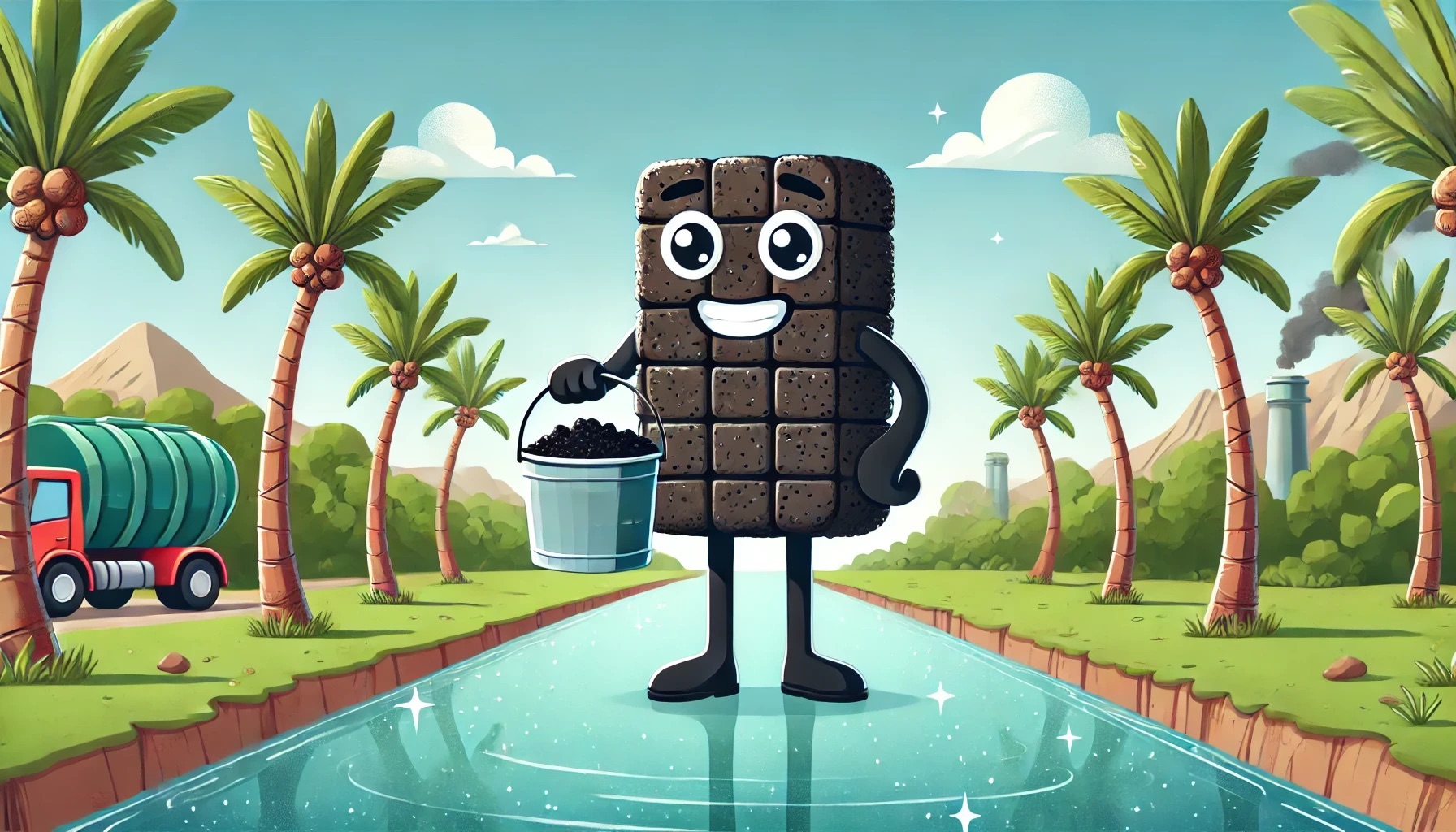
Al-Bayati, et al (2024) Date kernel biocharBiochar is a carbon-rich material created from biomass decomposition in low-oxygen conditions. It has important applications in environmental remediation, soil improvement, agriculture, carbon sequestration, energy storage, and sustainable materials, promoting efficiency and reducing waste in various contexts while addressing climate change challenges. More: A green approach to methylene blue removal from polluted water in Iraq. Water Science. https://doi.org/10.1080/23570008.2024.2379732
A recent study explored the use of biochar derived from Iraqi date kernels (Khestawi variety) as a sustainable adsorbent to remove methylene blue (MB) from polluted water. Date kernels are an abundant byproduct of date palm cultivation, which is prominent in Iraq and other Arab countries. Researchers investigated how different pyrolysisPyrolysis is a thermochemical process that converts waste biomass into bio-char, bio-oil, and pyro-gas. It offers significant advantages in waste valorization, turning low-value materials into economically valuable resources. Its versatility allows for tailored products based on operational conditions, presenting itself as a cost-effective and efficient More conditions—temperature, heating rate, and holding time—affect the biochar’s ability to adsorb MB.
The study revealed that higher pyrolysis temperatures and longer holding times decreased the biochar’s efficiency in removing MB. Biochar produced at a lower pyrolysis temperature of 350°C achieved a removal rate of 48.9%, while biochar made at 550°C only removed 30.9% of MB. Additionally, biochar produced with a 30-minute pyrolysis time removed 47.5% of MB, whereas a 90-minute duration reduced this to 30.3%.
The researchers used the Freundlich isotherm model to describe the adsorption behavior, indicating that the biochar had a high adsorption capacity. Activation of the biochar using bio-oil significantly enhanced its performance, with the activated biochar (ABC-1) showing a higher adsorption capacity and a Freundlich constant (KF) of 7.12, compared to 1.64 for non-activated biochar.
This research highlights the potential of date kernel biochar as an effective, eco-friendly, and low-cost adsorbent for water purification. By converting agricultural waste into a valuable resource, this approach not only addresses water pollution but also promotes sustainable waste management and resource utilization. Further studies could optimize biochar production and activation processes, enhancing its application in environmental remediation.




Leave a Reply