
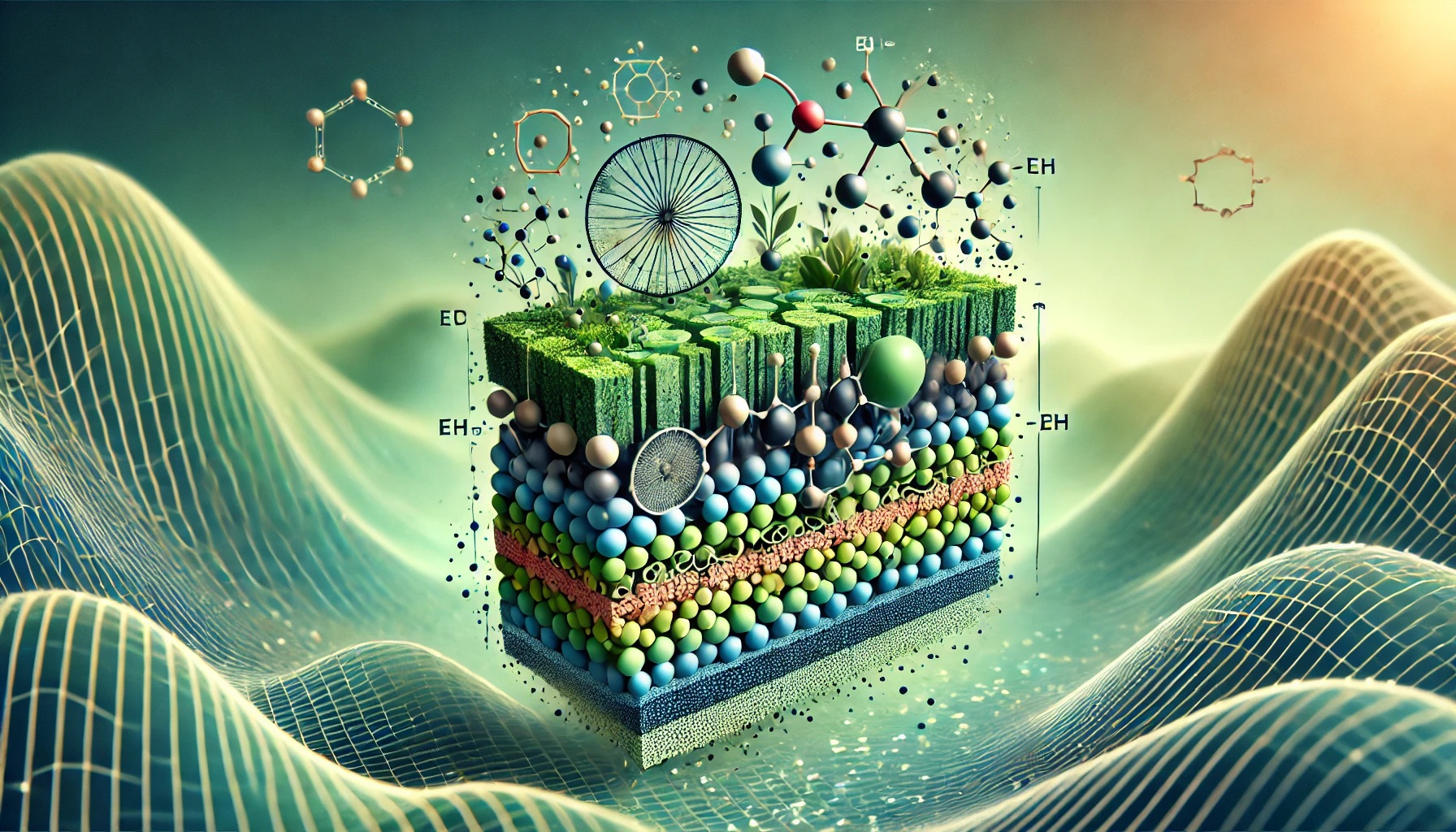
Rahman, et al (2024) BiocharBiochar is a carbon-rich material created from biomass decomposition in low-oxygen conditions. It has important applications in environmental remediation, soil improvement, agriculture, carbon sequestration, energy storage, and sustainable materials, promoting efficiency and reducing waste in various contexts while addressing climate change challenges. More/poly(aniline-pyrrole) modified graphite electrode and electrochemical behavior for application in low-cost supercapacitor. Arabian Journal of Chemistry. https://doi.org/10.1016/j.arabjc.2024.105938
Biochar (BC), a carbon-rich material derived from biomassBiomass is a complex biological organic or non-organic solid product derived from living or recently living organism and available naturally. Various types of wastes such as animal manure, waste paper, sludge and many industrial wastes are also treated as biomass because like natural biomass these More, has emerged as a promising candidate for use in energy storage devices due to its economic viability, tunable properties, and environmental benefits. The versatility of biochar allows for the design of materials tailored for various applications, including energy storage. Recent research has focused on utilizing biochar as a support for conducting polymers to enhance its performance in supercapacitors.
In this study, biochar was prepared from a sucrose solution using a simple hydrothermal method. The process involved dissolving sucrose in water, heating the solution in a Teflon-lined autoclave, and then centrifuging and washing the resulting black precipitate. The prepared biochar served as a seed for the oxidative copolymerization of aniline and pyrrole, forming a biochar-poly(aniline-pyrrole) (BC/P(Ani-Py)) composite. Two weight ratios of biochar to mixed monomers were used, resulting in composites named BC/P(Ani-Py)1:0.7 and BC/P(Ani-Py)1:1.
Characterization of these composites showed that biochar particles were spherical with smooth surfaces, which became rough and heterogeneous after composite formation. The size of the biochar particles increased slightly after copolymerization. Various techniques, including scanning electron microscopy (SEM), transmission electron microscopy (TEM), and X-ray photoelectron spectroscopy (XPS), confirmed the successful formation of poly(aniline-pyrrole) domains on the biochar surface.
Electrochemical properties of the composites were evaluated using cyclic voltammetry (CV), galvanostatic charging-discharging (GCD), and electrochemical impedance spectroscopy (EIS). The BC/P(Ani-Py)1:1 composite-modified graphite electrode exhibited the highest capacitance value of 274.27 F g−1 at a current density of 1.0 A/g. This composite also demonstrated excellent cycle stability, retaining 96.6% of its capacitance after 1000 cycles of charge and discharge.
The study highlighted the synergistic interaction between biochar and the conducting polymer, which improved the stability and electrochemical performance of the composite. The use of biochar as a support material not only enhanced the physical properties of the composite but also reduced the environmental impact and cost associated with producing high-performance supercapacitors.
This research underscores the potential of biochar-supported conducting polymers as low-cost, efficient materials for next-generation supercapacitors. The ability to fine-tune the properties of biochar through its synthesis process allows for the optimization of these composites for specific energy storage applications. The findings suggest that biochar can be a viable alternative to more expensive and environmentally harmful materials currently used in supercapacitor electrodes. Future work could focus on further improving the electrochemical performance by using functionalized porous biochar supports and exploring other polymer systems for biochar composites.




Leave a Reply