
Key Takeaways
- Mixing natural minerals or clay with raw plant waste before heating creates a highly stable material that mimics fertile ancient soils.
- Adding mineral components changes the internal structure of the material, which can either open up new microscopic spaces or accidentally clog existing pores.
- The addition of minerals like silicates and oxides significantly increases the presence of oxygen on the material surface, making it much better at attracting water.
- When placed into agricultural fields, these mineral-carbon mixtures help trap and lock away fresh carbon coming from plant roots, keeping it safely in the ground.
- Combining carbon with minerals helps deliver essential nutrients to plants while lowering the amount of raw toxic chemicals left behind after processing.
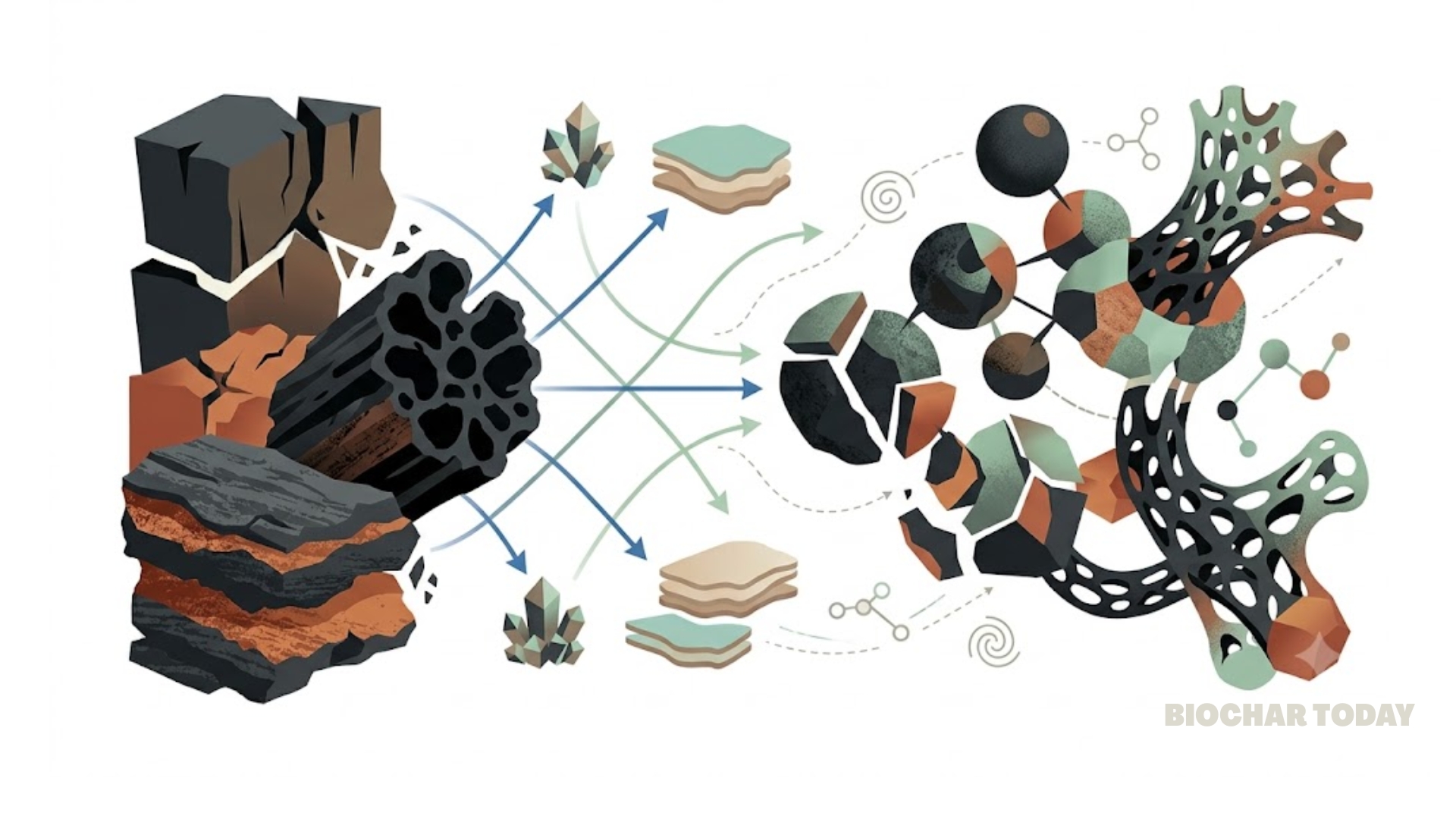
The journal BiocharBiochar is a carbon-rich material created from biomass decomposition in low-oxygen conditions. It has important applications in environmental remediation, soil improvement, agriculture, carbon sequestration, energy storage, and sustainable materials, promoting efficiency and reducing waste in various contexts while addressing climate change challenges. More recently published a comprehensive scientific review by lead author Liuwei Wang and co-researchers Jiale Yang, Xuanru Li, Liping Zhang, Lukas Van Zwieten, Ondřej Mašek, Stephen Joseph, Kaikai Zhang, and Kefu Yu that tracks the deep physical and chemical transformations occurring when pristine biochar is engineered alongside mineral components. While ancient, dark, highly fertile human-made soils found in the Amazon basin rely on natural, slow interactions between charcoalCharcoal is a black, brittle, and porous material produced by heating wood or other organic substances in a low-oxygen environment. It is primarily used as a fuel source for cooking and heating. More and surrounding earth components over centuries, modern material scientists are replicating these stable architectures in hours. By applying co-pyrolysis techniques, which heat biomassBiomass is a complex biological organic or non-organic solid product derived from living or recently living organism and available naturally. Various types of wastes such as animal manure, waste paper, sludge and many industrial wastes are also treated as biomass because like natural biomass these More feedstocks and mineral additives together under oxygen-limited conditions, or by using post-pyrolysis aqueous mixing, researchers can systematically tailor the resulting carbonaceous matrix. This strategic integration serves to customize the engineering properties of the biochar, adapting it for specialized large-scale field performance in agricultural nutrition, carbon storage, and environmental remediation.
The structural evaluation of these advanced composites reveals a complex phenomenon where mineral addition dramatically alters the native porosityPorosity of biochar is a key factor in its effectiveness as a soil amendment and its ability to retain water and nutrients. Biochar’s porosity is influenced by feedstock type and pyrolysis temperature, and it plays a crucial role in microbial activity and overall soil health. Biochar More and surface landscape of the carbon backbone. Quantitative data from diverse studies shows that combining biomass with specific expansion-prone minerals like montmorillonite or bentonite can stimulate high-temperature devolatilization, effectively increasing internal microscopic pore development by thirty to forty percent compared to heating pure biomass alone. However, this architectural benefit is balanced by an unexpected pore-blocking trade-off when different minerals or processing limits are introduced. For instance, heating bamboo biomass alongside kaolinite clay can actually cause a net reduction in structural porosity at elevated processing temperatures because the clay transforms into a dense, non-porous mineral phase that physically plugs up the open transport channels within the carbon matrix. Despite these localized physical restrictions, the overall mineral integration consistently yields high final ashAsh is the non-combustible inorganic residue that remains after organic matter, like wood or biomass, is completely burned. It consists mainly of minerals and is different from biochar, which is produced through incomplete combustion. Ash Ash is the residue that remains after the complete More levels and delivers strong, clear crystalline patterns under diffraction scanning, shifting away from the purely amorphous layout of raw biochar.
Beyond altering physical pore distribution, mineral modifications trigger profound chemical reconfigurations that directly amplify surface reactivity and long-term environmental durability. The inclusion of non-clay silicates and magnesium oxides yields the most substantial net increases in oxygen-to-carbon and hydrogen-to-carbon atomic ratios across the evaluated materials, confirming a high density of newly introduced oxygen-bearing surface groups. This change alters the baseline properties of the carbonaceous material, transitioning it into a highly hydrophilic and polarized matrix capable of strong bonding. When these modified materials are applied to agricultural soils, they form a defensive shell that physically shields the core carbon matrix from rapid microbial breakdown. Concurrently, this newly introduced surface layer alters the surrounding soil dynamics by promoting the formation of microaggregates that trap fresh root carbon secretions, establishing an indirect stabilization process that prevents newly captured carbon from burning off into the atmosphere as greenhouse gas emissions.
The practical potential of these engineered mineral-char matrices extends straight into field crop management and toxic mitigation. Field trials utilizing these simulated ancient composites demonstrate significant increases in plant nutrient uptake for essential elements like nitrogen, phosphorus, potassium, sulfur, and zinc, while encouraging beneficial microbial colonization around plant root zones. Specialized magnesium oxide and iron oxide configurations act as highly efficient, slow-release fertilizers by directly capturing and holding passing nutrients like phosphate within saline or alkaline soils. Furthermore, the embedded mineral networks successfully inhibit the formation of persistent toxic residues, such as heavy aromatic hydrocarbons, which normally linger after biomass heating. This chemical suppression lowers overall material toxicity, transforming the engineered biochar surface into an incredibly safe, welcoming environment that accelerates microbial colonization by beneficial soil bacteria.
Source: Wang, L., Yang, J., Li, X., Zhang, L., Van Zwieten, L., Mašek, O., Joseph, S., Zhang, K., & Yu, K. (2026). Engineered biochar composite with minerals: organo-mineral interactions, physicochemical changes, and implications for practical application. Biochar, 8(53), 1-23.


![Eucalyptus Wood Waste-Derived Biochar Achieves a Ninety-Eight Percent Removal Efficiency for Benzo[ghi]perylene in Vehicle-Wash Wastewater](https://biochartoday.com/wp-content/uploads/2026/10/SCIENCE-BLOGS-2026-2026-10-19T160523.703.jpg)


Leave a Reply