
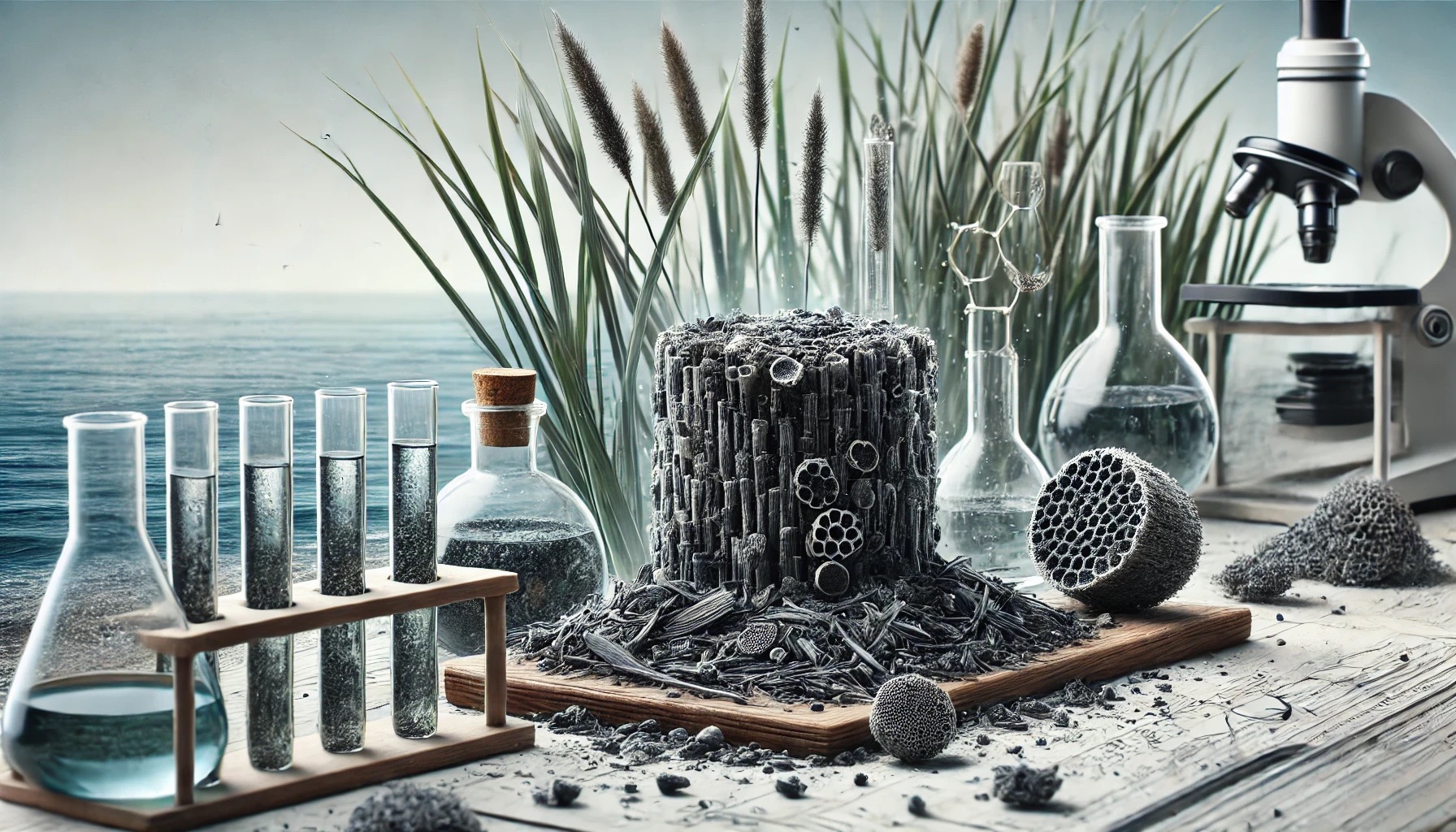
Mutatore, et al (2024) Recovery of rare earth elements by adsorption on biocharBiochar is a carbon-rich material created from biomass decomposition in low-oxygen conditions. It has important applications in environmental remediation, soil improvement, agriculture, carbon sequestration, energy storage, and sustainable materials, promoting efficiency and reducing waste in various contexts while addressing climate change challenges. More of dead Posidonia oceanicaleaves. Journal of Rare Earths. https://doi.org/10.1016/j.jre.2024.11.010
A recent study explored the use of biochar derived from Posidonia oceanica, a Mediterranean seagrass, as a cost-effective adsorbent for recovering rare earth elements (REEs) such as lanthanum (La), neodymium (Nd), and dysprosium (Dy). These elements are critical in renewable energy technologies and electronics but are difficult to extract sustainably from conventional sources.
The biochar was produced through pyrolysisPyrolysis is a thermochemical process that converts waste biomass into bio-char, bio-oil, and pyro-gas. It offers significant advantages in waste valorization, turning low-value materials into economically valuable resources. Its versatility allows for tailored products based on operational conditions, presenting itself as a cost-effective and efficient More of the dead seagrass leaves, an abundant byproduct of coastal ecosystems. To enhance adsorption performance, two forms of chemically activated biochar were developed using potassium hydroxide (BBCP) and phosphoric acid (ABCP). These materials were extensively tested for their ability to adsorb REEs under different conditions.
The study revealed that phosphoric acid activation introduced phosphate groups, significantly improving adsorption capacity. ABCP exhibited the highest performance due to its microporous structure and functional groups that strongly bind to REEs. At an optimal pHpH is a measure of how acidic or alkaline a substance is. A pH of 7 is neutral, while lower pH values indicate acidity and higher values indicate alkalinity. Biochars are normally alkaline and can influence soil pH, often increasing it, which can be beneficial More of 5, ABCP’s adsorption followed the Langmuir model, indicating a uniform adsorption process with a high affinity for smaller ionic radii, such as Dy³⁺.
While ABCP demonstrated high recovery efficiency, its recyclability was limited. Adsorption efficiency dropped by 80% after the first cycle, primarily due to structural changes. However, its low-cost production from waste biomassBiomass is a complex biological organic or non-organic solid product derived from living or recently living organism and available naturally. Various types of wastes such as animal manure, waste paper, sludge and many industrial wastes are also treated as biomass because like natural biomass these More aligns well with sustainability principles and circular economy goals.
This work highlights the potential of using biochar as a renewable and eco-friendly alternative for REE recovery, transforming seagrass waste into a valuable resource.



Leave a Reply