
Key Takeaways
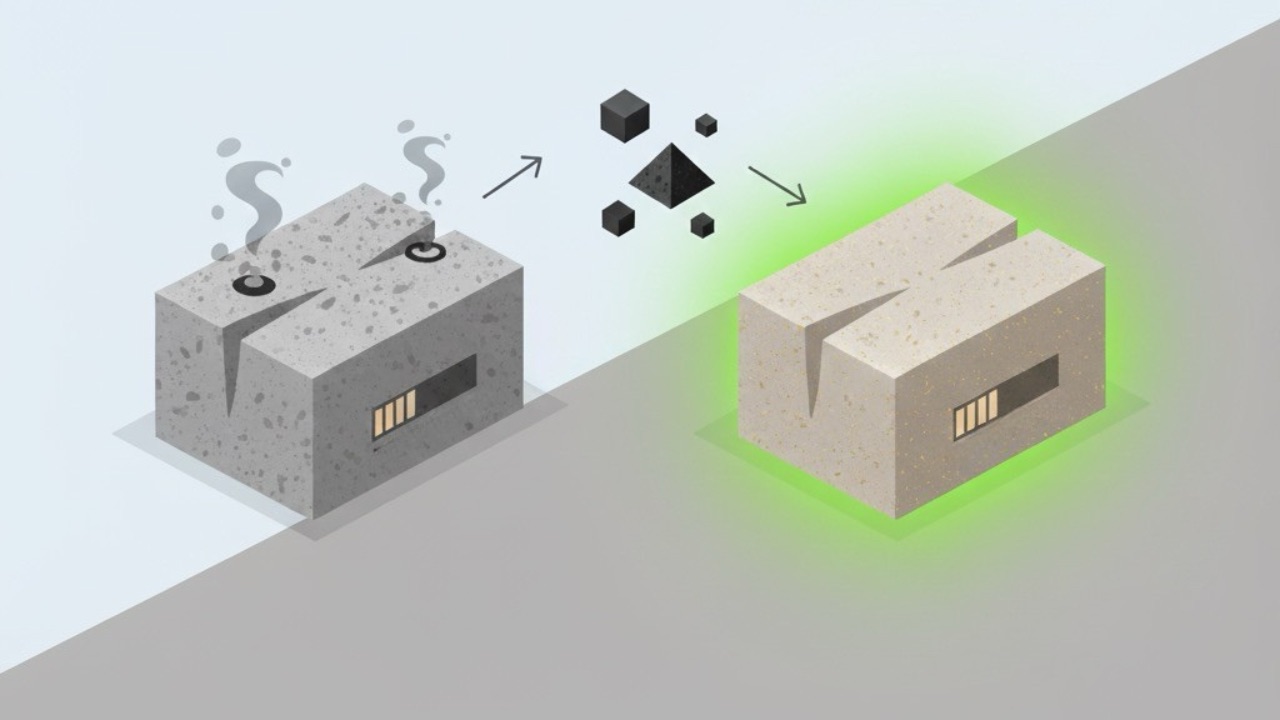
- A “Win-Win” for Farms and Builders: Rice husks, often treated as agricultural waste, are converted into a black powder called “biochar” that becomes a valuable ingredient for concrete.
- A Double Climate Victory: The biocharBiochar is a carbon-rich material created from biomass decomposition in low-oxygen conditions. It has important applications in environmental remediation, soil improvement, agriculture, carbon sequestration, energy storage, and sustainable materials, promoting efficiency and reducing waste in various contexts while addressing climate change challenges. More locks up carbon pulled from the air by the rice plants. By replacing 10% of cement (a major polluter), it also cuts a concrete block’s carbon footprint by 15%.
- Strength Without Sacrifice: The new blocks with 10% biochar kept 95% of their original strength. The tiny biochar particles act as a filler and help the concrete cure stronger from the inside.
- A Lighter Load: The biochar makes the concrete blocks lighter. This is a big advantage as it reduces transportation costs and puts less stress on a building’s foundation.
- Ready for Today: This research provides a proven recipe for builders to cut emissions and solve a farm waste problem right now, all without losing the performance we need.
The global construction industry is responsible for roughly 40% of all energy-related CO2 emissions, with the production of cement—concrete’s binder—accounting for a staggering 8% of the global total. Addressing this carbon footprint requires innovative materials that can replace cement without compromising the structural integrity of buildings. A recent study, “Biochar-Based Concrete Blocks from Rice Husk: A Sustainable Solution for Low-Carbon Construction,” published by Muhammad Fareed Javed, Nijah Akram, Dr. Ayesha Mehmood Malik, and colleagues provides a compelling answer. The researchers successfully engineered concrete blocks that replace a significant portion of cement with a carbon-negative agricultural byproduct: rice husk biochar.
The core of this research involves a concept known as the circular economy. Rice husk, the indigestible outer layer of a rice grain, is often treated as agricultural waste. By subjecting this husk to pyrolysis—heating it in a low-oxygen environment—it converts into a lightweight, highly stable material known as biochar. Unlike burning the husk, which releases carbon into the atmosphere, pyrolysisPyrolysis is a thermochemical process that converts waste biomass into bio-char, bio-oil, and pyro-gas. It offers significant advantages in waste valorization, turning low-value materials into economically valuable resources. Its versatility allows for tailored products based on operational conditions, presenting itself as a cost-effective and efficient More stabilizes the carbon, effectively turning the biochar into a long-term carbon sink. The researchers then took this powdered biochar and introduced it into the concrete mixture as a partial replacement for the standard cement.
The study aimed to identify the optimal replacement percentage that would maximize carbon benefits while maintaining the stringent structural requirements of concrete. Tests demonstrated that a 10% replacement of cement by rice husk biochar was the breakthrough point. This substitution is significant because every kilogram of cement produced releases approximately one kilogram of CO2 . By replacing a tenth of this high-emission material, the team achieved an estimated 15% reduction in the block’s overall manufacturing carbon footprint. This substantial cut is a dual victory: it avoids the emissions from cement production while simultaneously leveraging the carbon already sequestered within the biochar itself.
Crucially, the team measured the impact of this substitution on compressive strength, the ultimate performance metric for construction materials. The results were highly encouraging: blocks containing 10% biochar substitution retained an impressive 95% of the compressive strength achieved by traditional concrete blocks. This structural success is thought to be due to biochar’s unique properties. The fine biochar particles act as a filler, improving the density of the concrete mix and making the material more compact. Furthermore, biochar’s porous structure allows it to absorb internal moisture, acting as a form of “internal curing agent” that promotes better hydration of the remaining cement and leads to fewer micro-cracks and a stronger final structure.
In terms of physical properties, the biochar blocks also exhibited reduced density, making the finished product a form of lightweight concrete. This is a considerable advantage in construction, as lighter materials reduce the load on a building’s foundation and can lower transportation costs. While the addition of biochar slightly increased the water absorption rate compared to standard concrete, the team concluded that this change remained within acceptable standards for use in typical construction applications, such as non-structural walls and pavement.
The implications of this research are far-reaching. By demonstrating a viable pathway to use agricultural waste in a high-value, high-volume product like concrete blocks, the study not only addresses construction’s carbon problem but also offers a solution to waste management for countries with large agricultural sectors. The work provides a strong scientific basis for engineers and builders to adopt this low-carbon construction solution today, showing that sustainability does not require sacrificing performance.
Source: Javed, M. F., Akram, N., Malik, A. M., Khan, W. R., Asim, Z., & Rashid, M. (2025). BIOCHAR-BASED CONCRETE BLOCKS FROM RICE HUSK: A SUSTAINABLE SOLUTION FOR LOW-CARBON CONSTRUCTION. Spectrum of Engineering Sciences, 3(8), 2025.



Leave a Reply