
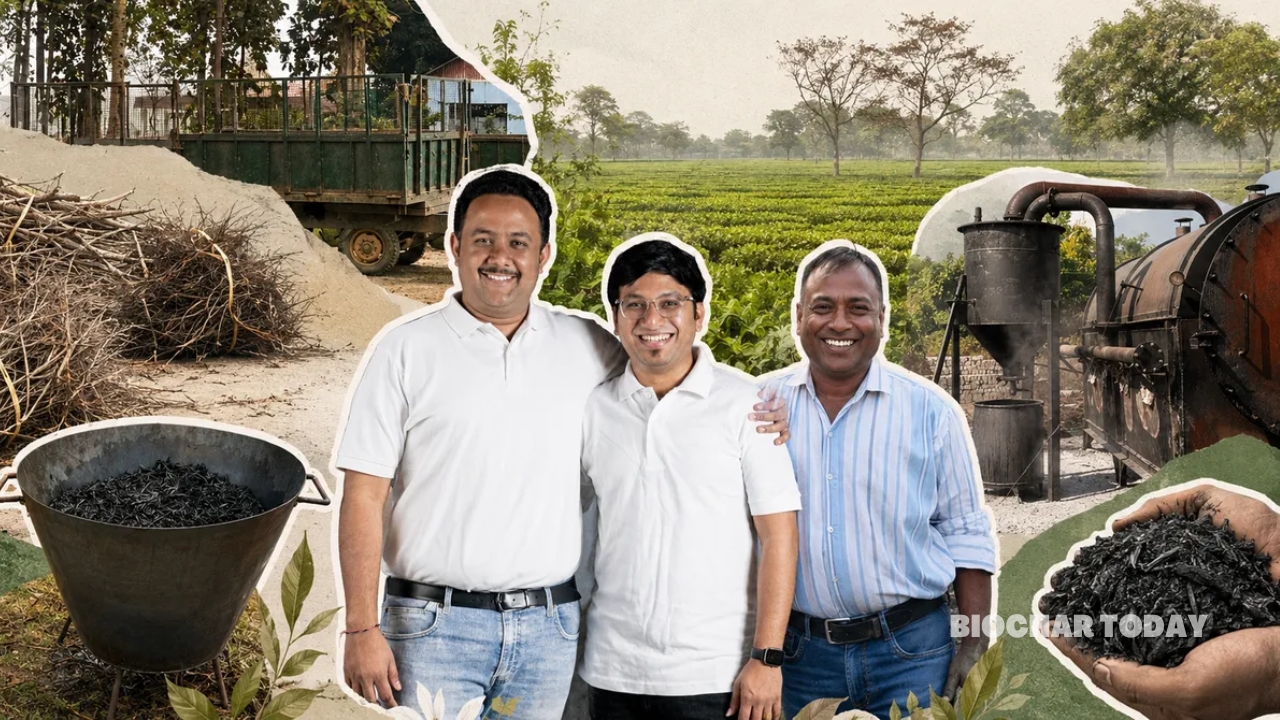
RenewCred, a climate-tech platform incorporated in Karnataka, India, has successfully deployed an artificial intelligence and blockchain-backed infrastructure to convert agricultural waste into verifiable carbon credits. Founded by Abhimanyu Rathi and Yogendra Panchal, the startup utilizes a network of 93 international scientists to build credible verification frameworks for carbon markets. By collaborating with local project developers like Shree Radharani Agrotech and JEET Agrotech in Gujarat, as well as Arka Carbon in Madhya Pradesh and Maharashtra, the platform enables smallholder farmers to participate in the global carbon economy. The initiatives primarily focus on thermal conversion of crop residue into biocharBiochar is a carbon-rich material created from biomass decomposition in low-oxygen conditions. It has important applications in environmental remediation, soil improvement, agriculture, carbon sequestration, energy storage, and sustainable materials, promoting efficiency and reducing waste in various contexts while addressing climate change challenges. More, establishing an evidence-based pathway for agricultural carbon monetization.
The primary challenge addressed by this initiative is the economic and environmental liability of post-harvest crop residue management for Indian farmers. After harvesting crops such as sugarcane, banana, and maize, farmers face substantial volumes of biomassBiomass is a complex biological organic or non-organic solid product derived from living or recently living organism and available naturally. Various types of wastes such as animal manure, waste paper, sludge and many industrial wastes are also treated as biomass because like natural biomass these More that require immediate clearance before the subsequent sowing cycle. Lacking affordable labor, transport infrastructure, or financial incentives to process this residual matter, many farmers resort to open-field stubble burning. This practice creates severe localized air pollution and immediately returns sequestered biological carbon into the atmosphere as greenhouse gases, while missing an opportunity to improve deteriorating rural soil quality.
To mitigate these challenges, RenewCred implemented a comprehensive Digital Monitoring, Reporting, and Verification (dMRV) system that tracks the lifecycle of agricultural biomass. Local aggregators collect the crop residue and process it via pyrolysisPyrolysis is a thermochemical process that converts waste biomass into bio-char, bio-oil, and pyro-gas. It offers significant advantages in waste valorization, turning low-value materials into economically valuable resources. Its versatility allows for tailored products based on operational conditions, presenting itself as a cost-effective and efficient More, transforming the volatile organic matter into stable biochar that is subsequently reapplied to agricultural soils. The entire conversion process is monitored via Internet of Things (IoT) sensors tracking feedstockFeedstock refers to the raw organic material used to produce biochar. This can include a wide range of materials, such as wood chips, agricultural residues, and animal manure. More weight, temperature, and pressure. These data streams are analyzed by a three-layer machine learning framework to calculate net emissions reductions and eliminate anomalies, followed by third-party verification and subsequent logging on a transparent blockchain registry to prevent double-counting.
The integration of this technological ecosystem has yielded distinct economic and ecological outcomes across RenewCred’s initial projects. The platform anticipates the generation of approximately 100,000 carbon credits during the current fiscal year, effectively mitigating 100,000 tonnes of carbon dioxide equivalent emissions. Financially, participating smallholders are projected to secure between 30,000 and 45,000 rupees in additional annual income from credit sales. Furthermore, the localized application of the resulting biochar enhances soil moisture retention and nutrient availability, directly supporting long-term agricultural productivity for over 200 engaged farmers.



Leave a Reply